LACMA

ShopMembershipMyLACMATickets
LACMA
Los Angeles County Museum of Art
5905 Wilshire Blvd.
Los Angeles, CA 90036
info@lacma.org
(323) 857-6000
Sign up to receive emails
Subscribe
© Museum Associates 2025

Museum Hours

Monday

11 am–6 pm

Tuesday

11 am–6 pm

Wednesday

Closed

Thursday

11 am–6 pm

Friday

11 am–8 pm

Saturday

10 am–7 pm

Sunday

10 am–7 pm


  • About LACMA
  • Jobs
  • Building LACMA
  • Host An Event
  • Unframed
  • Press
  • FAQs
  • Log in to MyLACMA
  • Privacy Policy
© Museum Associates 2025
Collections

Unknown
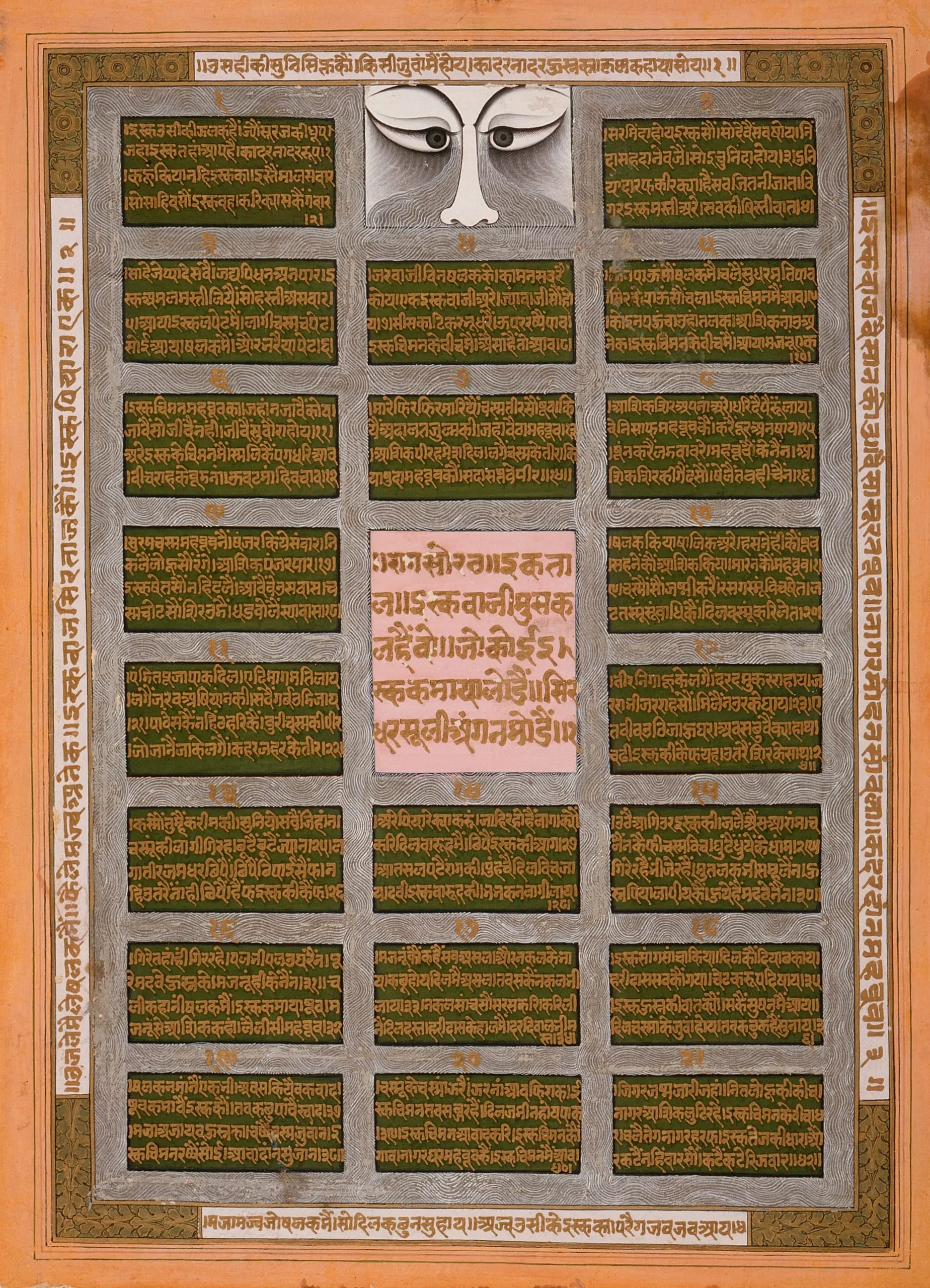
Maharaja Savant Singh's Tears Irrigate the Garden of His Poetrycirca 1750-1775

Not on view
Manuscript page with Devanagari script arranged in a grid of dark olive-green text panels on an apricot ground, with a painted face at the top center and a highlighted coral-pink central panel
Artist or Maker
Unknown
Title
Maharaja Savant Singh's Tears Irrigate the Garden of His Poetry
Place Made
India, Rajasthan, Kishangarh
Date Made
circa 1750-1775
Medium
Opaque watercolor, gold, and silver on paper
Dimensions
Sheet: 14 x 10 1/4 in. (35.5 x 26 cm); Image: 12 7/8 x 9 in. (32.7 x 22.86 cm)
Credit Line
Gift of Anna Bing Arnold
Accession Number
M.89.51.2
Classification
Drawings
Collecting Area
South and Southeast Asian Art
Curatorial Notes

This unusual, if not unique, work has for its subject a veritable garden of elegant devanagari calligraphy of poetry composed by the ruler of Kishangarh, Maharaja Savant Singh (r. 1748-1757). Writing under his pen name, Nagaridas, Savant Singh wrote poems and commissioned numerous paintings celebrating the love of Krishna and Radha, as a metaphor for his own deep love for a poetess and singer named Bani Thani. Eventually, he abdicated his throne and moved with his lover to the homeland of Krishna, where they spent the rest of their blissful days composing devotional poetry.

The love poem forming the subject of this extraordinary image is entitled Ishq Caman (The Garden of Love). It was written in c. 1720–1740 in the Rekhta vernacular of early Urdu that was popular in Delhi and Lucknow, rather than in Savant Singh’s more customary linguistic idiom, Hindi Braj Bhasha. The poem on the painting was recently translated and published by Heidi R. M. Pauwels, Cultural Exchange in Eighteenth-Century India: Poetry and Paintings from Kishangarh, Studies in Asian Art and Culture, no. 4 (Berlin: E. B. Verlag, 2015), pp. 245-256. It is also available in Stephen Markel, “The Enigmatic Image: Curious Subjects in Indian Art,” Asianart.com (http://asianart.com/articles/enigmatic/index.html).
Selected Bibliography
  • Markel, Stephen. "The Enigmatic Image: Curious Subjects in Indian Art." Asianart.com, July 28, 2015. http://asianart.com/articles/enigmatic.

  • Pauwels, Heidi Rika Maria. Cultural Exchange in Eighteenth-Century India: Poetry and Paintings from Keshangarh. Berlin: EB-Verlag, 2015.