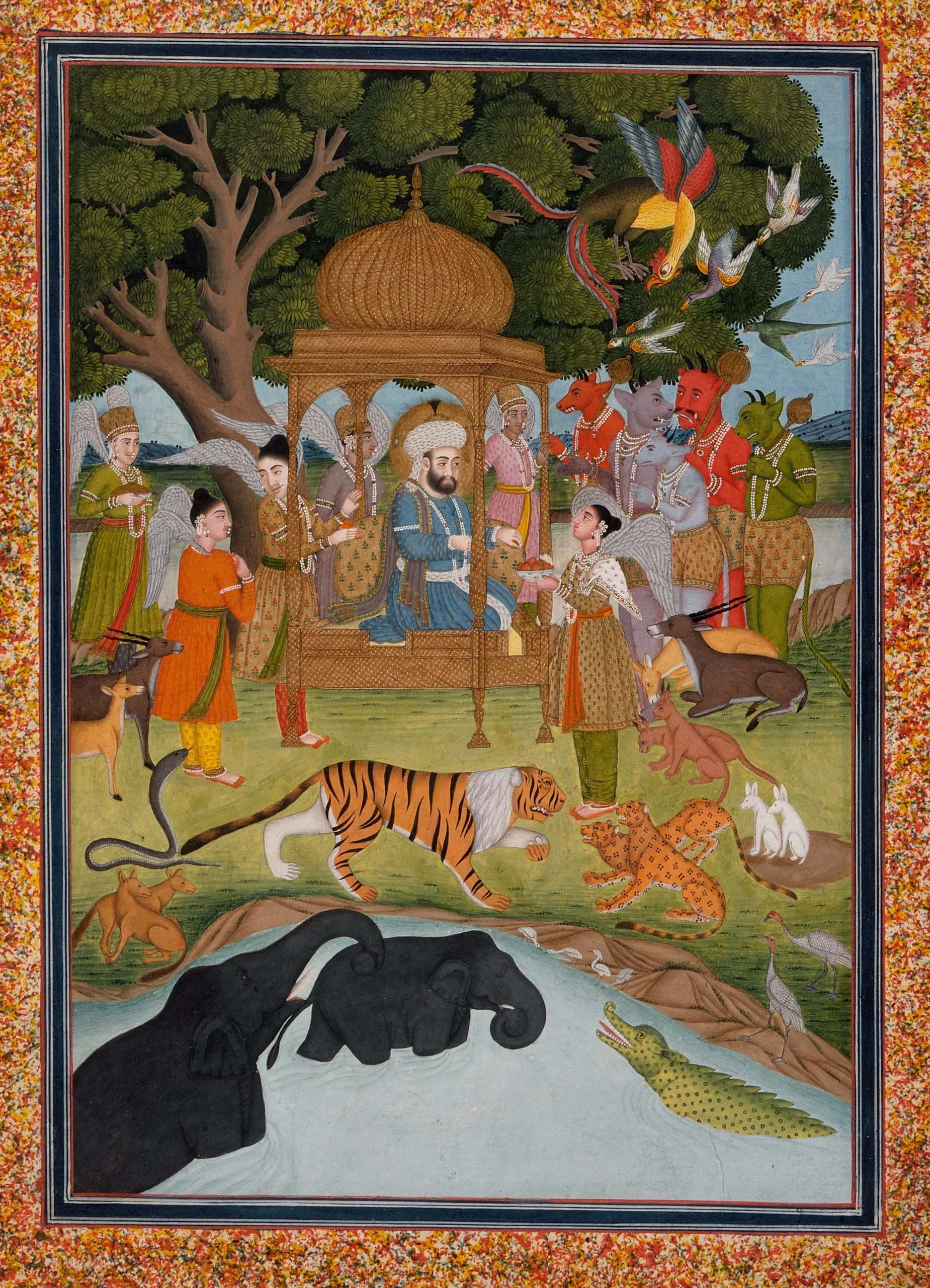
According to Islamic belief, Solomon (Arabic name: Sulayman), the third king of ancient Israel, was an archetype of the ideal of just kingship. Graced with the ability to communicate with and calm wild beasts, Solomon was regarded as the sovereign of the three worlds, the earthly realm (symbolized by the pacified animals beneath him), the nether world (symbolized by the subjugated demons), and the heavens (symbolized by the winged angels bearing offerings). The Mughals and other Islamic dynasties frequently commissioned portraits of Solomon as an allegorical metaphor and leitmotif to affirm the righteousness of their own reigns. He was believed to epitomize the just ruler of a harmonious kingdom.
The title of this painting is inscribed on the reverse: “Picture of the Throne of His Majesty Prophet Solomon.” The nimbate Solomon is enthroned in a golden domed pavilion. He is attended by a group of a winged angels in contemporaneous garb. One angel offers him fruit in a blue and white ceramic bowl, while another angel carries a blue and white bowl with a bejeweled golden lid. Various pacified animals gather beneath him, including a liger in the foreground and a Persian mythological simurgh flying above. A phalanx of subjugated demons pay homage before him. The composition is enlivened by the interaction between the angels, the interaction between the demons, and the interaction between the animals.
This painting is reportedly based on a Bijapuri work of 1620. See also M.76.113.11.