LACMA

ShopMembershipMyLACMATickets
LACMA
Los Angeles County Museum of Art
5905 Wilshire Blvd.
Los Angeles, CA 90036
info@lacma.org
(323) 857-6000
Sign up to receive emails
Subscribe
© Museum Associates 2026
  • About LACMA
  • Jobs
  • Building LACMA
  • Host An Event
  • Unframed
  • Press
  • FAQs
  • Log in to MyLACMA
  • Privacy Policy
© Museum Associates 2026
Collections

Unknown
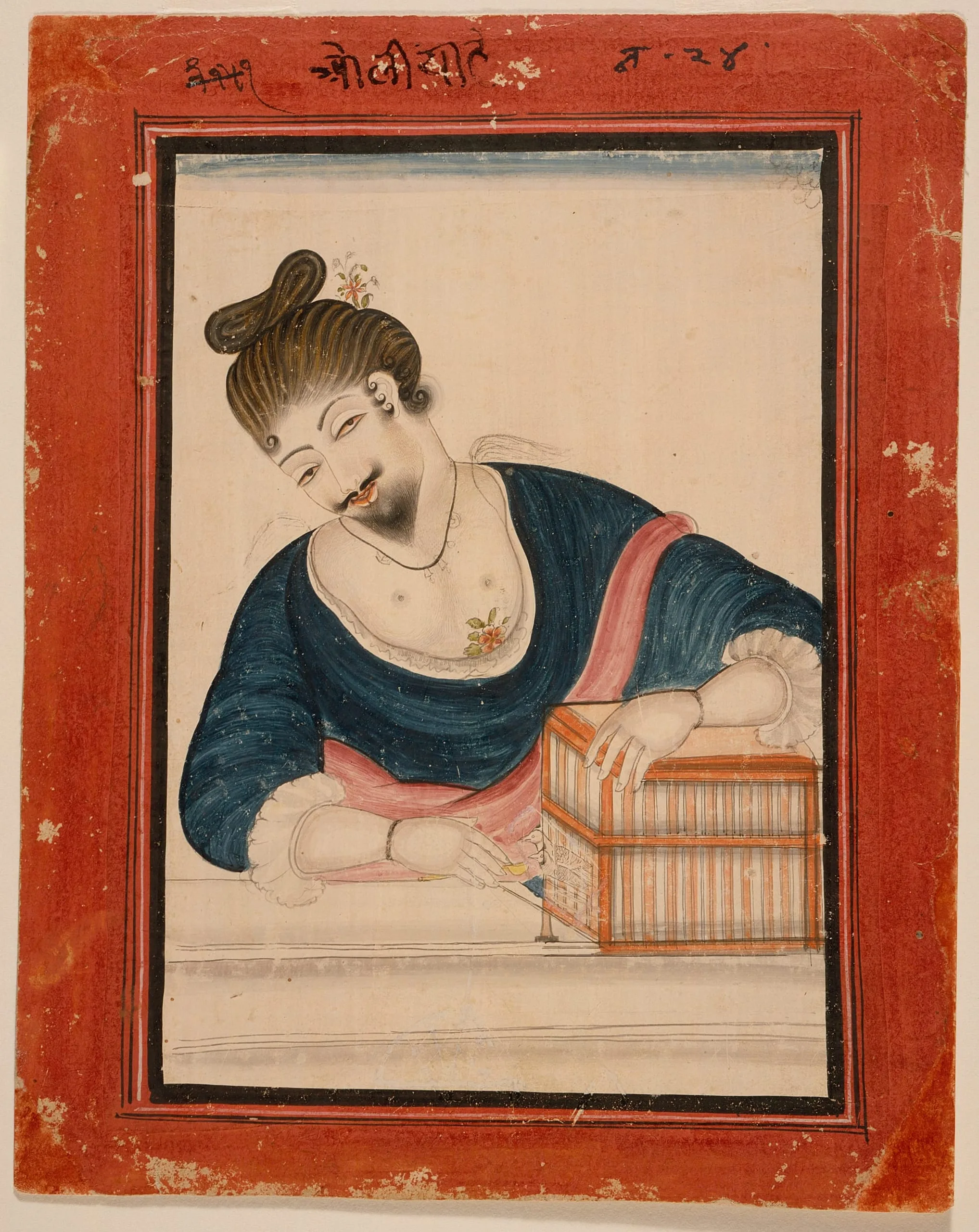
European Fortune Teller Feeding Pet Birds1700-1725

Not on view
Indian miniature painting, a woman in a teal garment leans over a ledge toward a striped rectangular box, shown from the waist up within a red border with Devanagari script

Unknown, European Fortune Teller Feeding Pet Birds, 1700-1725, Los Angeles County Museum of Art, Purchased with funds provided by Harry and Yvonne Lenart, photo © Museum Associates/LACMA

Artist or Maker
Unknown
Title
European Fortune Teller Feeding Pet Birds
Place Made
India, Rajasthan, Mewar, Udaipur
Date Made
1700-1725
Medium
Opaque watercolor and ink on paper
Dimensions
Image: 7 3/4 x 6 in. (19.68 x 15.24 cm); Sheet: 11 x 8 5/8 in. (27.94 x 21.9 cm)
Credit Line
Purchased with funds provided by Harry and Yvonne Lenart
Accession Number
M.85.139.1
Classification
Drawings
Collecting Area
South and Southeast Asian Art
Curatorial Notes

The Indian fascination with exotic foreigners is evident in this representation of a European fortune teller bestowed with a topknot, mustache, and goatee. He sports a floral sprig in his hair and on his chest. He wears a loose shawl over a shirt with a lace collar and folded cuffs, both features alien to Indian fashion. The fortune tellers’ birds would pick a playing card to tell the customer’s future or fortune, thus making his occupation seem equally outlandish to his audience. Here, he is feeding his birds a spoonful of seeds.

An almost identical representation in the British Museum (1956,0714,0.28) omits the mustache and goatee; hence, it has been misinterpreted as female despite the vaguely rendered nipples and chest hair.

The inscription in devanagari script in the upper border, probably added later, misidentifies the figure as an “oliya” (Arabic: auliya) or Muslim saint.
Selected Bibliography
  • Markel, Stephen. "The Enigmatic Image: Curious Subjects in Indian Art." Asianart.com, July 28, 2015. http://asianart.com/articles/enigmatic.

  • Blondet, José Luis. Six Scripts for Not I: Throwing Voices (1500 BCE-2020 CE). Los Angeles: Los Angeles County Museum of Art, 2020.

Related Unframed

The Enigmatic Image: Curious Subjects in Indian Art
  • January 5, 2017
  • Stephen Markel