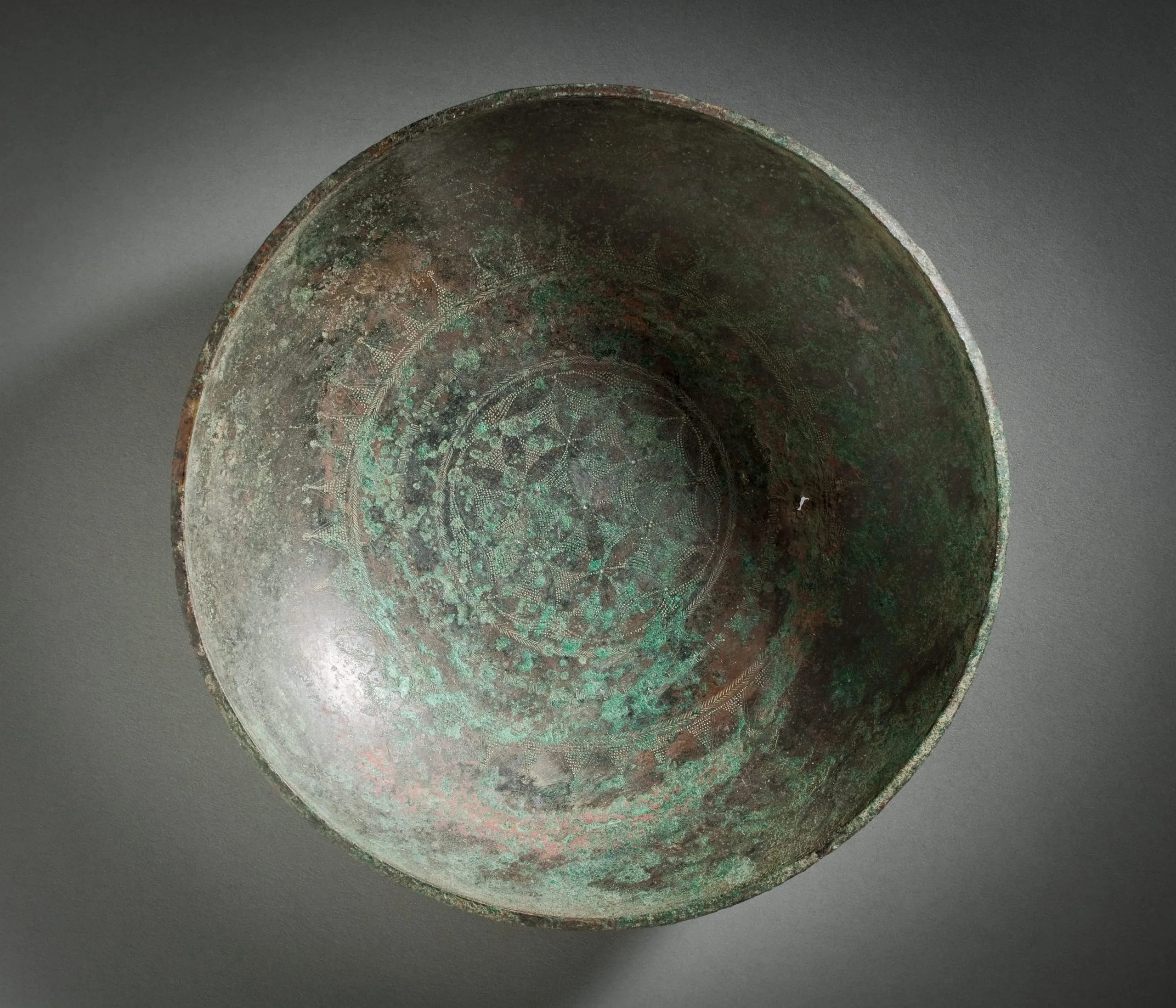
This bronze bowl, decorated on the inside with a pattern of intricate geometric designs, belongs to a corpus of metal vessels generically known as “Phoenician metal bowls.” Dated to the eighth and seventh centuries BCE, these objects have been found across a vast region stretching from modern-day Iraq to Greece, Cyprus, and Italy. Although Iron Age Phoenicia (or more broadly, the Levant) could have been the center of their production, due to their diverse imagery, which brings together several artistic traditions of the period (including Egyptian, Greek, Syrian, and Assyrian), it is also possible that they had been made in other locations in the Eastern Mediterranean and West Asia. Their expansive distribution and eclectic imagery speak to the interconnectedness of cultures in Iron Age Afro-Eurasia.