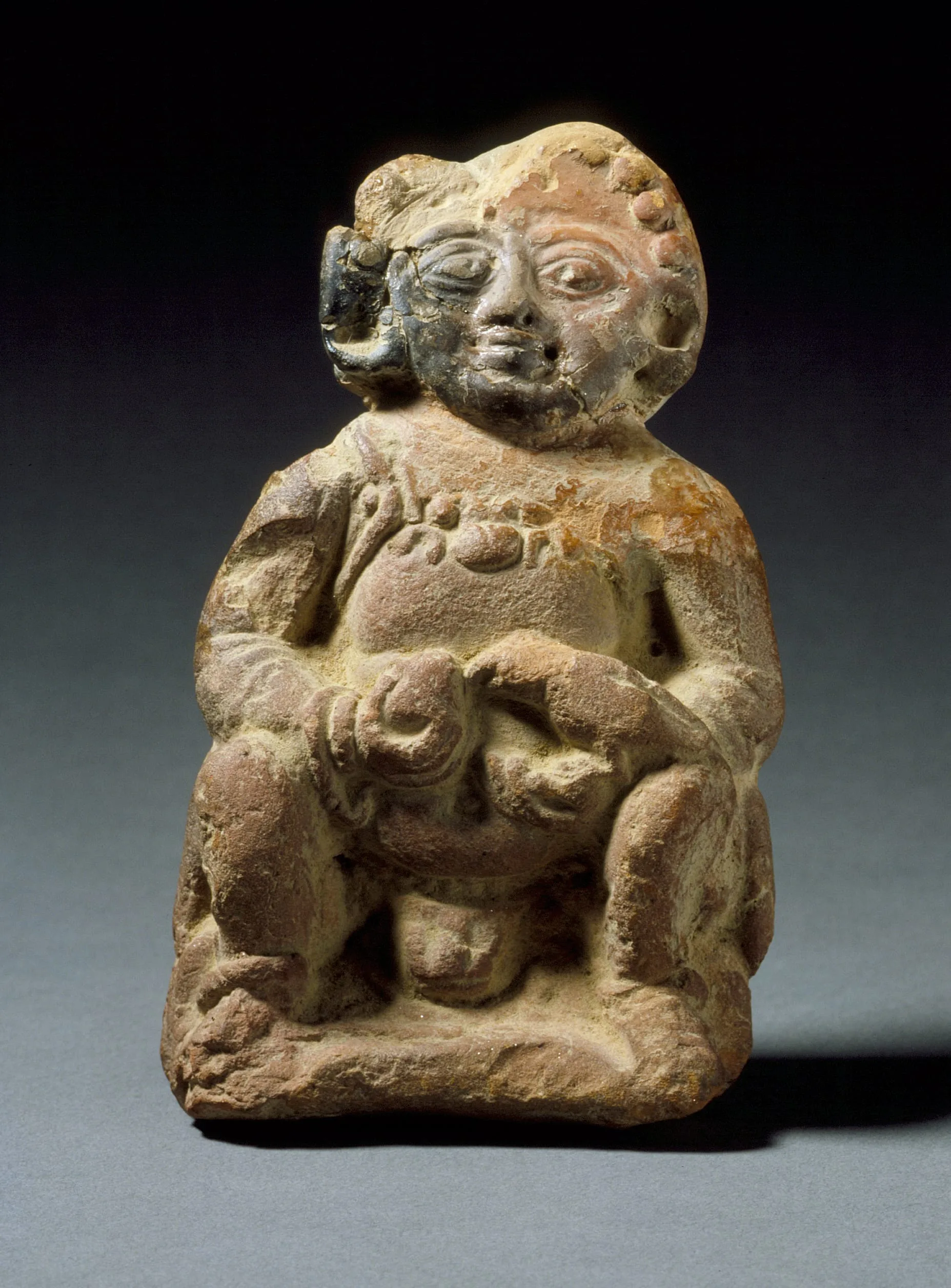
The ancient capital and important urban center of Chandraketugarh and its environs, located approximately 25 miles northeast of Kolkata (Calcutta) in the Ganges River delta, has yielded an abundance of artistically accomplished pottery of diverse object types and ceramic wares. Buff-colored low-fired earthenware was prevalent. Numerous sculptures, relief plaques, and ornate vases were produced. They are decorated primarily with images of sophisticated women and fertility goddesses richly adorned with elaborate hairstyles, intricately patterned textiles, and an abundance of jewelry.
This is a charming representation of a partially clothed squatting boy feeding a piece of fruit to a parrot held by his left hand. He wears a distinctive necklace or shawl clasp previously identified as a tiger-claw necklace (Pal 1986, p. 143, no. S23.) It more likely depicts an ovoid central bead flanked by open lotus blossoms atop a bifurcated base. The symbol is known as the ‘Three Jewels’ (triratna) of Buddhism: the Buddha (the enlightened one), the Dharma (the teachings and path to enlightenment), and the Sangha (the community of practitioners). In jewelry, the flanking elements can be displayed inverted to facilitate stringing the necklace. See a gold filigree and granulation set of such ornaments attributed to Uttar Pradesh or Madhya Pradesh, circa 150 BCE in the Cleveland Museum of Art (1973.66); and a stone representation worn by a yakshi (demigoddess) railing figure from the Bharhut Stupa, Madhya Pradesh, circa 100-80 BCE, in the Indian Museum, Kolkata. See also M.77.36.2, AC1992.207.1, and M.2005.155.