- Title
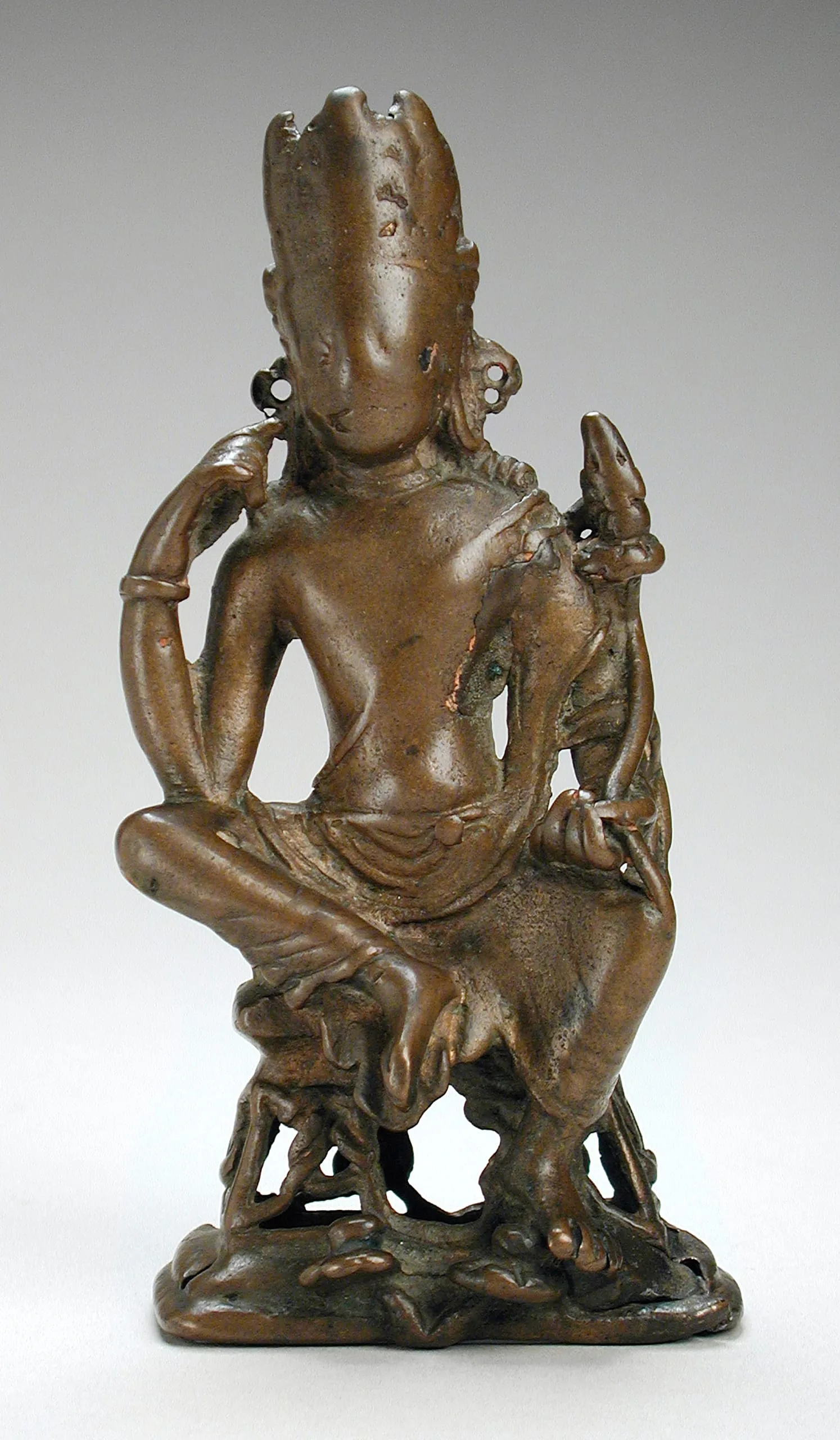
- Pensive Bodhisattva
- Date Made
- 5th century
- Medium
- Leaded copper-zinc-tin alloy
- Dimensions
- 4 13/16 x 2 1/8 x 1 11/16 in. (12.22 x 5.4 x 4.29 cm)
- Accession Number
- M.85.9
- Curatorial Notes
Images of a pensive bodhisattva first appear in the 2nd-3rd century during the Kushan Dynasty (1st-3rd century) in ancient Mathura, Uttar Pradesh, and in Gandhara (an important nexus of the Silk Routes and the transmission of Buddhism in present-day northwestern Pakistan and northeastern Afghanistan). See AC1994.8.1. Early Indian and Gandharan sculptures of a pensive bodhisattva are typically interpreted as portraying the Bodhisattva Avalokiteshvara or Prince Siddhartha Gautama in his First Meditation on the causes of life’s suffering before he achieved enlightenment and became the historical Buddha Shakyamuni (traditionally dated to 563–483 BCE). Images of a pensive bodhisattva spread to China by the 5th century, and by the 6th century to Korea and Japan where they are typically identified as the future Buddha, Maitreya. For example, see a Korean pensive bodhisattva attributed to the late 6th-century in the National Museum of Korea, Seoul (Bongwan 2789).
The bodhisattva is represented with his right hand raised to the shoulder with the index finger pointing to his chin. His effaced head is tilted to the side in deep contemplation. He is seated on a wicker stool with his left leg pendant and supported by the pericarp of a lotus flower (karnika). His right leg is raised and placed obliquely at the edge of the seat with his foot at the level of his opposite knee. He holds a lotus with a long stalk bud in his left hand. He wears a dhoti and a light shawl and the Brahmanical sacred thread (yajñopavita) over his left shoulder.
- Selected Bibliography
- Pal, Pratapaditya. Indian Sculpture, vol.1. Los Angeles: Los Angeles County Museum of Art; University of California Press, 1986.
- Reedy, Chandra L. Himalayan Bronzes: Technology, Style and Choices. Newark: University of Delaware Press, 1997.