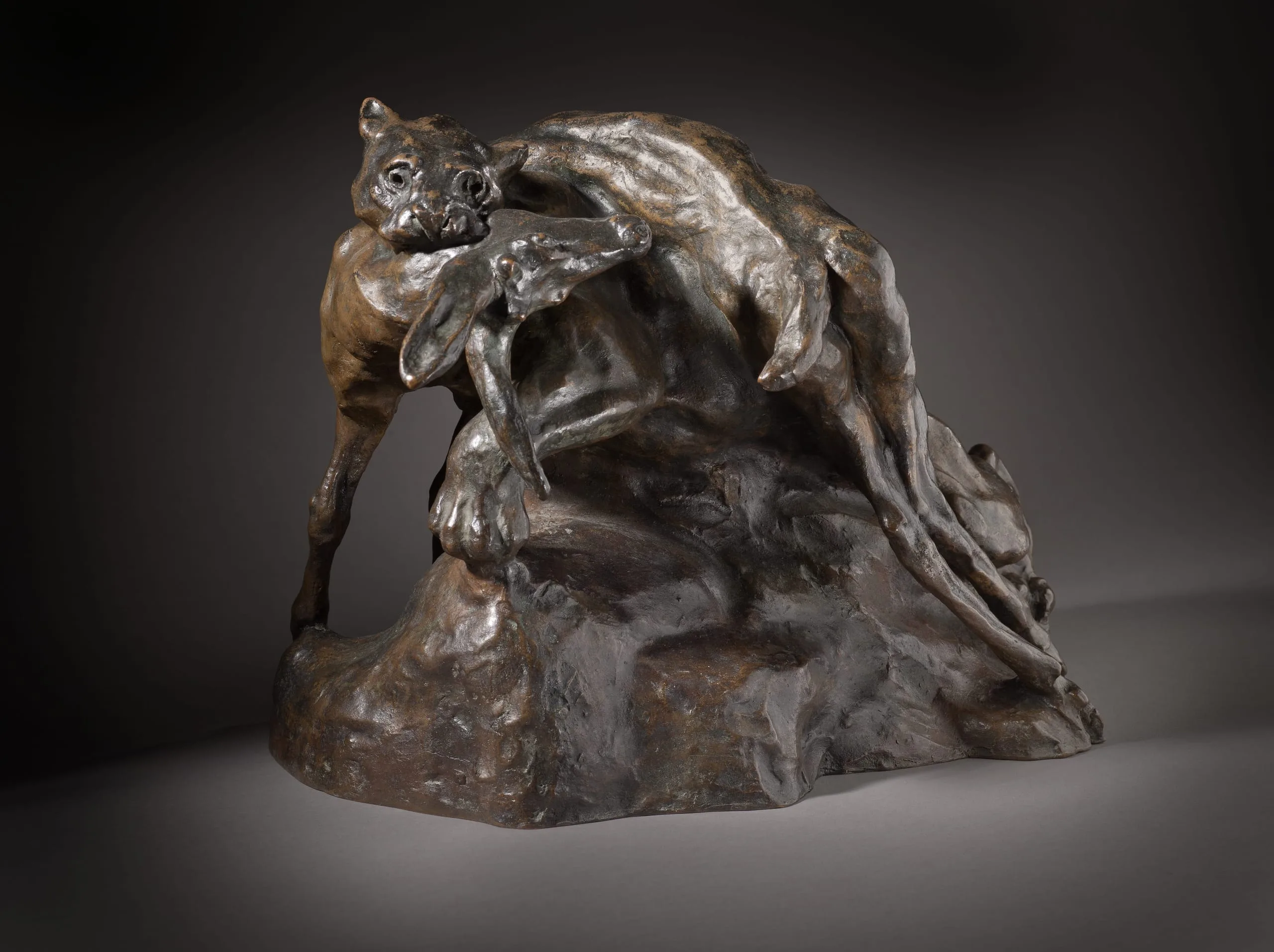
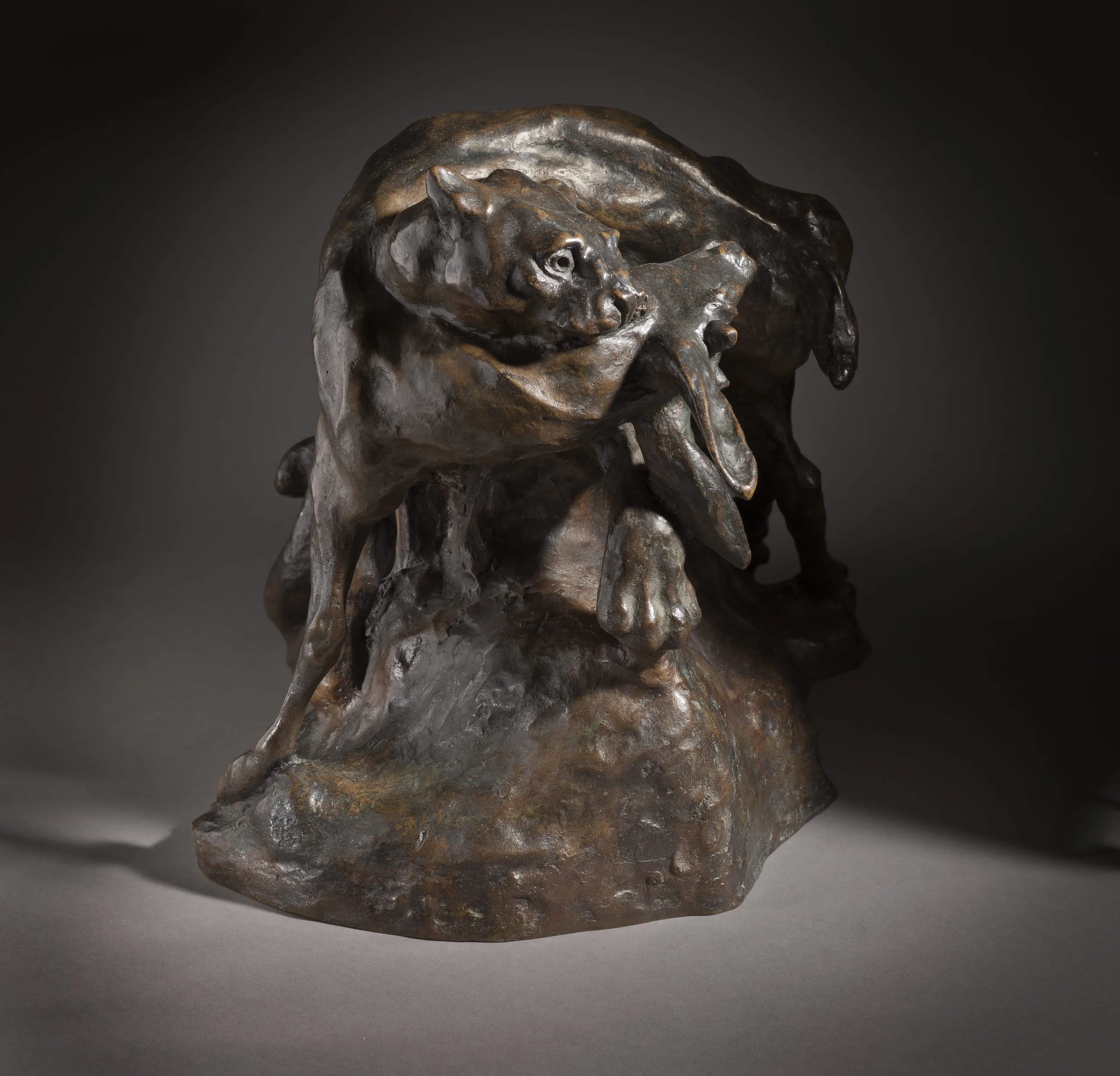
Several influences combined in Putnam’s distinctive work: the powerful animal subject matter of Antoine-Louis Barye (1796-1875), the fluid modeling of Auguste Rodin (1840-1917), and the artist’s own knowledge of California wildlife. Pumas and other large cats were Putnam’s favorite subjects, usually rendered, as here, as immensely powerful creatures with heavy, muscular limbs. In Puma and Deer the surging form of the puma is contrasted with that of the limp, lifeless deer carried across its back. Because of their vigorous modeling and lack of finish, Putnam’s works greatly appealed to modernists.
Little information concerning the bronzes cast by the different foundries used by Putnam is available. The museum’s cast has no foundry mark, but it does bear a copyright date of 1912. Putnam was associated with Macbeth Gallery in New York from 1908 to 1917 (Archiv. Am. Art, Macbeth Gallery Papers, Putnam-Gallery Correspondence, 1908-13, and Artists’ Credit Books, 1910-18, not on microfilm), and for part of that time, from at least 1911 to 1914, used Roman Bronze Works to cast his bronzes (New York, Roman Bronze Works, Ledgers, unpaginated). A cast of Puma and Deer in the Oakland Museum bears a Roman Bronze foundry mark and a different version of the copyright inscription, so it would appear the museum’s cast does not belong to the same edition. In 1913 Putnam induced his brother-in-law, Frederick Storey, to resume casting in their own foundry, with Putnam helping with the retouching and patination of the bronzes. Apparently with an interruption during the First World War, they continued to produce bronzes until early in 1918. Bronzes marked with the name "Putnam and Storey Foundry" are known, but it is not known whether all were so marked. During the war Rodin arranged for a foundry in Paris to make casts from Putnam’s plasters for exhibition at the Panama-Pacific International Exposition in 1915, but these casts have not been identified. In 1921 Mrs. Adolph Spreckels, who with her husband helped found the California Palace of the Legion of Honor in San Francisco, bought fifty-five plasters from the artist for the express purpose of having them cast by Alexis Rudier in his Paris foundry, whose mark they bear. Two sets were made, and Mrs. Spreckels gave one to the California Palace of the Legion of Honor (now part of the Fine Arts Museums of San Francisco) and the other to the Fine Arts Gallery of San Diego (now the San Diego [Calif.] Museum of Art).