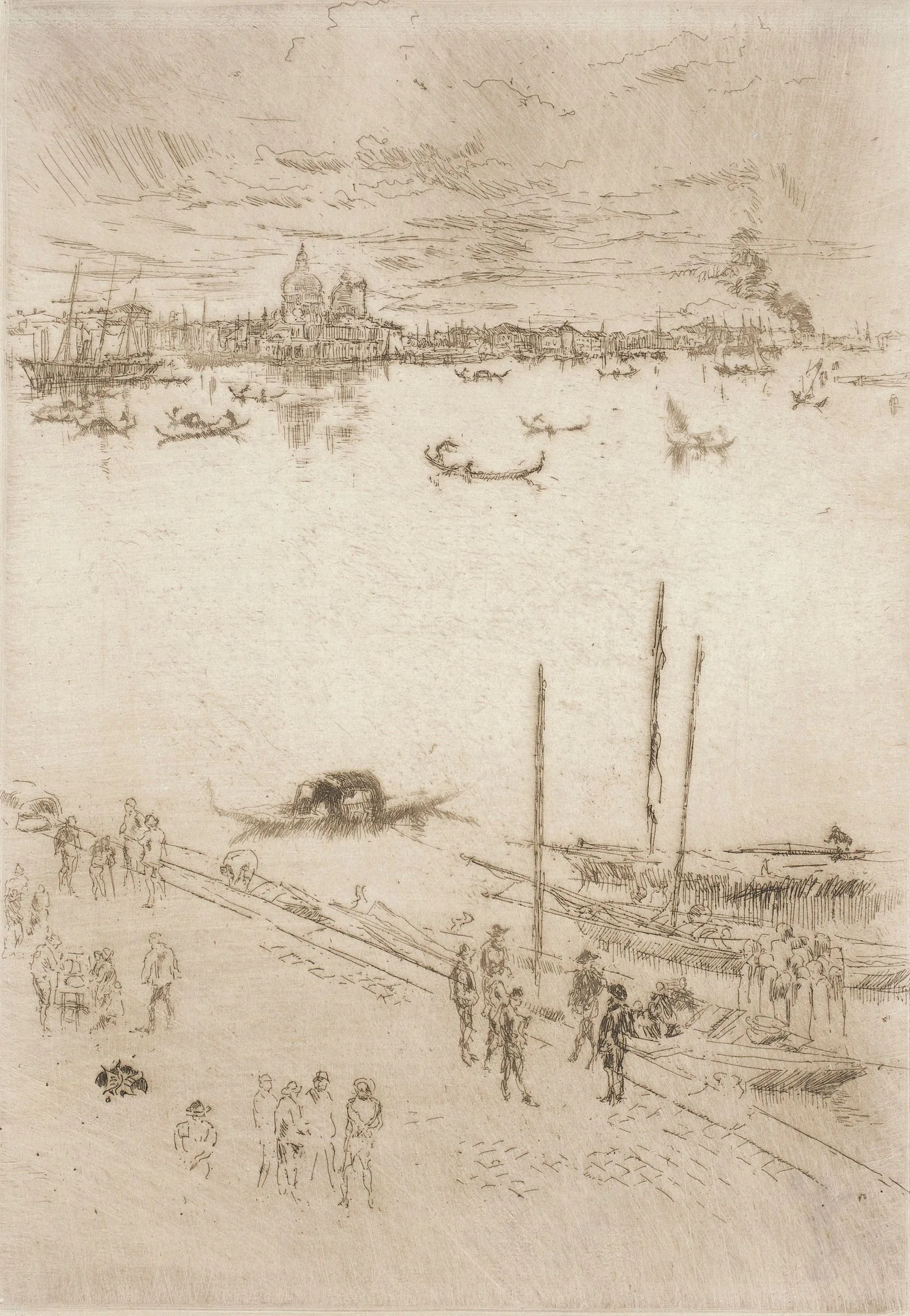
Whistler traveled to Venice in September 1879, commissioned by the Fine Art Society of London to create etchings illustrating the Italian city. Upright Venice was made soon after his arrival. In the print’s first state, he etched only the top half of the plate, showing the distant horizon of the city with the dome of Santa Maria della Salute, buildings near the waterfront, and gondolas and boats under a cloudy sky in the basin of San Marco, leading to the Grand Canal. The bottom half of the plate was left blank. Some six months later, following his further immersion in the city, Whistler returned to Upright Venice on several occasions to add the imagery captured in the plate’s lower half. LACMA’s etching with drypoint is an example of the second state, printed in brown ink. In this foreground addition, Whistler sketched an embankment and a multitude of figures, as well as more watercraft in the distant waters. The arrangement concords with the abstracted form of Japanese woodblock prints: the flattened land, water, and sky elements captured in distinct bands that traverse the sheet of paper, and the diagonal thrust of the embankment, reminiscent of works by artists such as Utagawa Hiroshige, whose land- and seascape woodcuts often incorporate a similar skewed orientation. As noted by Ruth Fine, “It is surprising in a way that the composition holds together, as it is actually comprised of two distinctly different aspects of Venice that Whistler most often approached individually: the city at a distance, sandwiched between sky and water, and the bustle of waterfront activity. It is Whistler’s perfect composite Venetian view” (Fine 1984: 121).
Upfront Venice was published in 1886 as part of A Set of Twenty-Six Etchings, commonly known as the Second Venice Set, a sequel to the first twelve etchings made in 1880, which comprise the First Venice Set.
Claudine Dixon
2024
Bibliography
Fine 1984. Ruth E. Fine. Drawing Near: Whistler’s Etchings from the Zelman Collection. Los Angeles: LACMA, 1984.