- Title
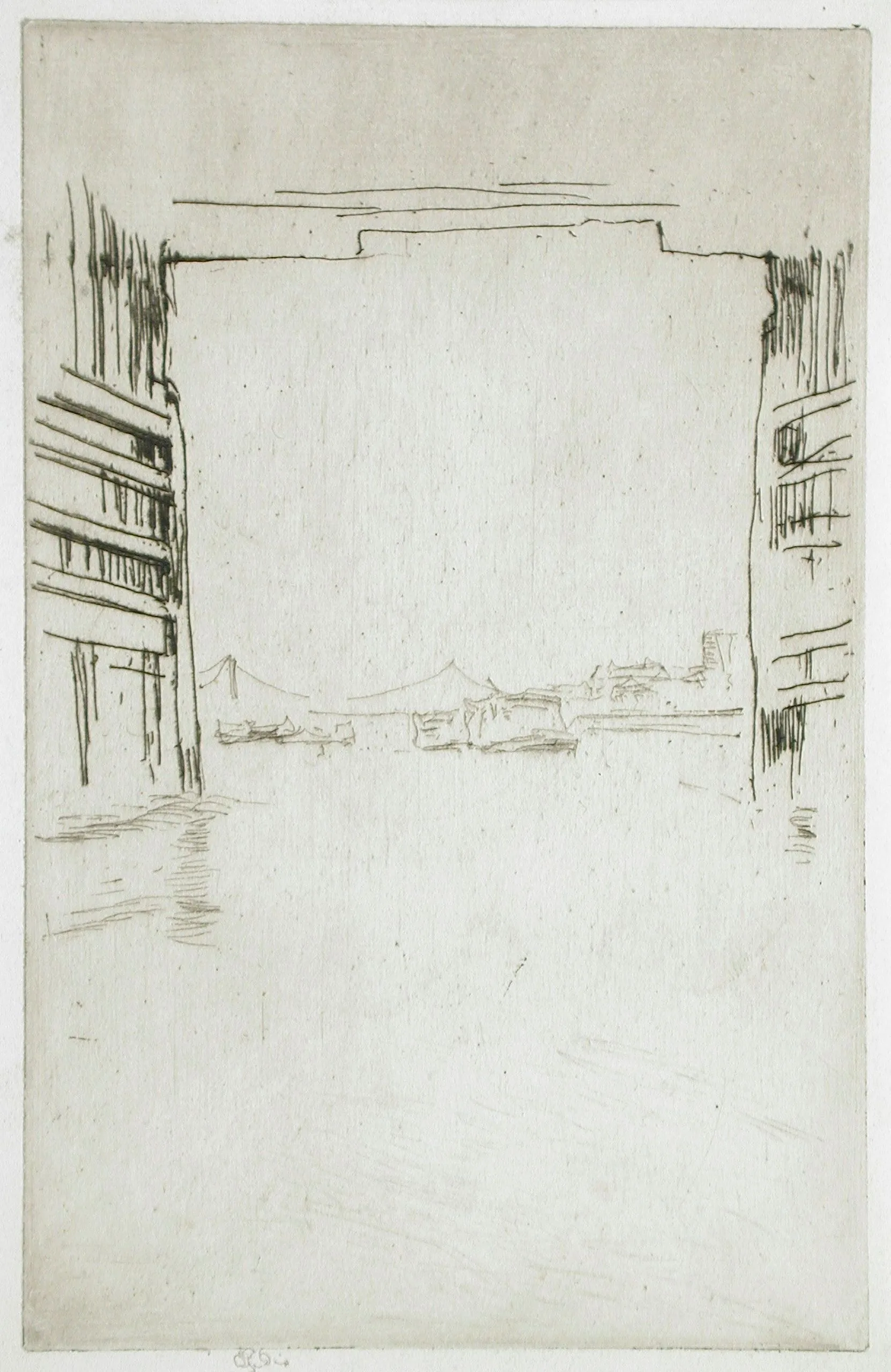
- Under Old Battersea Bridge
- Date Made
- 1876/1878
- Medium
- Etching, drypoint, and open bite
- Dimensions
- 8 3/8 x 5 3/8 in. (21.27 x 13.65 cm)
- Accession Number
- M.84.279.26
- Curatorial Notes
Whistler’s etchings of the Thames testify to his abiding interest in recording life along the river. In 1871, he issued A Series of Sixteen Etchings of Scenes on the Thames, commonly called the Thames Set. The London waterfront underwent extensive transformation during the latter half of the nineteenth century, and Whistler’s prints are now appreciated as documents of the city’s past. In this etching with drypoint, the artist left much of the paper untouched. The massive wood pylons of the Old Battersea Bridge on either side of the sheet, rendered in the firmest, darkest application of ink, function like borders of a window casement, framing a view on the riverscape. The water is suggested by the unmarked paper, and the gentle lapping of the tide is insinuated by the hatched lines where the pylons emerge from the depths of the river. Thickly inked lines describe the deck of the bridge above the pylons, while wispily drawn lines illustrate boats and buildings along the Chelsea shoreline and its suspension bridge in the distance. The flattening of various components derives from Whistler’s reinterpretation of Japanese woodblock prints.
At the time this etching was produced, the Battersea Bridge was the oldest surviving wooden bridge on the Thames; it was demolished in 1885 and replaced by a modernized cast-iron and granite structure. The Chelsea suspension bridge met the same fate in the 1930s.
Naoko Takahatake and Claudine Dixon
2012/2024
- Selected Bibliography
- Fine, Ruth E. Drawing Near: Whistler Etchings from the Zelman Collection. Los Angeles: Los Angeles County Museum of Art, 1984.