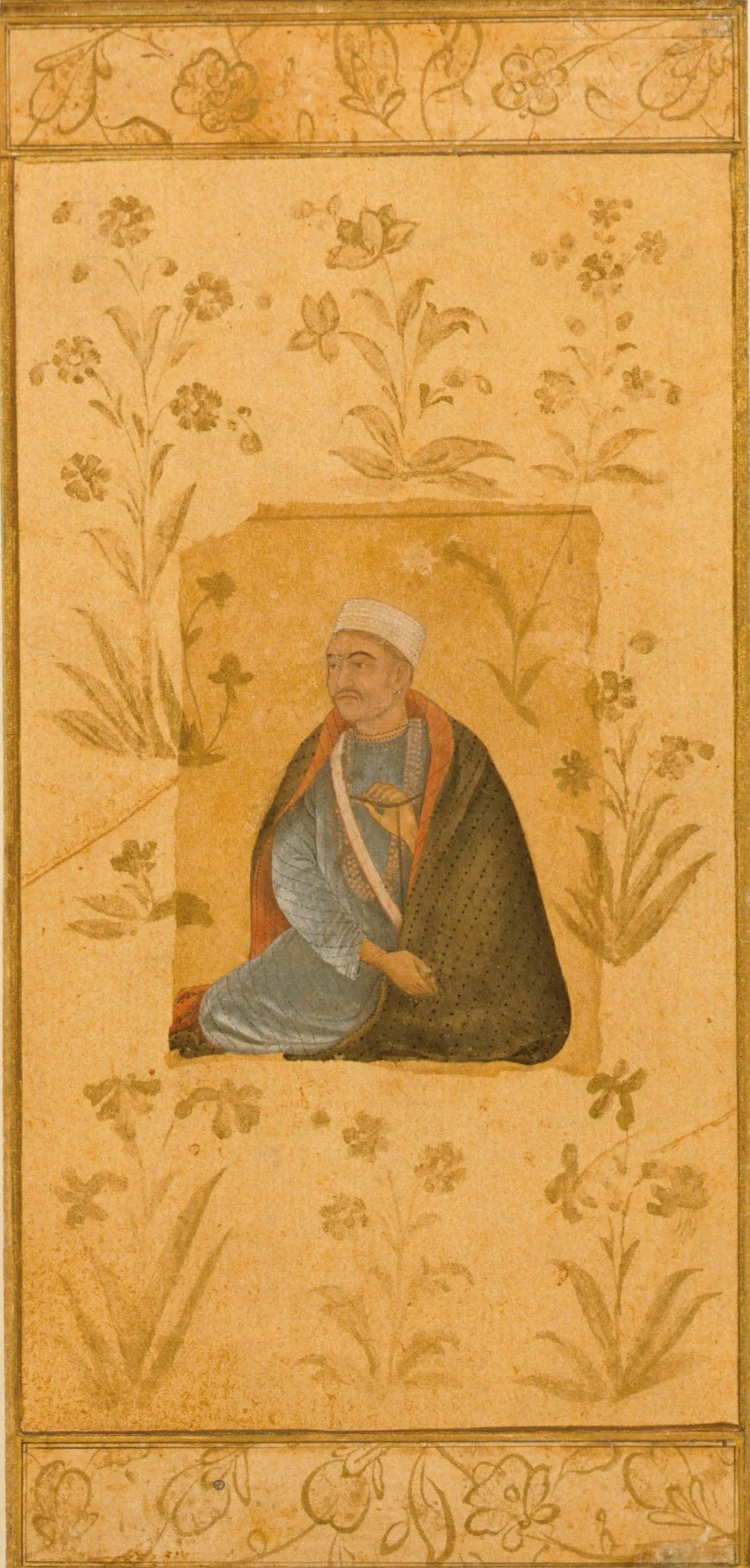
This sensitive portrait of an unidentified Muslim holy man wearing a South Asian-style white prayer cap (topi, kufi, or taqiyah), blue-gray tunic, narrow white sash, thick brown shawl lined in red, two types of bead necklaces, a pierced earring with two pearls. The pearl earring perhaps indicates that he is an ‘ear-bored slave’ or follower of the Sufi saint Khwaja Muin al-Din Chishti (1143–1236). (Similarly, in 1614 Emperor Jahangir (r. 1605-1627) had both ears pierced and started wearing pearl earrings after crediting the saint with his recovery from a severe illness.) Seated cross-legged, the holy man holds a bead rosary in his right hand and his left hand grasps the handle of a metal ascetic’s crutch. Such crutches were often used as arm supports by anchorites of various faiths (for a Hindu representation, see M.2011.156.4). They often held a concealed dagger in the shaft that could be used for defensive purposes (a similar example termed a Cushion of Victory (zafar takieh) is in the Metropolitan Museum of Art, New York; 36.25.1091a, b).
The figure is painted on a small fragment of thin transparent paper that has been pasted on a section of an album page border embellished in gold with flowering plants, perhaps intended as lilies. The two small panels above and below with sketchily rendered flowering vines are likely of a later date.