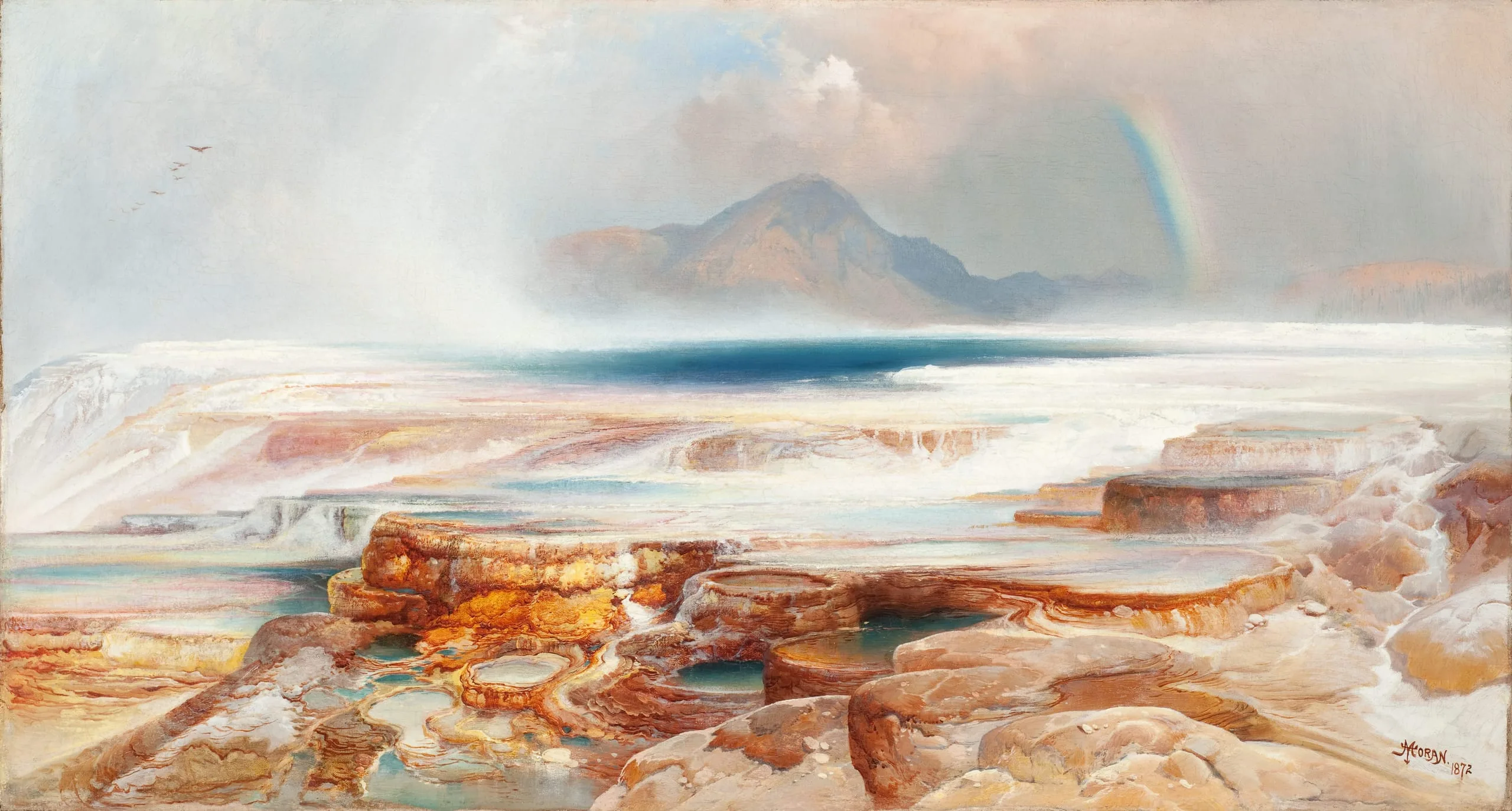
As a guest in 1871 of the official government survey team led by Ferdinand Hayden, Thomas Moran explored the headwaters of the Yellowstone River and became the first Euro-American artist to paint the area. While he was out in the field, Moran worked in pencil and watercolor. These watercolor field sketches were used to influence Congress in its decision to declare the Yellowstone area America’s first national park.
On his return to Philadelphia at the end of the summer of 1871 Moran produced a series of highly finished watercolors, which became his best-known early images of the Yellowstone. Contemporaneously dated oil paintings of Yellowstone by Moran are rare, and only three from 1872 have been documented: the museum’s painting, an unlocated The Tower Falls, and The Grand Canyon of the Yellowstone. The last is perhaps Moran’s best known work, having been bought by Congress soon after its exhibition in Washington in 1872.
Here Moran depicted the main terrace of Mammoth Hot Springs in the Wyoming Territory, just south of what is today the Wyoming-Montana state line. The Hayden group spent three days in late July 1871 exploring the springs, and Moran’s watercolors express the group's enthusiasm for the unusual geology of the area. Hayden noted, "The scenery in the vicinity of these hot springs is varied and beautiful beyond description" ("The Wonders of the West-II," Scribner’s Monthly 3 [February 1872]: 391). In the meticulously rendered foreground details Moran showed the hot springs and unusual travertine terraces, geological formations which were not well known to his East Coast audiences. Hot springs tend to be concentrated along drainage basins of lakes and streams, and Moran’s delineation of a lake in the broad plain of the middle distance is faithful to geological principles. The streams that feed into the lake eat away at the rock as the water, rich in minerals, filters through limestone crevices. Even his dabbing style of brushwork mirrors the cauliflowerlike appearance of sulfur deposits.
The entire scene is conveyed in the vibrant palette typical of Moran’s watercolors: salmon, yellow, sulphur, onyx, and a bit of green. The intense hues, although seemingly exaggerated, realistically present the extraordinary colors that the rocks take on from the sulfur, sodium, and other minerals in the water. When he originally transcribed this view of the hot springs, Moran was looking south toward what is now known as Bunsen Peak, which rises near the Gardiner River. Although the high mountain visible in the distance can be identified as Bunsen Peak, Moran took liberties with its profile. The entire distant area, with its soft opalescent atmosphere and rainbow, is idealized. The romanticized view suggests that Moran intended the painting to be an exhibition piece rather than a highly developed preparatory study.