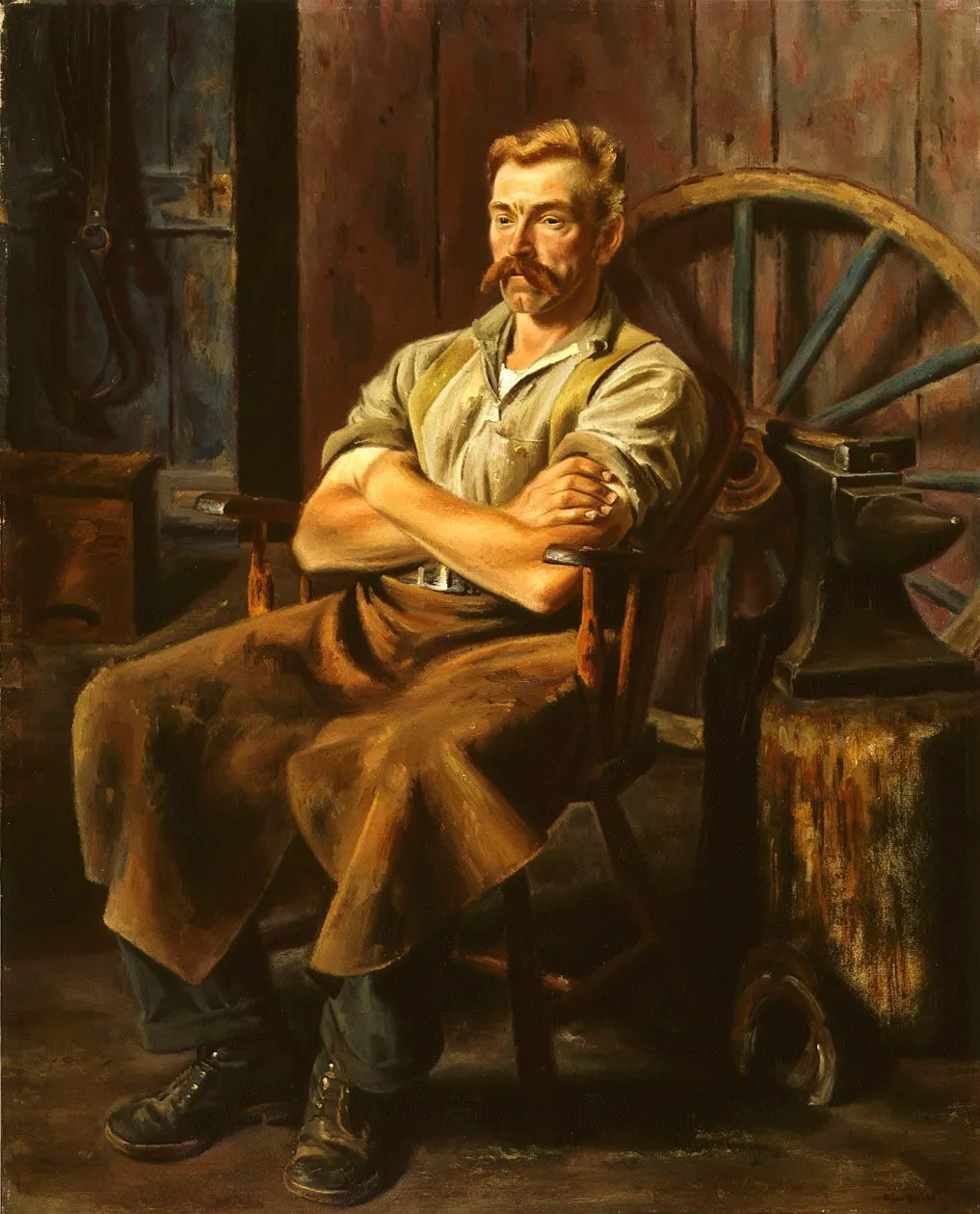
In 1933 Speicher met Vincent Moore, a farmer from Glenford, New York, a village three miles from Woodstock. Speicher first saw Moore, who was nicknamed "Red" because of his red hair and formidable moustache, swinging a hammer in his blacksmith shop and was so struck by his exceptional physical presence that he persuaded Moore to pose for him. Eventually Moore became one of Speicher’s favorite models, sitting for him every year for five years, but only in the autumn after the farming and hunting seasons. What resulted was a series of drawings and paintings in which the artist was able to convey the strength and ruggedness of this modern version of Longfellow’s "Village Blacksmith," as one critic referred to him.
Speicher usually depicted the brawny Moore wearing work clothes-a rough shirt, pants, and heavy shoes-characteristic of the rural American laborer. (Speicher thought of him as an independent son of the soil.) He placed Moore in interior settings natural for him, often with different implements indicative of his manly activities: an anvil and wheel for this blacksmith scene, a gun for the painting of Moore as a hunter, and a table laden with food for the image of Moore as a farmer. A restrained palette was typical of Speicher, and here the choice of browns was exceptionally well suited for underscoring the rugged, masculine quality of the image. Further conveying Moore’s physical power is his assertive gesture of crossing his muscular arms over his broad chest.
The painting was exhibited in several major American cities during the mid-1930s, winning awards that confirmed Speicher’s being one of the most important figure painters of the day. Although his approach to the figure was conservative, Speicher’s handling was that of a modernist, for he built form with a soft, but square, planar and economical brushstroke. The artist was commended for this "direct painting" in a review of the Whitney Biennial.
Speicher painted another version of Moore as a blacksmith (see Related Works). His reason for creating this other version is not known nor is the chronology. The two blacksmith paintings were the only images of Moore that Speicher made as full-length figures, and they are among the most monumental of his images. Speicher’s romantic conception of such rural American figures seems to be midway between the classicism of academic painting and American regionalism.