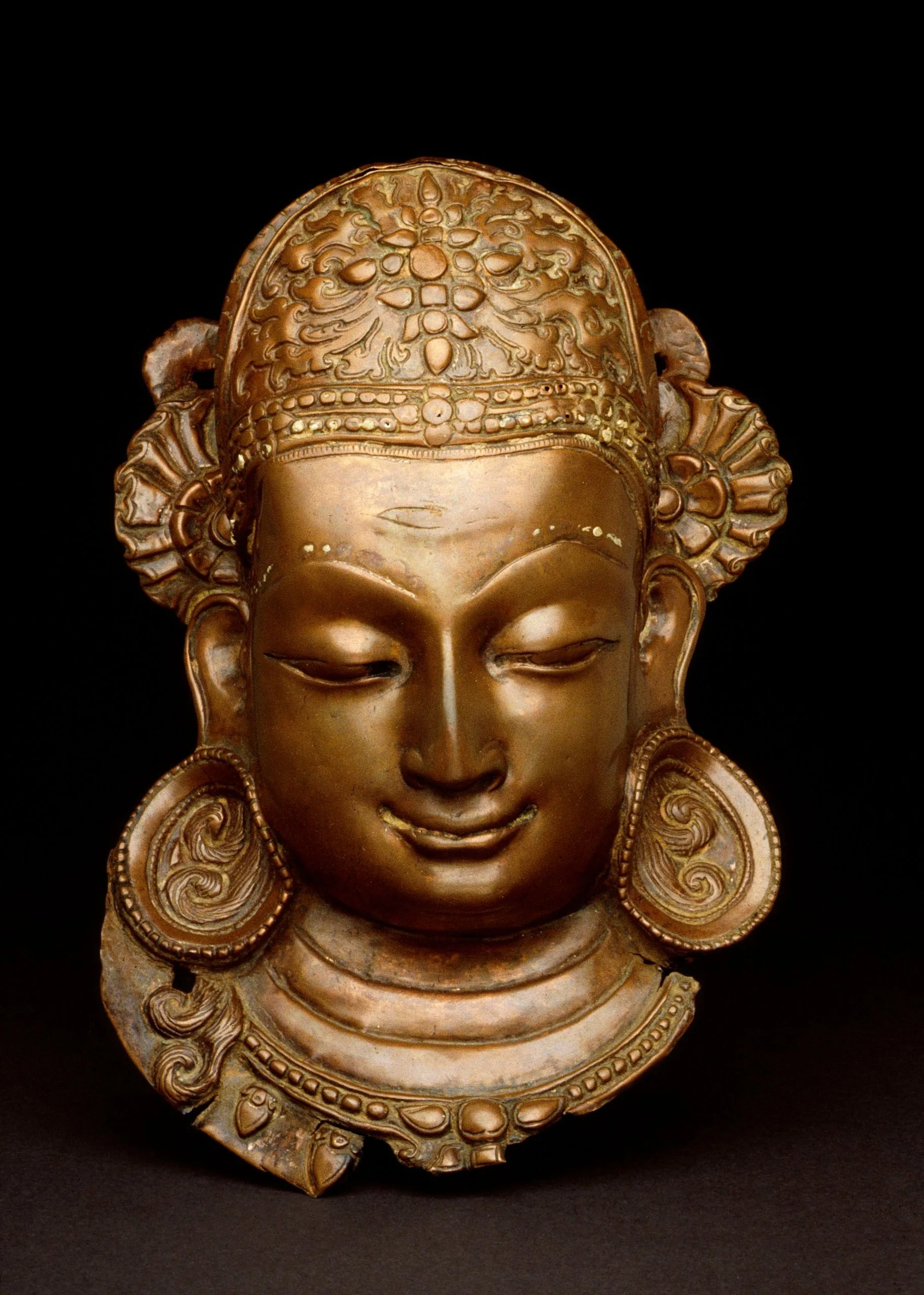
This exquisite repoussé unalloyed copper mask of Indra, Chief of the Gods, was likely made as a festival image (utsava murti). It would have been displayed in a village shrine to be publicly worshipped during festivals as well as carried in portable temples as a processional image.
Indra can be identified by his horizontal third eye on his forehead that refers to his one thousand eyes (sahasranayana) symbolic of his cosmic nature, and by his tall crown similar to a mitre, which is an idiosyncratic Nepalese attribute. He has long hair and wears round earrings (kundala) and an ornate necklace (kanthi). His gentle smile symbolizes his deep compassion and the blessings of agricultural prosperity for the monsoon rains. There are also related masks of Indra’s consort, Indrani (also known as Indrayani), who is one of the Eight Mother Goddesses (Ashta Matrikas) protecting the Kathmandu Valley. Indrani wears an undifferentiated crown, however, rather than Indra’s tall crown. See Kamal P. Malla, "The Repoussé Images from Pharping," AsianArt.com (5/19/2009), https://www.asianart.com/articles/malla/index.html#3
Comparable Nepalese repoussé masks are in the Patan Museum, Patan.