- Title
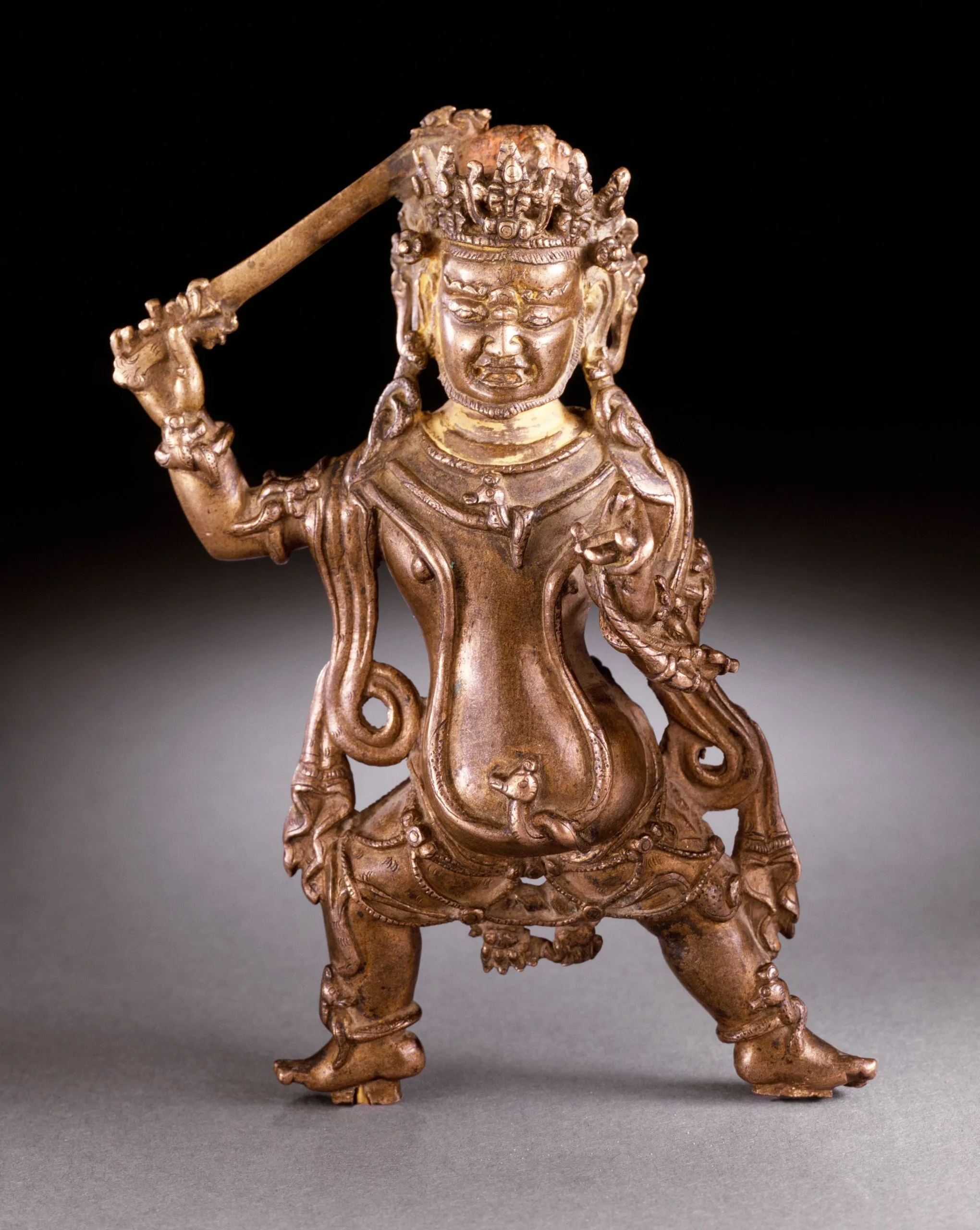
- The Buddhist Protective Deity Achala
- Date Made
- 16th century
- Medium
- Leaded bronze with traces of cold gold and red devotional paint
- Dimensions
- 4 13/16 x 3 1/8 x 1 1/2 in. (12.22 x 7.93 x 3.81 cm)
- Accession Number
- M.84.171.1
- Curatorial Notes
Achala (Immovable One), also known as Chandamaharoshana (Fierce and Great Wrathful One), is an angry manifestation of the Jina Buddha Akshobhya and his female aspect Mamaki in Vajrayana Buddhism in Tibet and Nepal. He is also the Regent of the North-East Direction (dikpala) and one of the major exoteric forms of Chakrasamvara in Nepal. Achala is believed to destroy all evil forces and obstructions (mara) with his anger (krodha). He typically holds in his right hand the flaming sword of wisdom, used to cut all obstacles and to purify all offerings.
Here, Achala brandishes his sword in his right hand and carries a diamond noose (vajra pasha) in his left hand, which is held in a gesture of admonition (tarjani mudra). He has a ferocious expression and wears a tiger skin around his waist and numerous serpents as ornaments. He stands in a militant posture (alidha asana) with his right leg bent forward and his left leg extended.
See also M.71.98.1, AC1994.13.1, and AC1995.39.1.
- Selected Bibliography
- Reedy, Chandra L. Himalayan Bronzes: Technology, Style and Choices. Newark: University of Delaware Press, 1997.
- Pal, Pratapaditya. Art of Tibet. Expanded edition. Los Angeles: Los Angeles County Museum of Art, 1990.