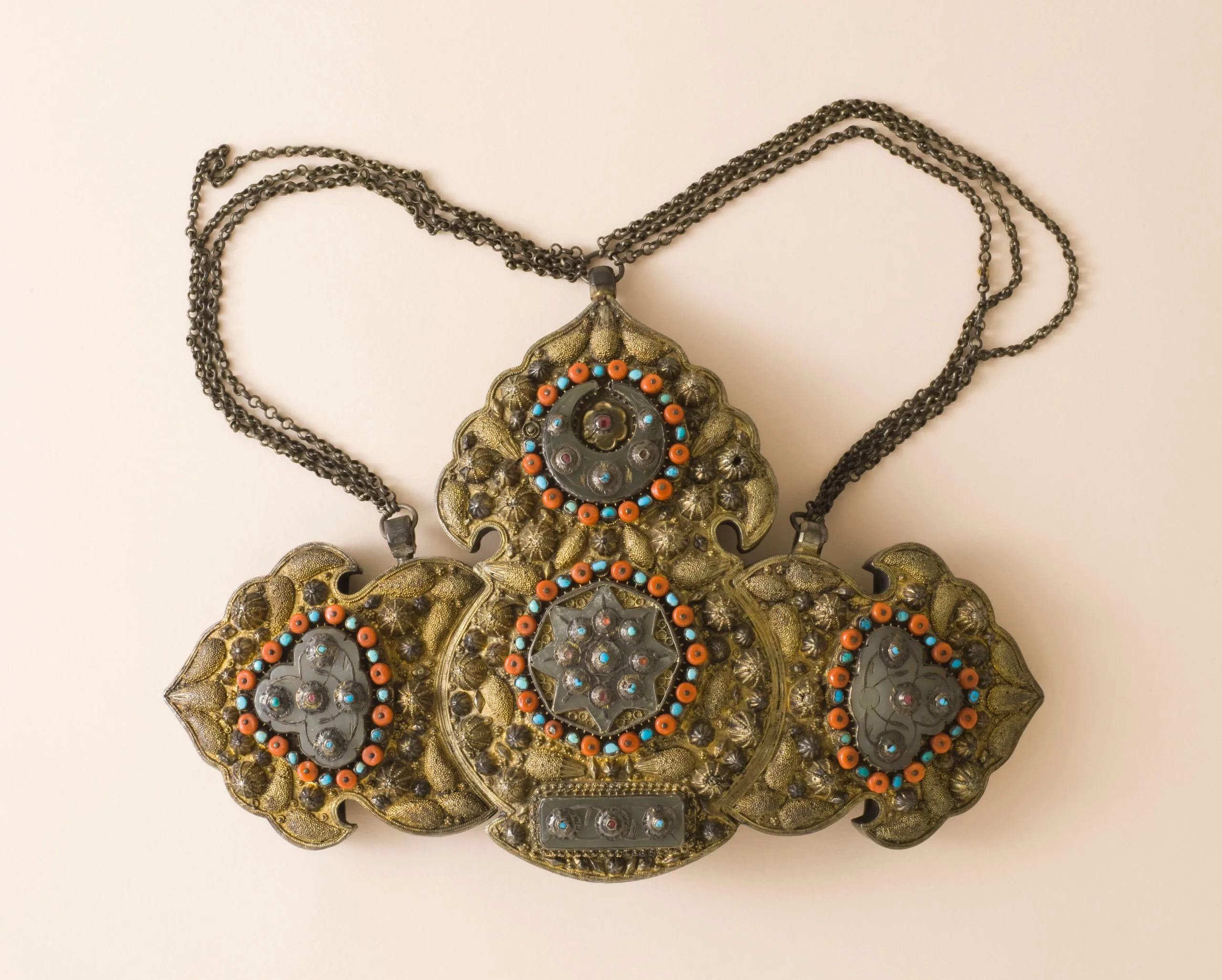
This large tri-lobed buckle is formed from gilt steel, accented with jade, turquoise, and coral, befitting a well-to-do Ottoman woman. Belts that could support buckles of this size served as visible markers of status and wealth, while offering an ideal place to casually display a finely embroidered handkerchief. Such large belt buckles provided the finishing touch to a woman’s indoor outfit, tying together the many layers of her ensemble, which included a transparent silk shift, a tight long-sleeved waistcoat, loose trousers, matching caftan, and a head covering. Similar buckle shapes appear in countless paintings of elite women produced by both European and Ottoman artists.
Given how valuable the materials of a single belt buckle could be, a woman could leverage these works for cash in times of financial need or even have them melted down for their metals, which may explain why so few buckles of pure gold survive to this day. Indeed, such belts are frequently listed among the wardrobe contents in Ottoman trousseaus from the seventeenth and eighteenth centuries. On surviving lists, owners registered a belt’s exact worth based on the weight of their metals and the quality of their gems, pearls, or semiprecious stones.
Belt buckles like this found admirers not only among the Ottoman ladies, but also among travelers and the wives of European diplomats. Lady Mary Wortley Montagu (d. 1762), the wife of the English ambassador to Istanbul during the early eighteenth century, noted her great appreciation for the accessories of elite Ottomans in her letters. In fact, during her time in the empire, Lady Mary commissioned her own Ottoman outfit that appears in her later portrait, painted by Jean Étienne Liotard in 1756, which shows off a large belt buckle of gold or another gilt metal. Lady Mary was only one of many women who donned their “Turkish” outfits after returning to Europe, proudly displaying these accessories as testaments to their worldly connections and fashionable sensibilities. Between their adopted fashions and the many depictions of Ottoman women that circulated throughout Europe, elements of Ottoman dress were absorbed into Turquerie costumes, including accessories like this belt buckle. For one example of how such belts were transformed in a Turquerie ensemble, see M.87.231.63.https://collections.lacma.org/node/170395">M.87.231.63.