- Title
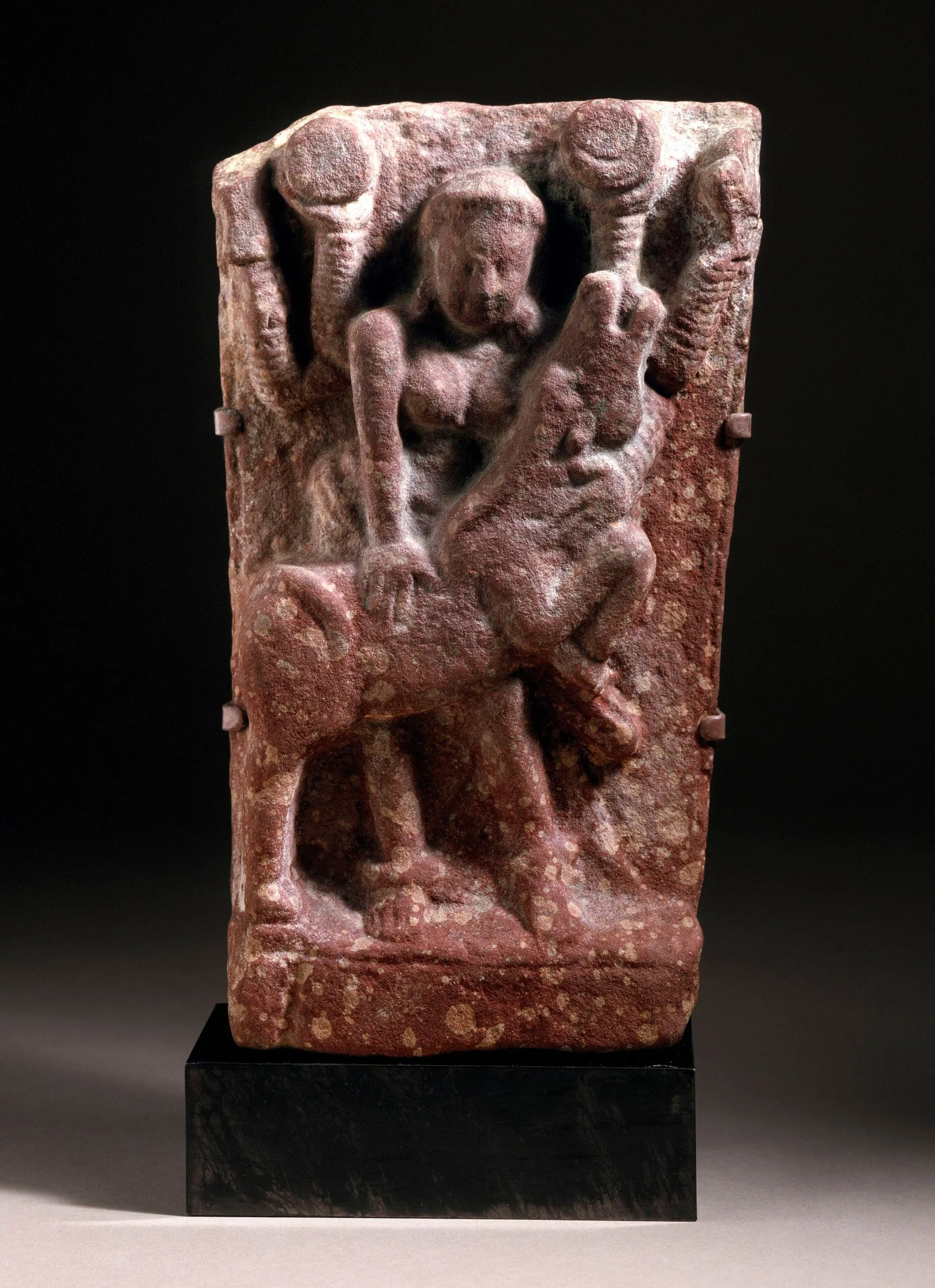
- Durga Slaying the Buffalo Demon
- Date Made
- circa 200
- Medium
- Mottled red sandstone
- Dimensions
- 9 1/2 x 5 5/8 x 1 3/4 in. (24.13 x 14.28 x 4.44 cm)
- Accession Number
- M.84.153.1
- Curatorial Notes
The Hindu goddess Durga (Unconquerable) first appears in Indian art during the Kushan Dynasty (circa 30-375) in small images such as this that were likely used in domestic shrines. One of the most widely venerated deities of Hinduism, Durga’s origins may be traced back to diverse tribal goddesses whose worship she absorbed, as well as to the ancient Middle East and Mediterranean region where various powerful warrior and mother goddesses were prominent. It was not until the Markandeya Purana (circa 250) with its later additions extoling Durga, which were subsequently extracted as a stand-alone text, the Devimahatmya (Glory of the Goddess; circa 550), that Durga became a foremost member of the Hindu pantheon. The Devimahatmya describes the great goddess in her various aspects triumphing over several demonic adversaries, including the buffalo demon Mahishasura (see M.77.19.27 and M.70.1.1).
Durga is represented here slaying the buffalo demon by strangling it or breaking its neck with her two principal arms. In her upraised remaining four arms she holds a sword, the Sun and crescent Moon representing her cosmic nature, and a shield (left to right).
- Selected Bibliography
- Pal, Pratapaditya. Indian Sculpture, vol.1. Los Angeles: Los Angeles County Museum of Art; University of California Press, 1986.
- Yaldiz, M.; Lobo, W., eds. Investigating Indian Art. Berlin: Museum fur Indische Kunst, 1987.