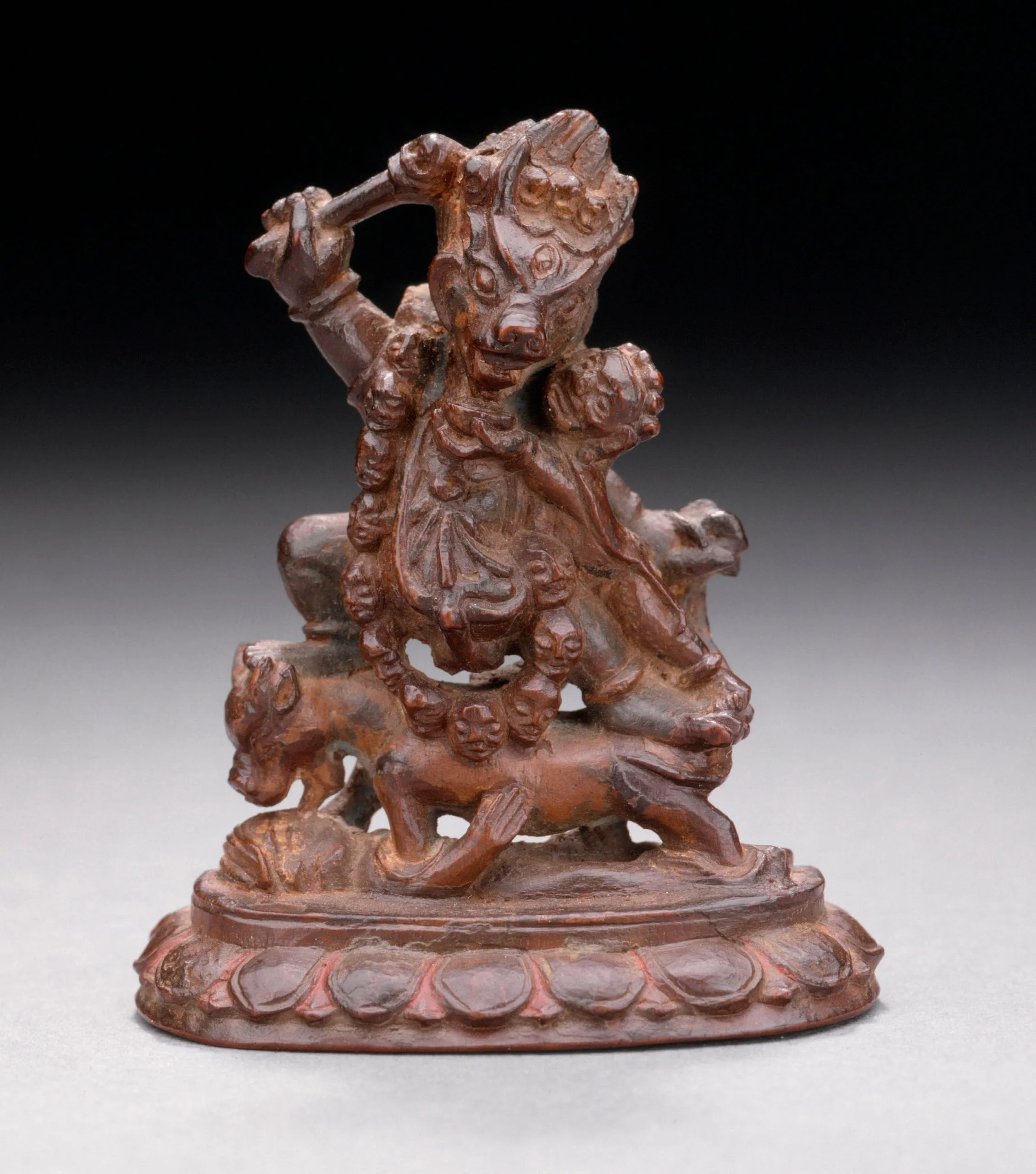
Although small in size, this is a powerful representation of the Vajrayana (esoteric) Buddhist protective deities Yama and his sister Yami. Yama is the Lord of the Underworld who judges the soul at the gates of hell. As a Dharmaraja (King of the [Buddhist] Law), Yama is a major member of the Dharmapalas (Protectors of the [Buddhist] Law), who are believed to defend Buddhism and its teachings, and destroy the hindrances of its followers. He is specifically depicted here in his conceptual form of the Outer Yamaraja (Lord of Death), who protects Buddhists and monasteries from droughts, bandits, and other evils. See also M.71.78.
The macabre imagery of Yama and Yami serves to terrify those who might seek to harm Buddhists. Yama is thus represented in a fierce form with a buffalo’s head and wearing a diadem of skulls and a long garland of severed skulls (mundamala). He brandishes a chastising staff (yama-danda) in his upraised right hand. In his left hand, he carries what is likely a noose to bind souls. Yami, with a fearful expressions and wearing a skull. diadem, offers Yama a ritual skullcup (kapala) full of demon-blood elixir. They stand aggressively in a militant posture (alidha asana) on a roaring lion, which crushes a female figure symbolic of ignorant life who is depicted lying on a lotus base.
This diminutive image may have been made as the icon for a portable reliquary shrine (ga'u). See M.80.48.1-.2 and AC1994.116.3.1-.5.