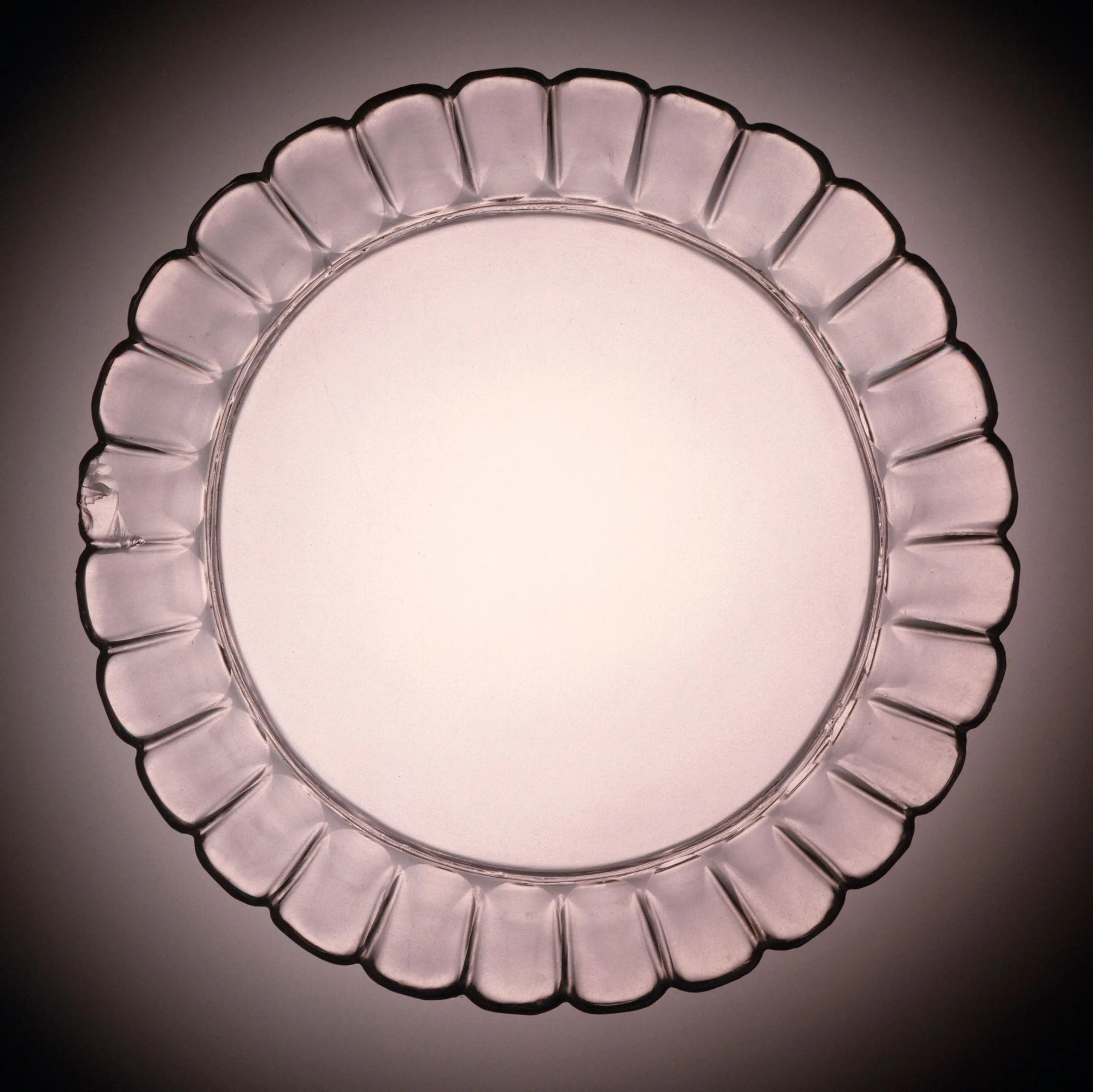
Fashioned from clear rock crystal free of visible inclusions, this small plate exhibits an austere elegance. It has a plain central reserve encircled by a scalloped border of twenty-eight petals.
Rock crystal carving (technically, abrading) has an ancient heritage in South Asia. The principal center of production was in western India near the coastal city of Cambay (present-day Khambhat) in Gujarat, where it was long used to make Buddhist and Hindu amulets and votive objects. In the early modern era, clear rock crystal was the inspiration for the creation of the renowned Venetian Cristallo soda ash glassware in the mid-15th century and lead crystal glassware in the late 17th century in England by George Ravenscroft (1632-83) and other glassmaking firms. Lead crystal glassware was soon imported into India in significant quantities. Niccolao Manucci (1638-1717), a Venetian explorer and physician who wrote a detailed account of his travels in Mughal India between 1653-80, recorded that rock crystal dishware was a precious commodity in the Mughal domains.