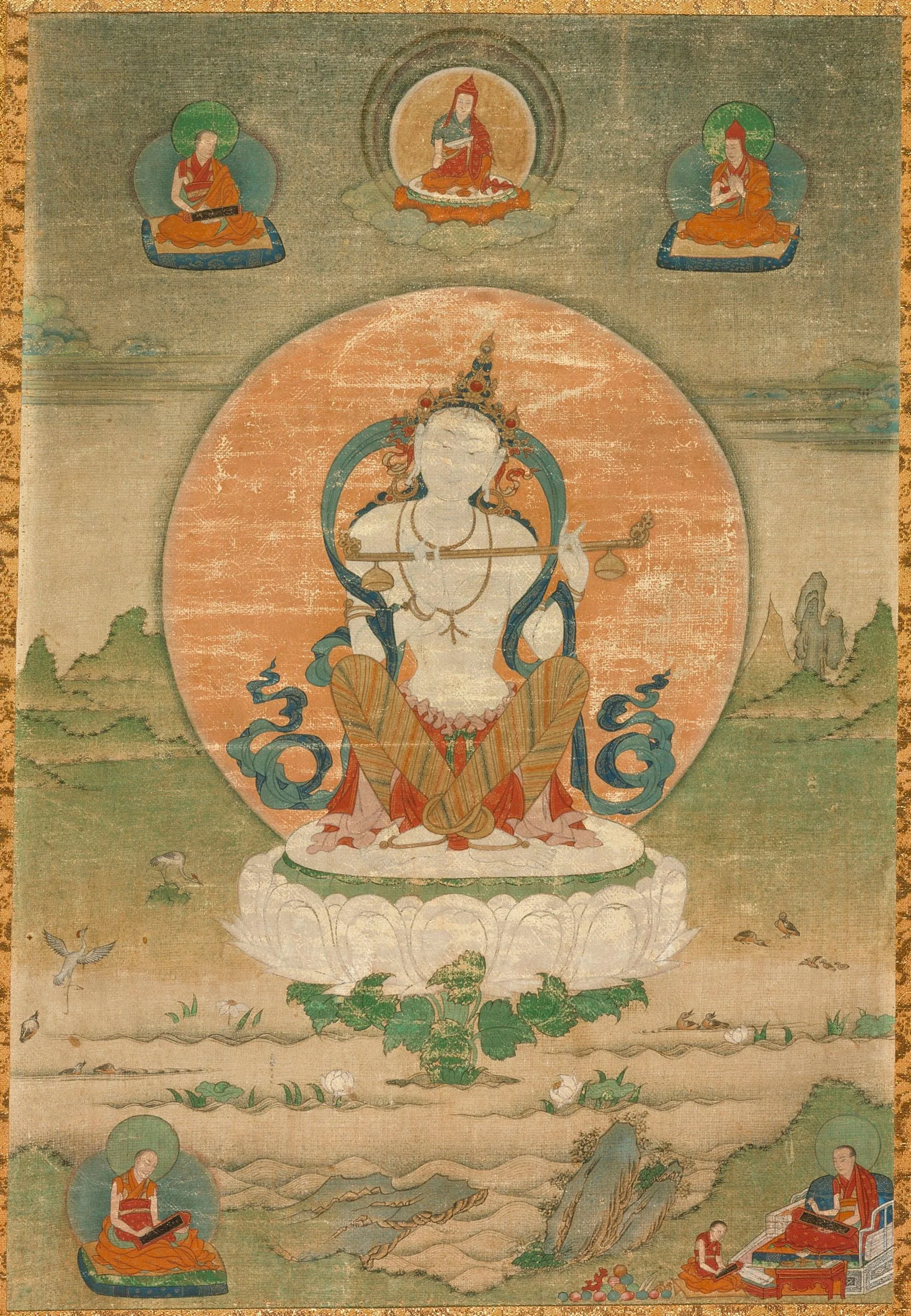
Venerated by Jains, Hindus, and Buddhists alike, Sarasvati (or Saraswati) is the goddess of knowledge, learning, speech, poetry, and music. Her reverence began in the early Vedic (proto-Hindu) period (circa 1500-1000 BCE) when she was worshipped in the Rigveda (Knowledge of Hymns) as the river goddess of the mythological Sarasvati River imagined as having once flowed in northwestern India. As Sarasvati carries her principal attribute of a vina regardless of her sectarian affiliation, the religious context of a given image of Sarasvati can be generally determined by its iconographic program and geo-historical origin. Accordingly, that this painting depicts a Buddhist Saraswati is evidenced by the presence of the five Sakypa monks surrounding the goddess. For examples of Hindu and Jain images of Sarasvati, see M.91.294.1 and M.86.83 respectively. This elegant representation of Sarasvati is believed to have been designed and commissioned by Situ Panchen (1700-1774), the renowned Buddhist master, scholar, patron, and artist in the Karma Kagyu school in Derge, Kham. See David P. Jackson, Patron and Painter: Situ Panchen and the Revival of the Encampment Style (New York: Rubin Museum of Art, 2009), pp. 115-116, no. 6.3.
Sarasvati sits on a white lotus base with an orange aureole (prabhavali) behind her. The goddess is crowned, white-skinned, and has two arms holding a vina. She squats in an unusual position with her knees raised and ankles crossed, which may be a posture for musical performance. She wears a striped skirt and a long green scarf with flowing ends that forms a nimbus around her head. Sarasvati sits in a spacious landscape rendered in the Karma Gadri style of painting that flourished in the 17th-18th centuries and incorporated stylistic elements of Ming Dynasty (1368-1644) painting.
A comparable painting of White Manjushri designed by Situ Panchen is in the American Museum of Natural History, New York (70.2/649).