- Title
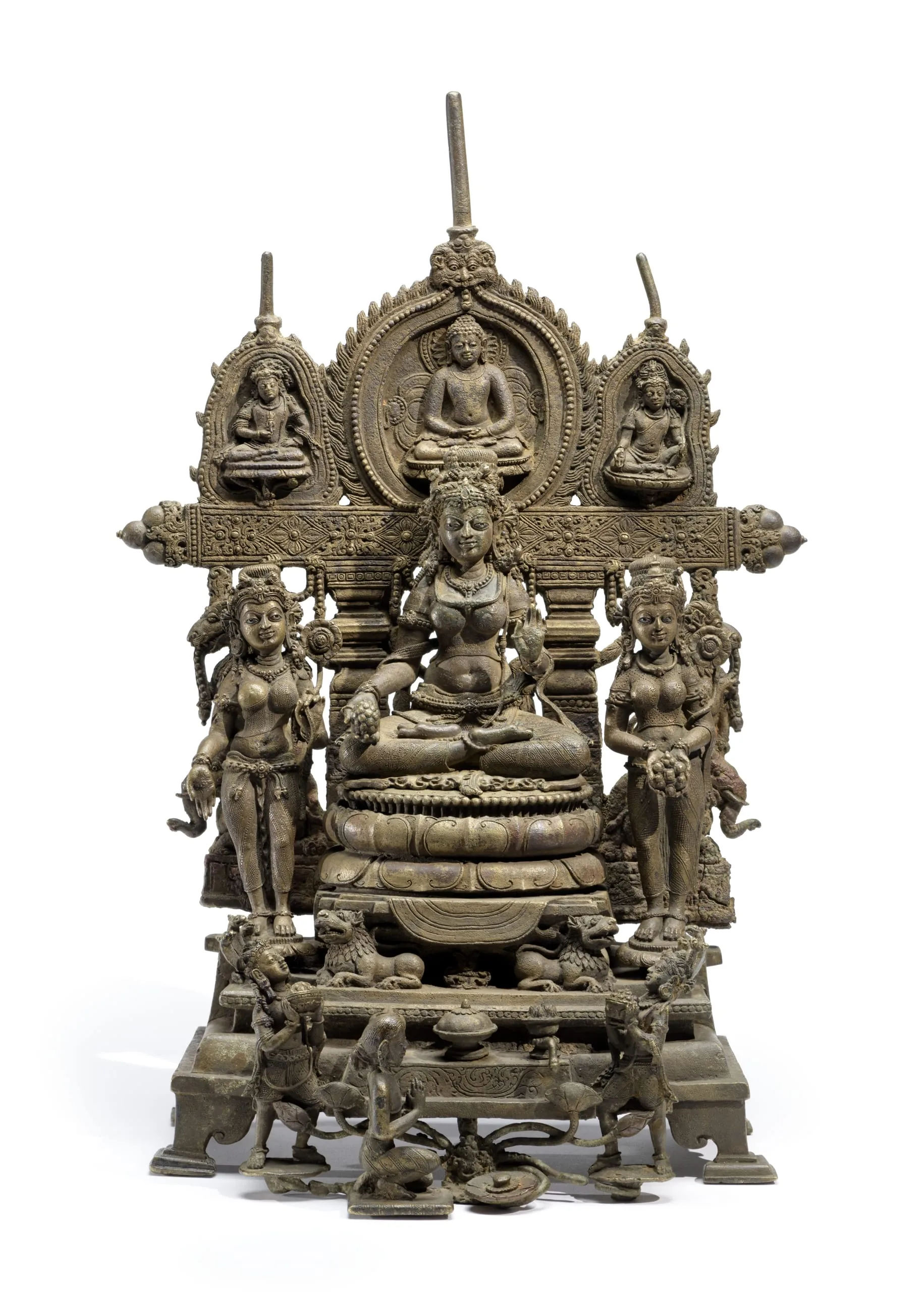
- Buddhist Altarpiece with the Goddess Green (Shyama) Tara Flanked by White (Sita) Tara and Bhrikuti (center), and the Transcendental Buddha Amitabha Flanked by the Bodhisattvas Vajrapani and Avalokiteshvara (top)
- Date Made
- circa 8th century
- Medium
- Copper alloy inlaid with silver and copper
- Dimensions
- 15 x 10 1/8 x 7 in. (38.1 x 25.71 x 17.78 cm)
- Accession Number
- M.84.32.1a-d
- Curatorial Notes
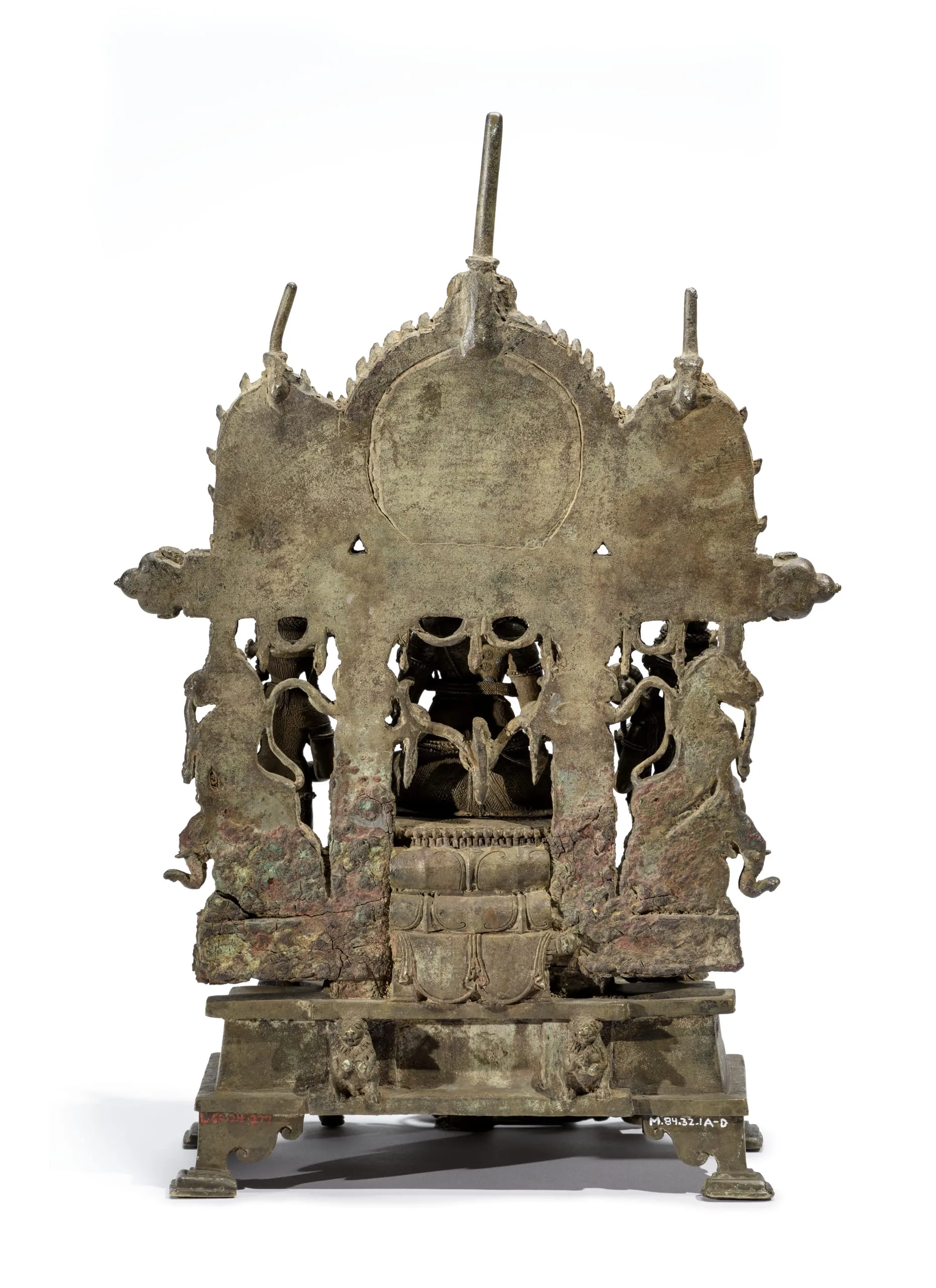
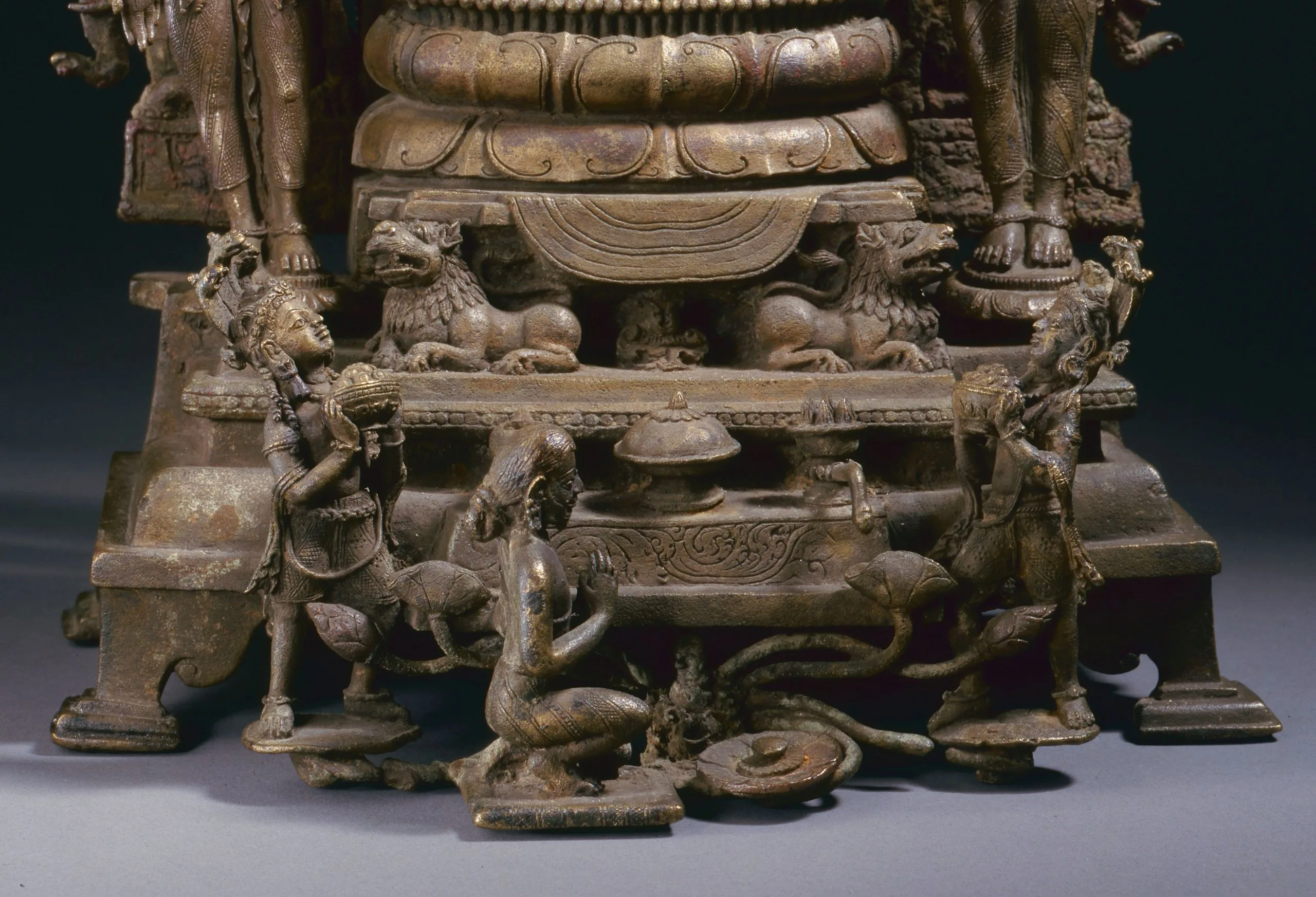
One of the great treasures of the Los Angeles County Museum of Art, this extraordinary Buddhist altarpiece is a remarkable tour de force of compositional intricacy and technical sophistication. It bespeaks the strength of Buddhist patronage and artistry in central India at a time when the faith was generally waning elsewhere in South Asia. The garments worn by the figures—rendered through chasing and the inlay of silver and copper into the finished surface—are detailed records of the intricately designed fabrics for which India was justly famous. The elegant patterns of floral medallions, geometric bands, and vegetal scrolls combine with the figures’ ornate jewelry and the lush surface ornamentation of the throneback to form a rich tableau of texture and motif.
There are many forms of Tara, all of whom help practitioners overcome hindrances and difficulties on the path to Enlightenment. Each Tara has a different symbolic character and associated color. Green Tara is one of the most popular Buddhist protective goddesses in Nepal and Tibet. She is said to have been born from the Bodhisattva Avalokiteshvara’s tears of compassion. She is a gracious form regarded as the savior from all suffering and the symbol of Enlightenment in female form. She is often propitiated for longevity. White (Sita) Tara is also believed to have been born from Avalokiteshvara’s tears of compassion. She is associated with healing, longevity, and purification. Bhrikuti is a consort of Avalokiteshvara and is associated with Tara. She embodies compassion.
See also M.90.164.
- Selected Bibliography
- Rosenfield, John. The Arts of India and Nepal: The Nasli and Alice Heeramaneck Collection. Boston: Museum of Fine Arts, Boston, 1966.
- Ray, Nihar Ranjan, Karl Khandalavala, and Sadashiv Gorakshkar. Eastern Indian Bronzes. New Delhi: Lalit Kalā Akademi, 1986.
- Melwani, L. "Looking for the Perfect Ganesha." Arts and Antiques (October 2000).
- Sivaramamurti, C. India, Ceylon, Nepal, Tibet. 2 vols. Torino, Italy: UTET, 1988.
- Soon, Teoh Eng. The Lotus in the Buddhist Art of India. Singapore: Teoh Eng Soon, 2003.
- Asher, Frederick M. Art of India: Prehistory to the Present. London: Encyclopædia Brittanica, Inc., 2003.
- Pal, Pratapaditya; Dehejia, Vidya; Slusser, Mary Shepherd; Fisher, Robert E.; Brown, Robert L. Arts of Asia 15 (6): 68-125 (November- December 1985).
- Pal, Pratapaditya. Elephants and Ivories in South Asia. Los Angeles: Los Angeles County Museum of Art, 1981.
- Pal, Pratapaditya. Indian Sculpture, vol.2. Los Angeles: Los Angeles County Museum of Art; University of California Press, 1988.
- Beckett, Sister Wendy. Sister Wendy's American Collection, Toby Eady Associates, ed. Harper Collins Publishers, 2000.
- Huntington, John C. and Dina Bangdel. The Circle of Bliss: Buddhist Meditational Art. Columbus: The Columbus Museum of Art; Chicago: Serindia Publications, 2003.
- Peyton, Allysa B. and Katherine Anne Paul. Arts of South Asia: Cultures of Collecting. Gainesville: University of Florida Press, 2019.
- Little, Stephen, Tushara Bindu Gude, Karina Romero Blanco, Silvia Seligson, Marco Antonio Karam. Las Huellas de Buda. Ciudad de México : Instituto Nacional de Antropología e Historia, 2018.
- Little, Stephen, and Tushara Bindu Gude. Realms of the Dharma: Buddhist Art across Asia. Los Angeles: Los Angeles County Museum of Art, 2025.