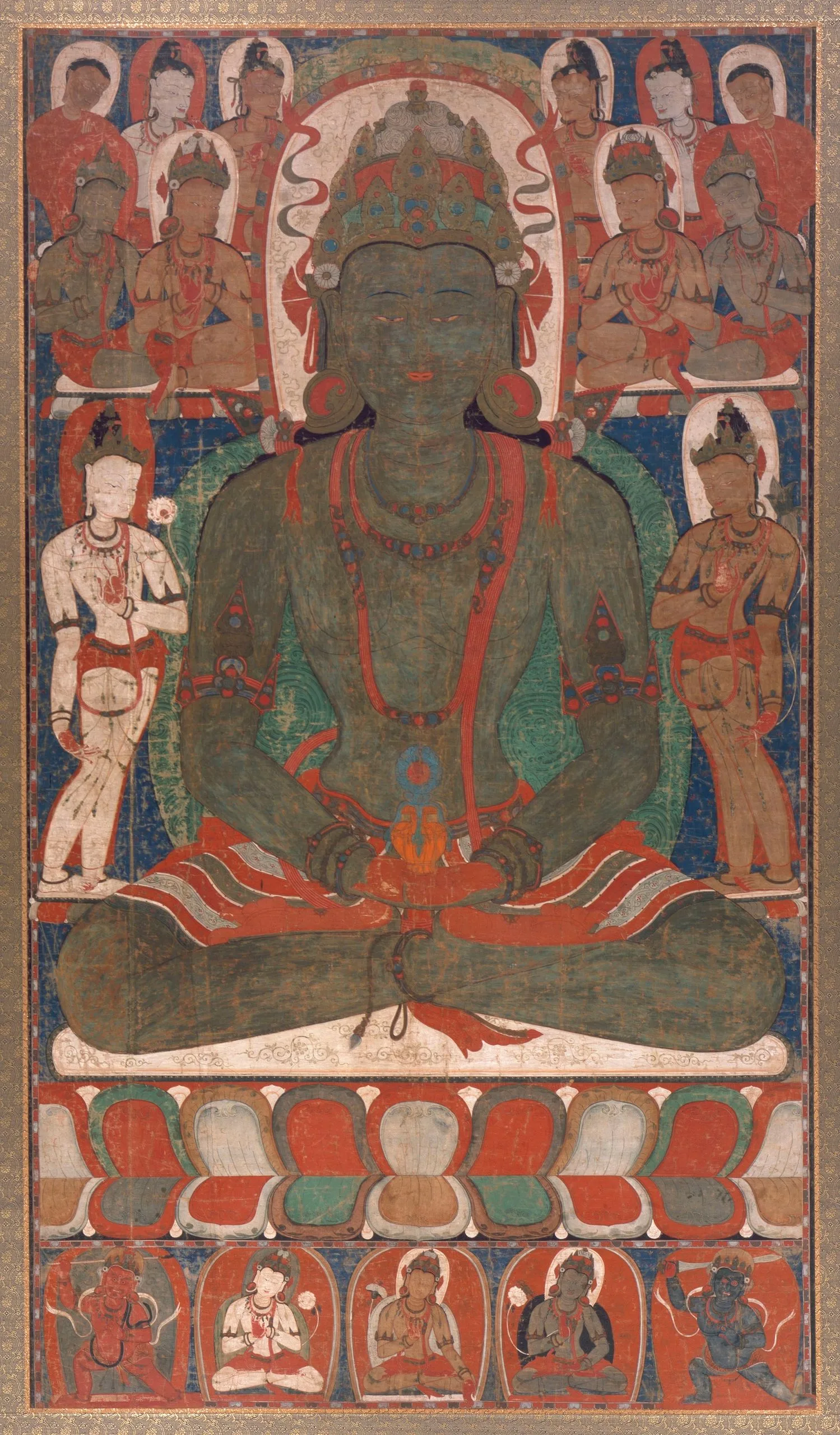
In twelfth-century Tibet a flourishing Buddhist religious life was dominated by theistic and faith-centered Tantric observance. It focused on salvation through codified recital of mantras, ritual dances and gestures, and special meditation. Strict codes also determined color, size, proportion, and formal details of the painted and sculpted images employed at temples and shrines to aid worship.
This thanka (religious painting), one of the oldest and largest preserved outside Tibet, bears an inscription acknowledging its unusual size and stating that it was made for the lama Chokyi Gyaltsen (1112-89) for the life-attainment ceremony honoring the fulfillment of his monk's vows.
The canonically prescribed colors of some of the painting's figures may have changed or been altered over time. The large central tathagata (manifestation of Buddha) sits on a lotus throne and holds a flower-filled vase. Through his attributes, gestures, and link with the lama's ceremony, scholars identify him as Amitayus, tathagata of endless life, although a green complexion usually indicates a Buddha of healing. He is flanked by two bodhisattvas (enlightened saintly beings), who stand swaying on smaller lotuses. The white one is Avalokitesvara, patron of Tibet, and the brown one, if originally red or golden, would be Maitreya, the future Buddha. Four bodhisattvas and an apotheosized monk appear on each side of the tathagata's head. Beneath his throne are three placid bodhisattvas: Avalokitesvara, Manjusri, and Vajrapani; they are flanked by two fierce protectors: Hayagriva and Acala. The work is a visualization as well as a mystical evocation of deities and saints.