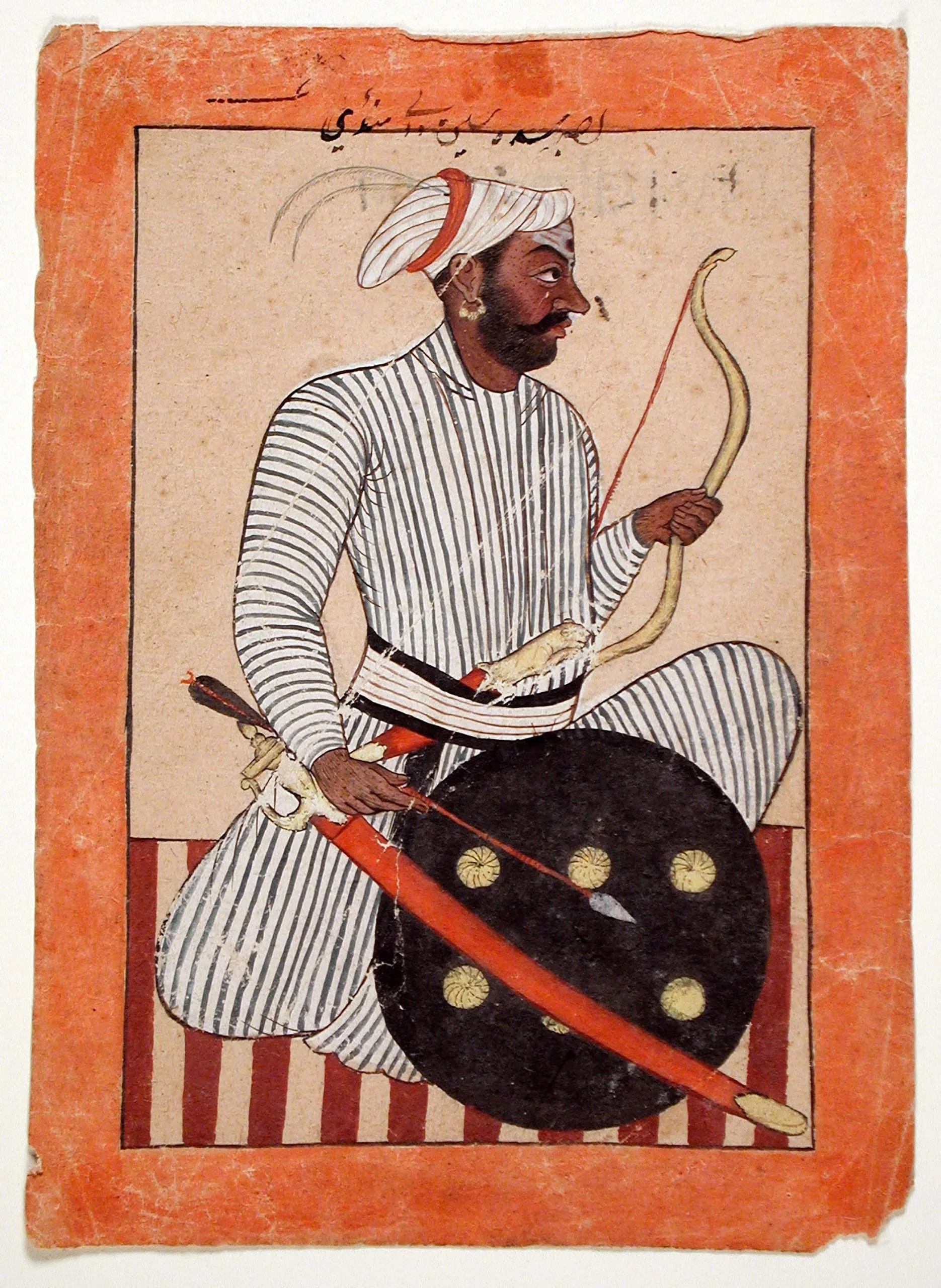
Raja Sidh Sen (r. 1684-1727) was born in 1634. At the age of fifty in 1684 he ascended the throne of the princely state of Mandi in present-day Himachal Pradesh and ruled for forty-three years until his death in 1727. Sidh Sen was noteworthy for his primary devotion to Shiva and commissioned several temples dedicated to Shiva and the Goddess. Many portraits depict him as Shiva incarnate (see M.75.4.25). His legendary stature, over seven feet tall, is affirmed by numerous portraits. He was a great warrior and a deeply religious man who followed tantric practices and was believed to have supernatural powers. His golden amulet (gutka) was said to enable him to fly to the source of the Ganges River each morning for his daily bath.
In this portrait, Sidh Sen has a feather plume in his turban indicating royalty. His sectarian affiliation is indicated by his forehead markings of a third eye in emulation of Shiva’s third eye of wisdom. His face is characteristically pockmarked. Although his conventionalized seated portraits often show him in the unusual pose of holding a sword upright in an ominous manner (see AC1999.1217.10), here his sword and shield are propped against his left leg and he holds a bow and arrow. His distinctive tiger-headed dagger is tucked into his waist sash.
Comparable seated portraits of Sidh Sen are in the Victoria and Albert Museum, London (IS.131-1964), University of Michigan Museum of Art, Ann Arbor (2010/2.26), and National Gallery of Canada, Ottawa (23627).