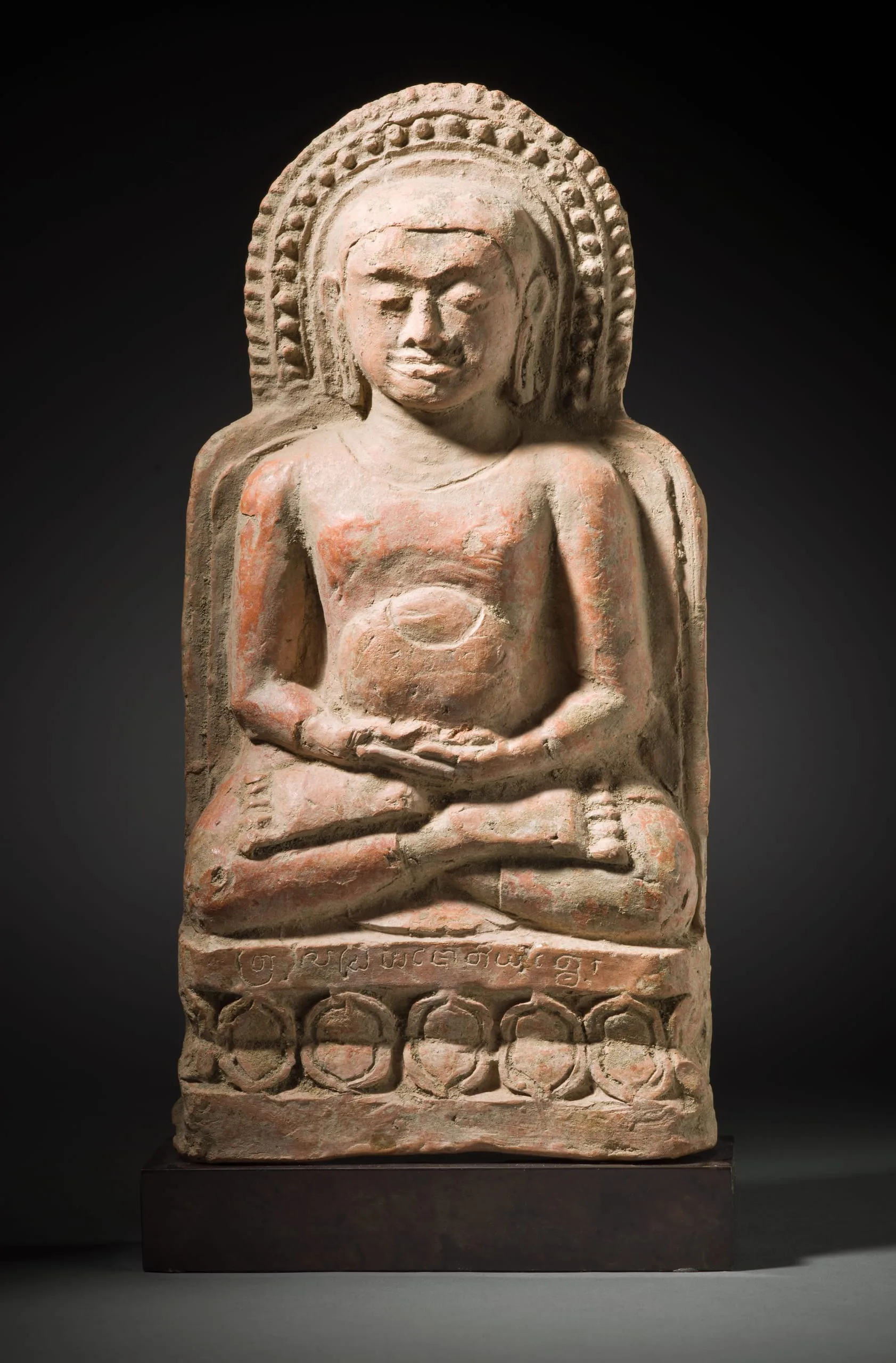
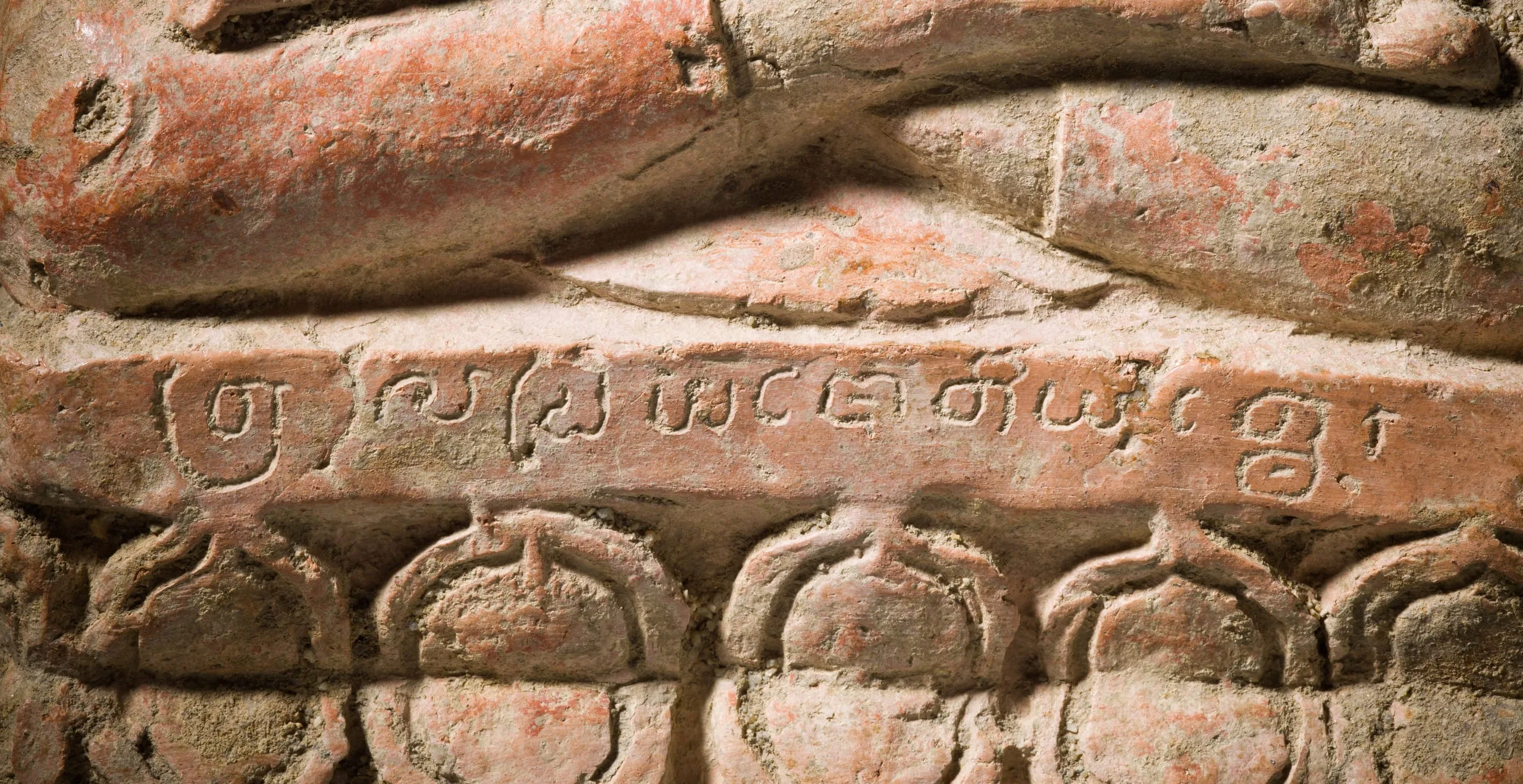
This image of a meditating monk was likely one of a series fashioned from a mold during the Mon-Dvaravati kingdom (7th-13th century) in Thailand. Similar plaques have appeared on the art market in the 1990s and one and a fragment of another are in the Narai National Museum, Lopburi (24/2523 and 23/2523). The plaques in the Narai National Museum are from a site in Saraphi District, Chiang Mai; hence, the LACMA plaque may be from the same vicinity. It has been suggested that the plaques are from a set of eighty close disciples of the Buddha called the "Great Hearers" (
Mahasavaka). The Mon inscription on the lotus base reads, "my Lord Jotiya thera." (Updated translation by Christian Bauer, 1991). The story of Jotiya becoming a monk is related in a 5th-century Pali text, the
Dhammapada Thakatha.
The monk can be distinguished from a Buddha by his shaven head and lack of a cranial protuberance symbolizing his omniscience (ushnisha). He is seated in the meditation posture (dhyana asana) with his legs crossed beneath him and his hands laid on top of one another in his lap (dhyana mudra). He holds a monk’s begging bowl above his hands. Otherwise, the nimbate figure shares the standard iconography for a Buddha, including empty elongated earlobes symbolizing his renunciation of the material world.
See Robert L. Brown, "Buddhist Monk," Southeast Asian Art at LACMA: An Online Scholarly Catalogue (Los Angeles: Los Angeles County Museum of Art, 2013). http://seasian.catalog.lacma.org/#section/331/p-331-1