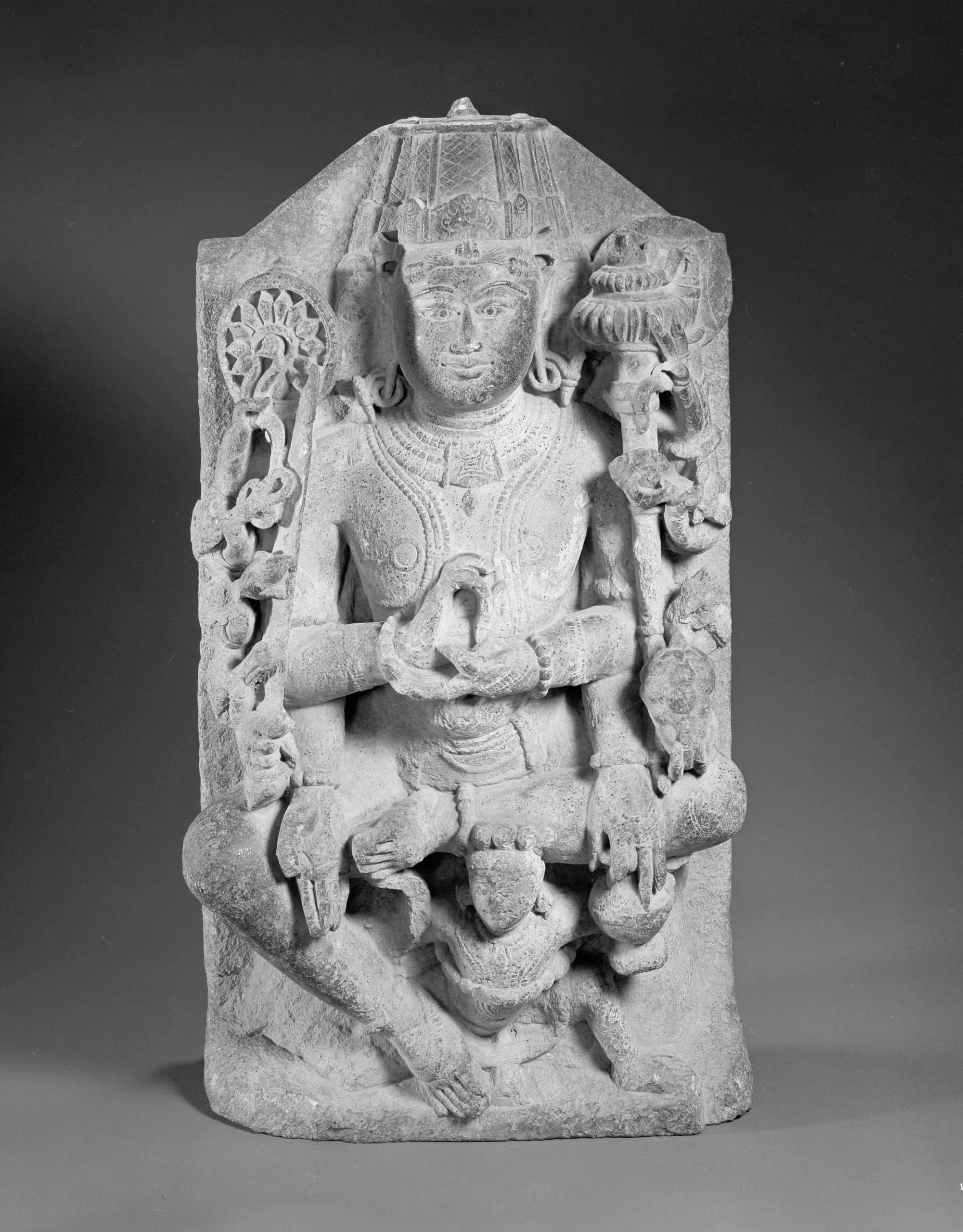
Vishnu, the Hindu god of preservation, can assume many iconological aspects. His supreme manifestation is believed to be the cosmic form known as Vishvarupa (Universal Form). In chapters 10-11 of the Bhagavad Gita (Song of God) dating from the 2nd century BCE, Krishna reveals to Arjuna his omniscient form with innumerable heads and arms that encompassed all the creatures in the infinite universe. In the earliest extant artistic representations of Vishvarupa dating from the Gupta period (late 4th-early 6th century CE), the deity is often shown with four heads: human, demonic, porcine, and leonine. In painted portrayals made during the second millennium, Vishvarupa is typically envisioned with multiple diverse heads and arms.
Here, Vishnu is unusually envisioned with three human heads and a fourth head understood to be at the back. This may represent a western Indian iconographic tradition (Pal 1988, p. 132, no. 56; see also M.2002.216). He wears his tall mitre crown (kirita mukuta) and profuse jewelry. Seated in a relaxed posture (lalita asana) with his right leg pendant, he is being borne aloft by Garuda, his half-avian, half-human mount (vahana). His fourteen hands carry the following attributes: conch, lotus, mace, discus, sword, shield, noose, bow (now broken), arrows, citron, and ascetic’s waterpot, and display the gestures (mudras) of charity (varada), half-exposition (vyakhya), and half-meditation (dhyana).
Comparable traditional representations with multiple diverse heads are in the Metropolitan Museum of Art, New York (1986.506.15) and Government Museum, Mathura (42-43.2989).