LACMA

ShopMembershipMyLACMATickets
LACMA
Los Angeles County Museum of Art
5905 Wilshire Blvd.
Los Angeles, CA 90036
info@lacma.org
(323) 857-6000
Sign up to receive emails
Subscribe
© Museum Associates 2025

Museum Hours

Monday

11 am–6 pm

Tuesday

11 am–6 pm

Wednesday

Closed

Thursday

11 am–6 pm

Friday

11 am–8 pm

Saturday

10 am–7 pm

Sunday

10 am–7 pm


  • About LACMA
  • Jobs
  • Building LACMA
  • Host An Event
  • Unframed
  • Press
  • FAQs
  • Log in to MyLACMA
  • Privacy Policy
© Museum Associates 2025
Collections

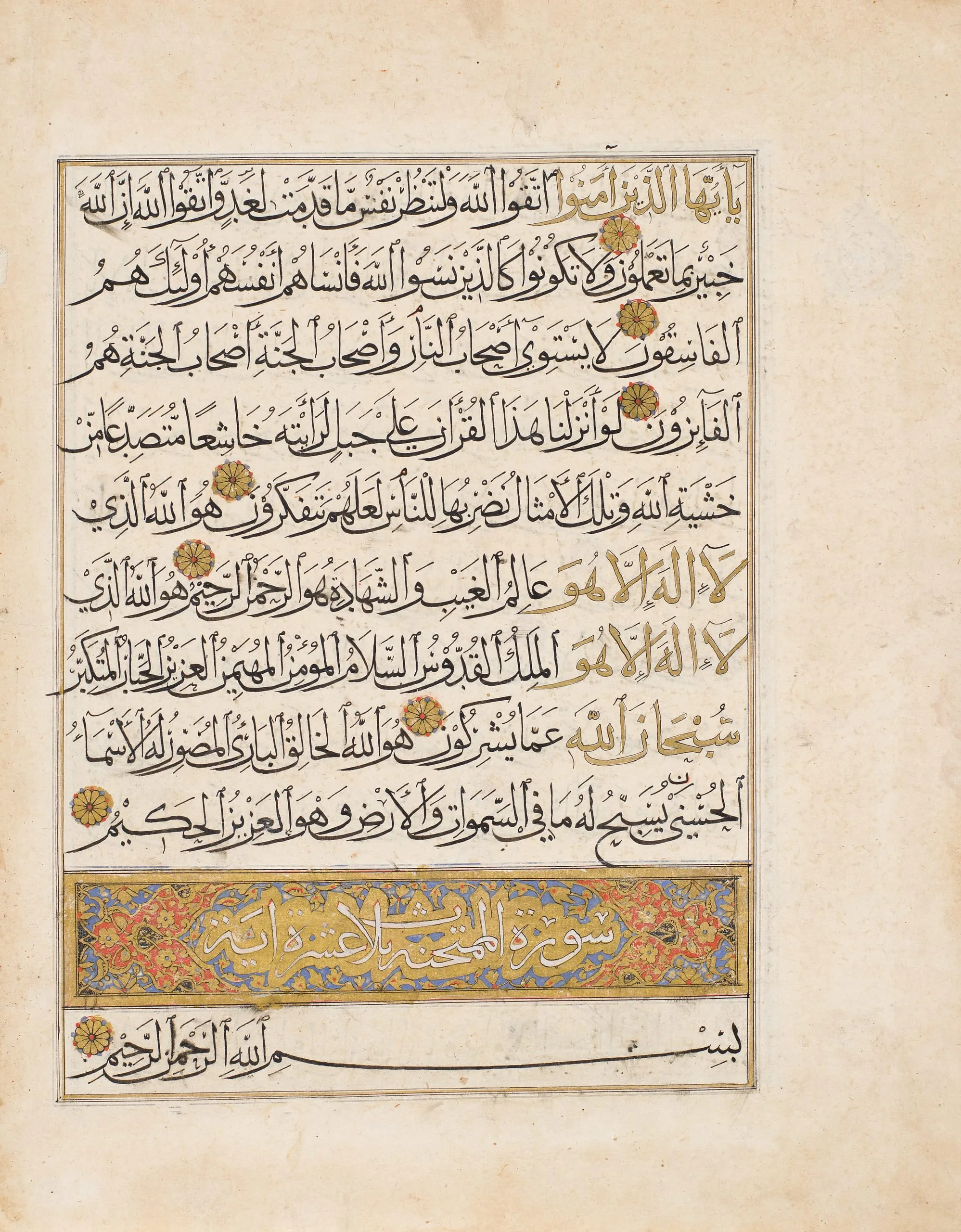
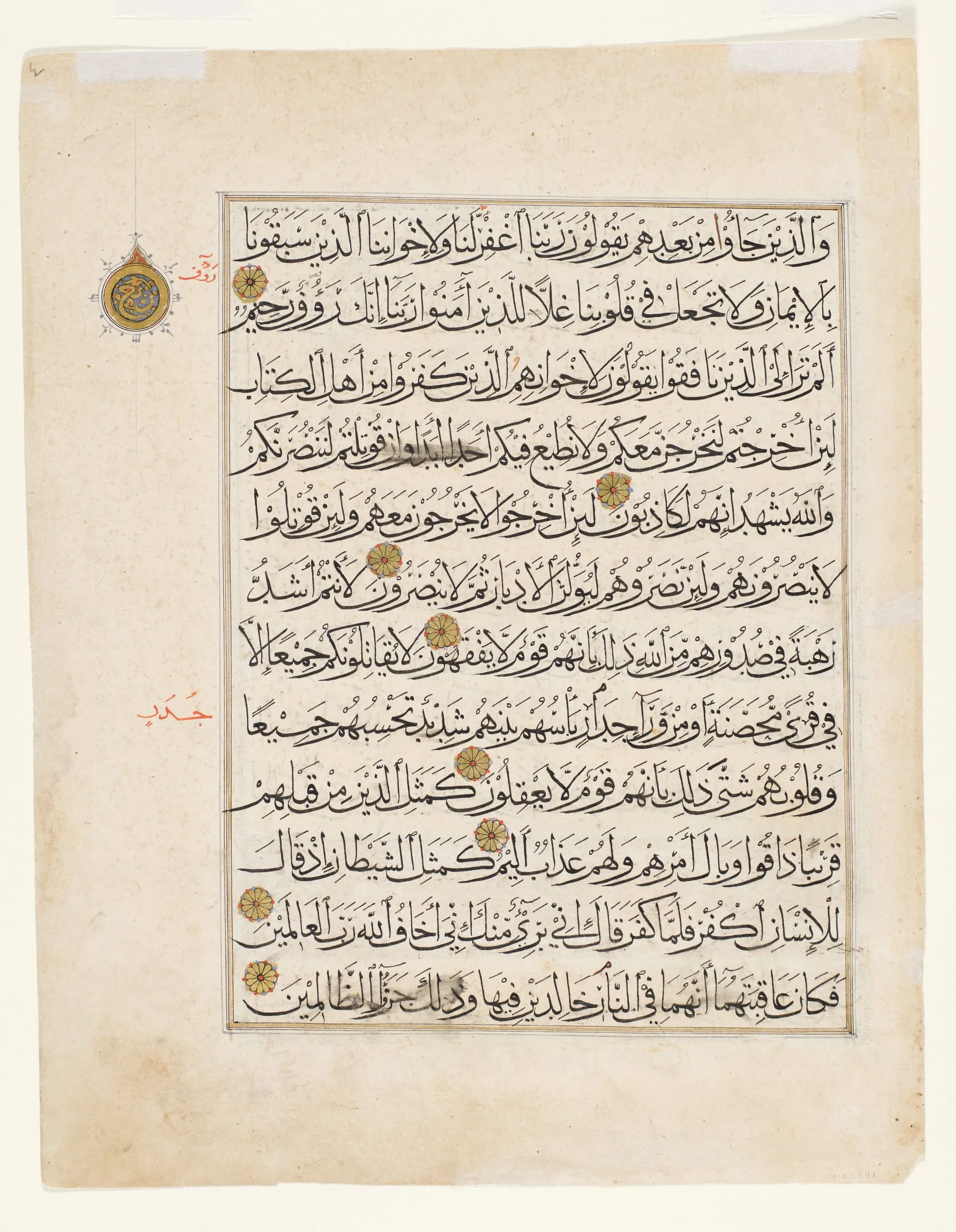
Page from a Manuscript of the Qur'an (59:10-17; 59:18-24, 60:sura heading)14th century

Not on view
Illuminated Quran manuscript page with Arabic calligraphy in black and gold ink, a decorated floral panel in red, blue, and gold near the bottom
Manuscript folio with Arabic calligraphy in black naskh script, arranged in horizontal lines within a ruled border. Gold and blue rosette verse markers punctuate the text, with a small illuminated roundel in gold and blue at the upper left margin.
Title
Page from a Manuscript of the Qur'an (59:10-17; 59:18-24, 60:sura heading)
Place Made
Egypt
Date Made
14th century
Medium
Ink, opaque watercolor, and gold on paper
Dimensions
16 1/8 x 12 1/2 in. (40.96 x 31.75 cm); 12 x 8 7/8 in. (30.48 x 22.54 cm)
Credit Line
Gift of Marion Hammer in memory of Nat Hammer
Accession Number
M.83.249
Classification
Manuscripts
Collecting Area
Art of the Middle East: Islamic
Curatorial Notes

From the tenth to the thirteenth century in most regions of the Islamic world, manuscripts of the Qur’an underwent a series of significant changes that radically transformed their appearance: the use of paper instead of parchment pages, a switch from a horizontal to a vertical format, and the adoption of round cursive scripts, instead of the rectilinear Kufic scripts. A comparison of this page from a fourteenth-century Egyptian Qur’an manuscript with earlier examples (consider https://collections.lacma.org/node/240044">M.73.5.503 and https://collections.lacma.org/node/239663">M.73.5.515), visually documents the major shifts that occurred. The new format continued well into the late Islamic period, and its impact is still felt in Qur’an manuscripts produced today. Also see M.2002.1.354https://collections.lacma.org/node/204536">M.2002.1.354.
Selected Bibliography
  • Lo Terrenal y lo Divino: Arte Islámico siglos VII al XIX Colección del Museo de Arte del Condado de Los Ángeles. Santiago: Centro Cultural La Moneda, 2015.