- Title
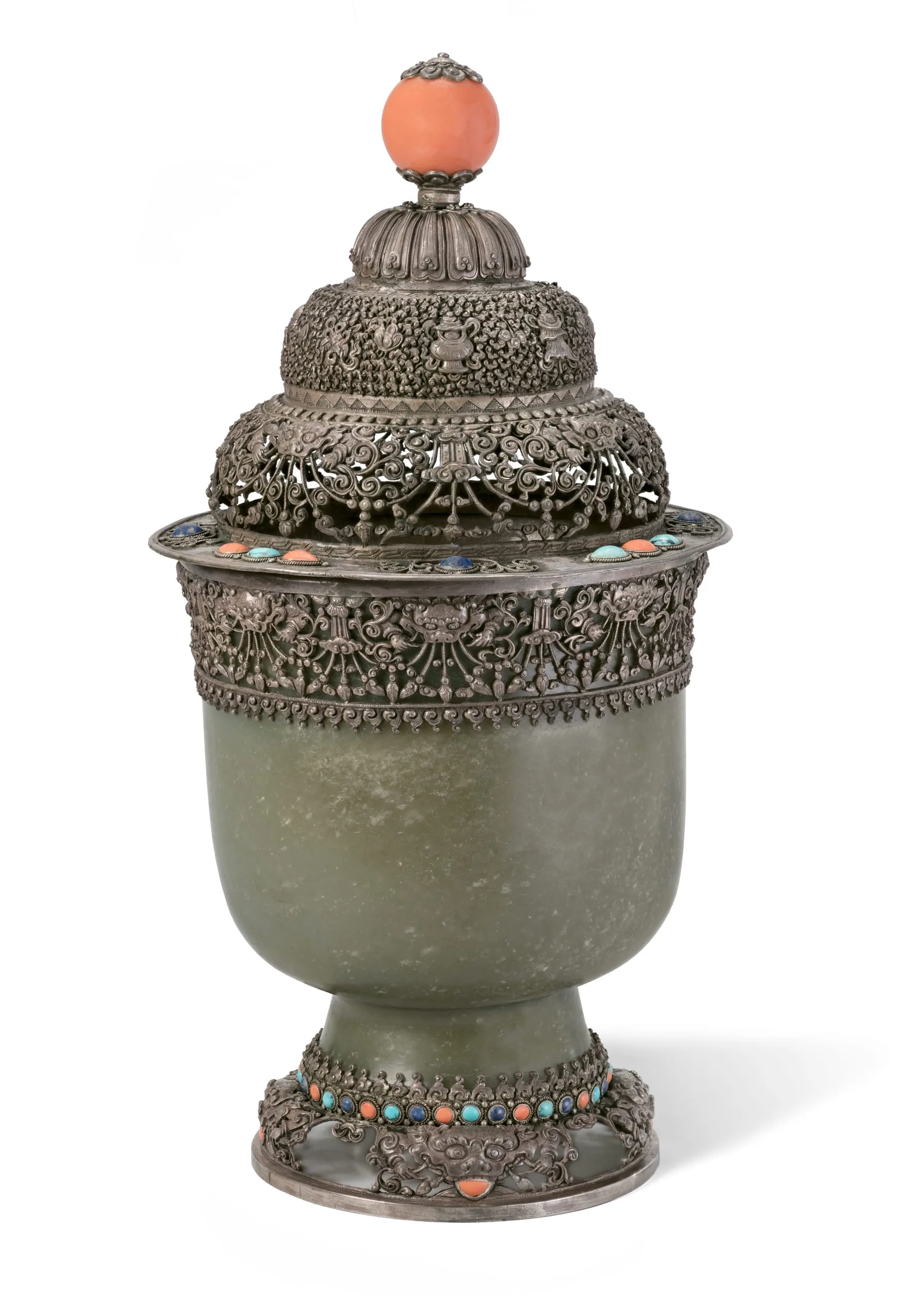
- Ceremonial Urn
- Date Made
- circa 16th century
- Medium
- Mottled greeen nephrite jade with silver fittings inlaid with coral, turquoise, and lapis lazuli; glass finial
- Dimensions
- Urn: 7 1/2 x 6 1/2 in. (19.05 x 16.51 cm); Lid: 5 1/2 x 6 3/4 in. (13.97 x 17.15 cm)
- Accession Number
- M.83.247a-b
- Curatorial Notes
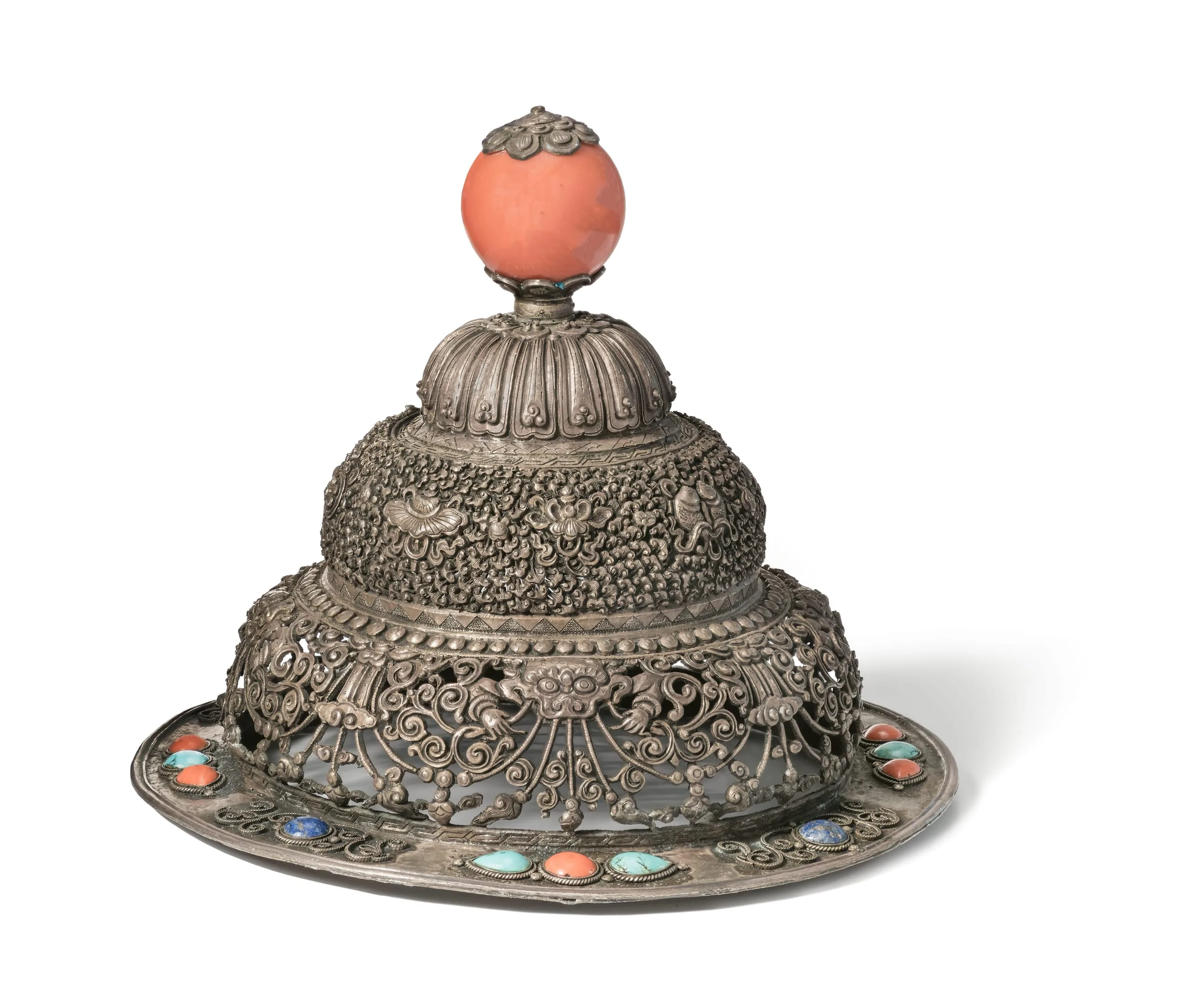
This exceptional Ceremonial Urn was fashioned from a single block of mottled green nephrite jade that was hollowed out to make the body of the urn in the form of a pedestal vase with a splayed foot. It has a silver and pierced silver tiered domed cover with a flat, horizontal rim and pendant bezel, which is a characteristic of Chinese ceramic export ware. The rim is inlaid with triple groupings of coral and turquoise cabochons or petal forms alternating with a single lapis lazuli. The silver dome is surmounted by a glass finial replicating coral with silver lotus petal fittings. The first two tiers are solid while the third tier is openwork. Geometric motifs adorn the dividing bands between tiers. The first tier is in the form of lotus petals. The second tier has a dense floral background interspersed with the Eight Auspicious Symbols (ashta mangala) of Buddhism. The third tier has a pierced scrolling vine adorned with the face of a mythical animal (Chinese: taotie, Tibetan: zipac), which an apotropaic symbol akin to the Indian "Face of Glory" (kirttimukha). The faces alternate with pendant swags. The upper edge of the jade body is embellished with a lace-work collar similar to the third tier designs. The base is a silver and gemstone collar encircling the splayed foot that is set above an open work tier with four mythical animal faces with inlaid coral.
The rituals in which this Ceremonial Urn was used have not been identified. A comparable nephrite ewer from the same or closely related workshop was offered on the London market (https://www.michaelbackmanltd.com/object/tibetan-or-mongolian-ceremonial-nephrite-jade-ewer/).
- Selected Bibliography
- Pal, Pratapaditya. Art of Tibet. Expanded edition. Los Angeles: Los Angeles County Museum of Art, 1990.
- Markel, Stephen. Mughal and Early Modern Metalware from South Asia at LACMA: An Online Scholarly Catalogue. Los Angeles: Los Angeles County Museum of Art, 2020. https://archive.org/details/mughal-metalware (accessed September 7, 2021).
- Little, Stephen, and Tushara Bindu Gude. Realms of the Dharma: Buddhist Art across Asia. Los Angeles: Los Angeles County Museum of Art, 2025.