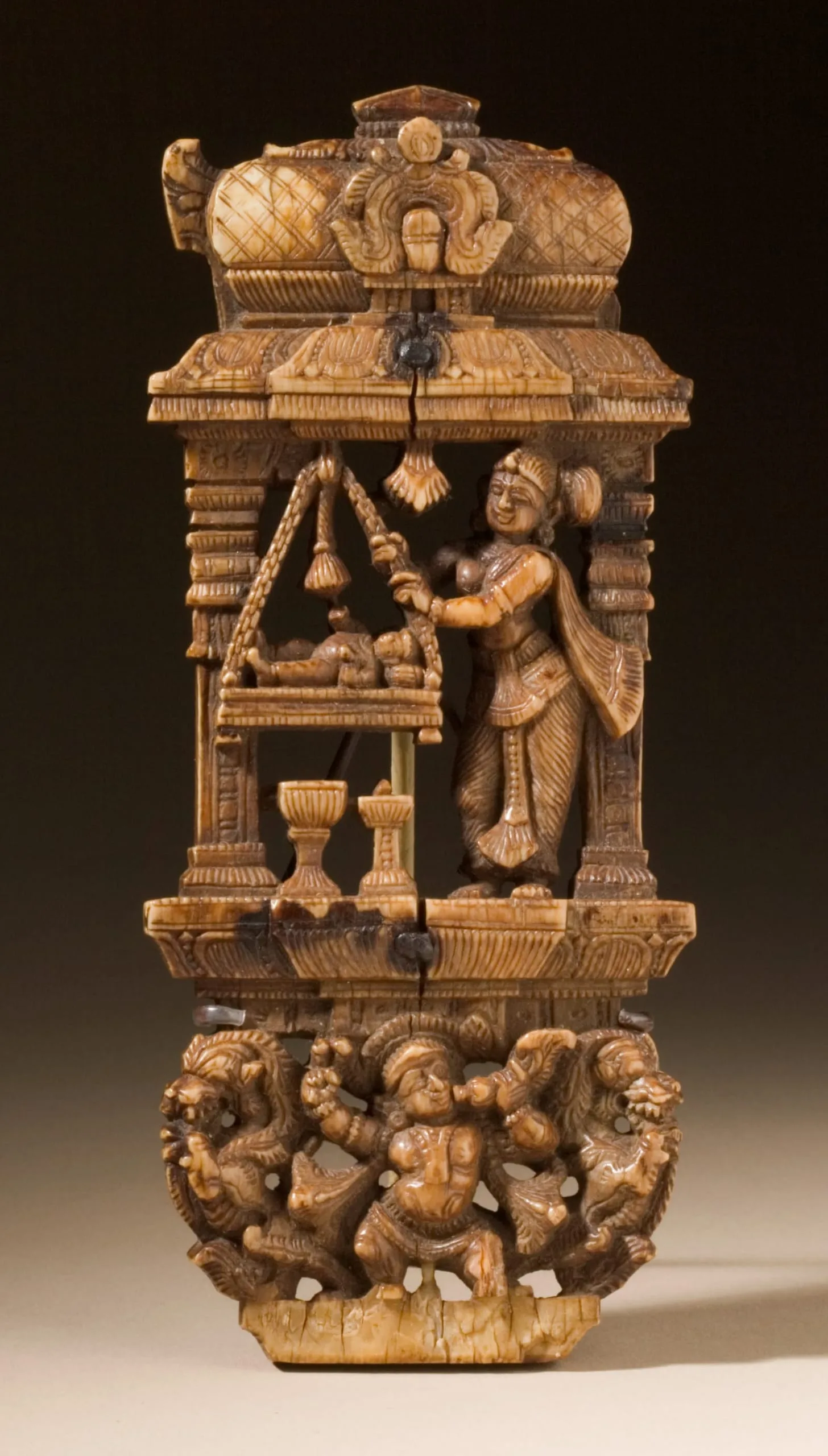
Madurai, the principal capital of the Nāyak Dynasty (1529–1736) in Tamil Nadu, is renowned for its temple and palatial architecture, especially under the reign of the illustrious King Tirumala Nayaka (r. 1623–1659). It was also an important center for the pictorial and decorative arts, particularly painting and ivory carving. In addition to freestanding ivory representations of royal and amorous couples, Hindu deities, and religious personages, sets of ivory plaques carved in low-relief or openwork were used to adorn furniture (principally jewelry boxes and thrones) and palatial portals.
This openwork plaque celebrates the maternal nurturing of baby Krishna by his foster mother Yashoda. She gently rocks him in a swing hung by chains, while the divine infant lies on his back playing with a rope tassel. Two tall offering bowls are prominently displayed beneath the swing. This charming familial scene is set within a Dravidian-style pavilion with a barrel-vaulted roof and a projecting horseshoe-shaped arch above the cornice that encircles a schematically rendered human head. The structure is supported by a dancing cherub flanked by rampant leonine creatures.
Venerating an episode in the legendary life of Krishna, this south Indian vignette evokes the Phul-Dol (Flower Swing) Ceremony in Nathdwara, Rajasthan, in which an image of the crawling baby Krishna holding a ball of butter is placed in a swing and rocked reverentially by devotees.