- Title
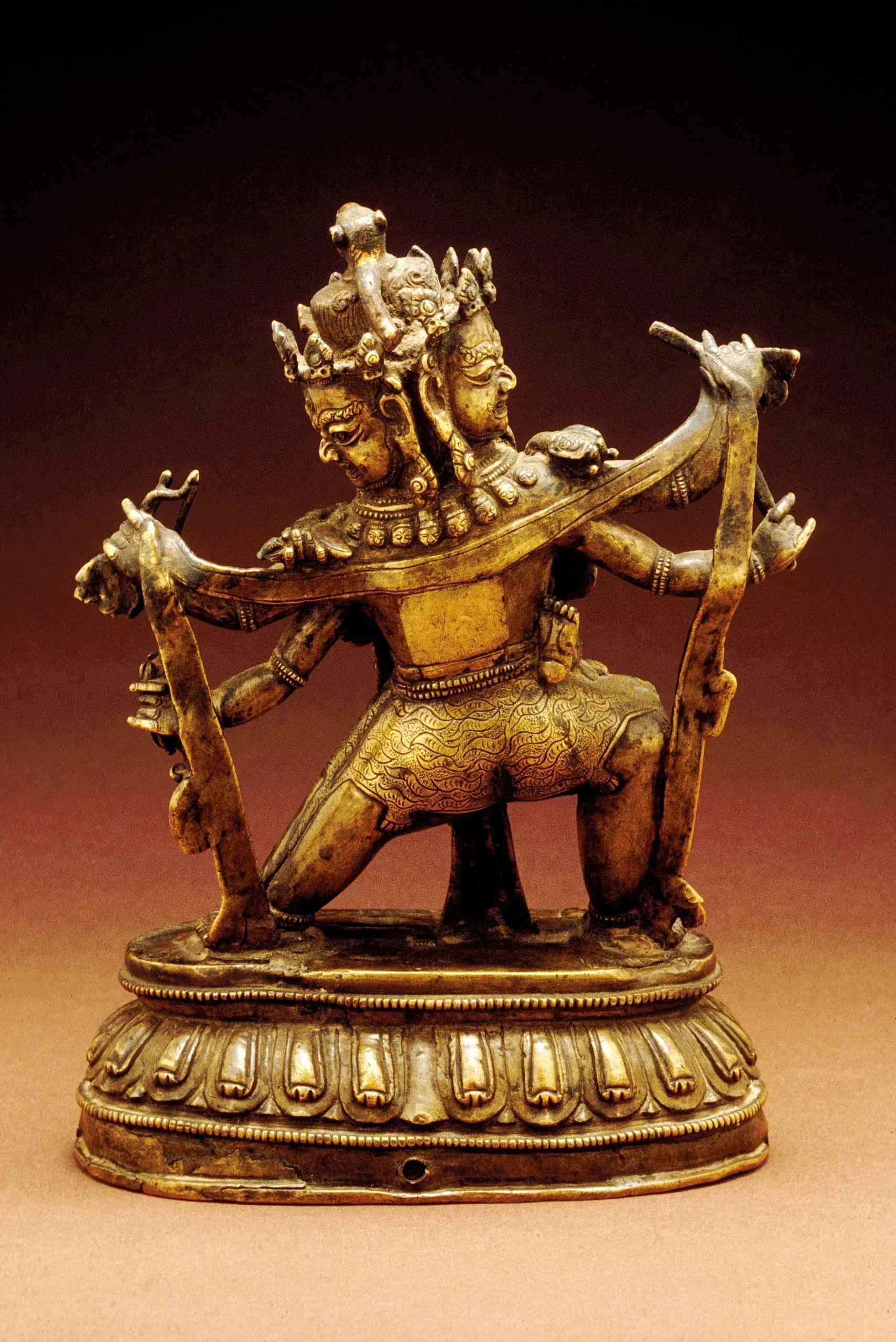
- The Buddhist Deity Hayagriva and his Consort Vajravarahi
- Date Made
- 13th-14th century
- Medium
- Brass inlaid with silver
- Dimensions
- 7 9/16 x 5 7/8 x 3 7/16 in. (19.2 x 14.92 x 8.73 cm)
- Accession Number
- M.83.220.6
- Curatorial Notes
Hayagriva (Horse-Necked One) is a wrathful manifestation of the Bodhisattva Avalokiteshvara in Tibetan Vajrayana Buddhism. Hayagriva removes spiritual hindrances, such as delusion, passion, and ignorance, as well as external negative energies. He is both a Dharmapala (Guardian of the Buddhist Law) and a yidam (meditational deity). Hayagriva has multiple iconographic forms in Vajrayana Buddhism, including the LACMA representation where he is sexually embracing (yab-yum) his female consort Vajravarahi (Adamantine Sow), known in Tibetan as Dorje Pagmo. Regardless of the specific form, Hayagriva’s idiosyncratic identifying feature is one or three diminutive horse heads (ashva mastaka) surmounting his crown.
Here, Hayagriva has three fierce faces and six arms. His two principal arms encircle Vajravarahi and display the gesture of "Making the sound of [the seed syllable (bija)] HUM with the vajra" (vajrahunkara mudra) with the hands crossed and holding a thunderbolt (vajra) in the proper right hand and a bell (ghanta) in the proper left. The mudra symbolizes the inseparability of wisdom (bell) and compassion (thunderbolt). His two uppermost hands stretch an elephant’s hide behind him. His four remaining hands hold the attributes of a bow-and-arrow, two staffs, thunderbolt, and a noose. He wears a garland of severed skulls (mundamala) and a tiger skin (vyaghra ajina) around his waist. Vajravarahi has a diminutive sow’s head on the top of her head. She holds a blood-filled skull cup (kapala) in her left hand and a flaying knife (kartika) in her right hand. They are used respectively to hold the blood symbolic of wisdom's triumph over delusion and to cut through the fog of ignorance. The divine couple is depicted in a militant posture (alidha asana) standing upon two human corpses symbolizing egotistical hindrances.
- Selected Bibliography
- Reedy, Chandra L. Himalayan Bronzes: Technology, Style and Choices. Newark: University of Delaware Press, 1997.
- Pal, Pratapaditya. Art of Tibet. Expanded edition. Los Angeles: Los Angeles County Museum of Art, 1990.