- Title
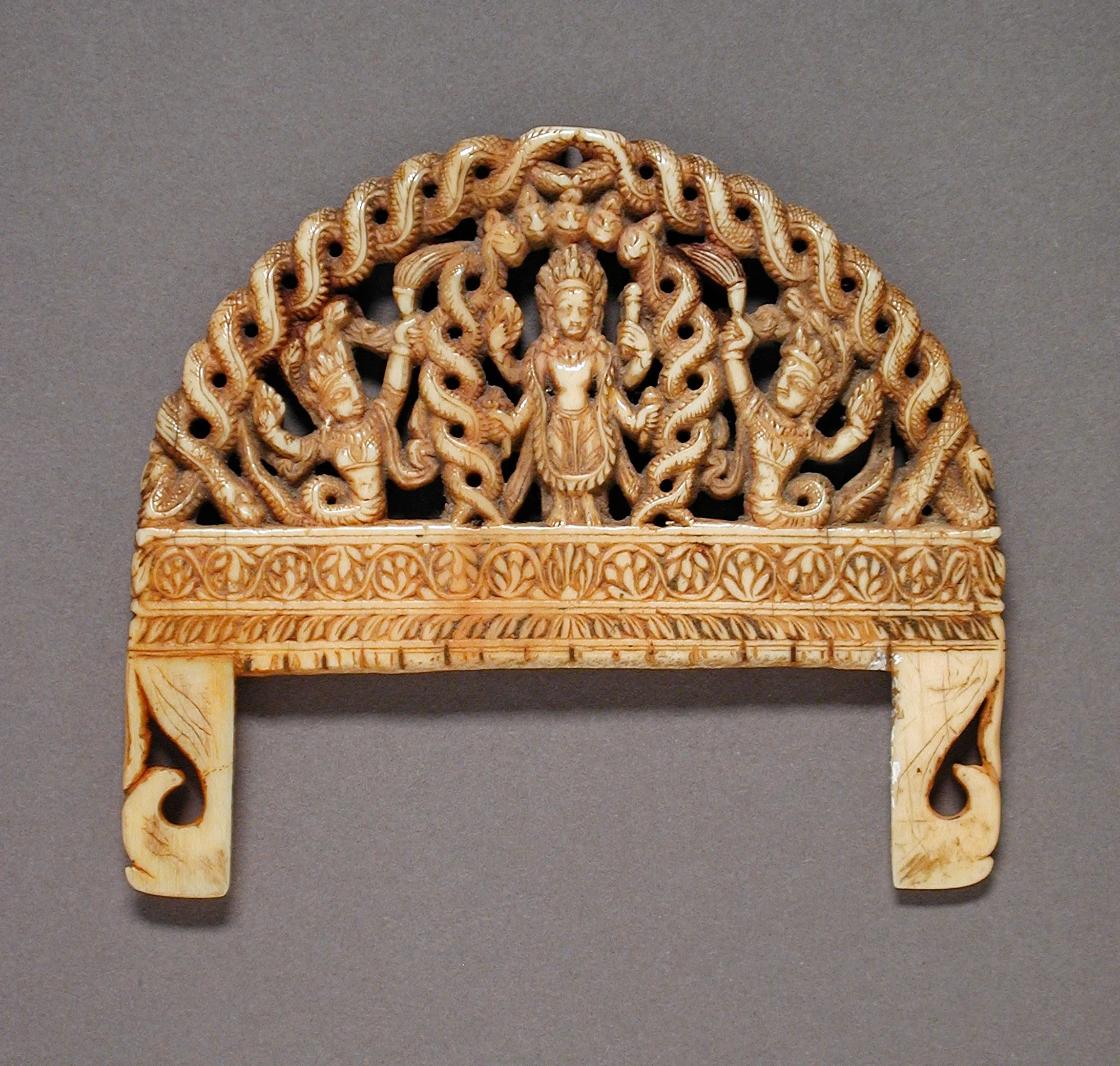
- Comb with Vishnu Adored by Serpent Kings
- Date Made
- circa 1750-1800
- Medium
- Ivory with traces of paint
- Dimensions
- 2 3/4 x 3 1/8 x 1/4 in. (6.99 x 7.94 x .64 cm)
- Accession Number
- M.83.218.1
- Curatorial Notes
The teeth of this originally wide toothed comb have been removed, probably due to breakage. The handle is carved in a hemispheric openwork panel resembling a tympanum (for a contemporaneous Nepalese tympanum, see M.76.48.3). This configuration may have been favored when the comb was used as a hairpin.
The pierced crescentic handle depicts the Hindu god Vishnu crowned and wearing a long forest garland (vana mala). He stands in a stiff, frontal pose (samapada sthanaka) under an aureole (prabhavali) of intertwining multihooded serpents. Vishnu has four arms bearing in his hands his standard attributes of a conch (lower right), discus (upper right), mace (upper left), and a lotus bud (lower left). Flanking him are serpent kings (naga rajas), each wearing a tiara and a coat of mail. They each waive an honorific flywhisk with their hand closest to Vishnu and hold a discus in their far hand. The handle is bordered above by an arch of intertwined serpents and below by two decorative bands. The upper band is a meandering vine with blossoms, while the lower band is lotus petals. The lower side flanges of the comb are in the form of stylized peacocks shown in profile. The back of the comb is carved in an identical design.
See also M.80.232.1. For coeval Mughal and Karnataka ivory combs, see respectively https://www.sothebys.com/en/auctions/ecatalogue/2011/c-welch-part-ii-l11228/lot.102.html and https://www.pinterest.com/pin/652670170978952929/)
- Selected Bibliography
- Pal, Pratapaditya. Art of Nepal. Los Angeles: Los Angeles County Museum of Art; University of California Press, 1985.
- Pal, Pratapaditya. Elephants and Ivories in South Asia. Los Angeles: Los Angeles County Museum of Art, 1981.