The Bhagavata Purana (Ancient Stories of the Lord) is traditionally ascribed to the legendary poet-sage Vyasa in the 8th-10th century CE. It stresses the path of devotion (bhakti) to Krishna, the eighth incarnation of Vishnu, the Hindu God of Preservation. To fulfill his role as the guardian of the world and savior of humanity, Vishnu appears as a succession of heroic animals and semi-mortal saviors, called avatars, through which he intervenes in times of crisis or unrighteousness.
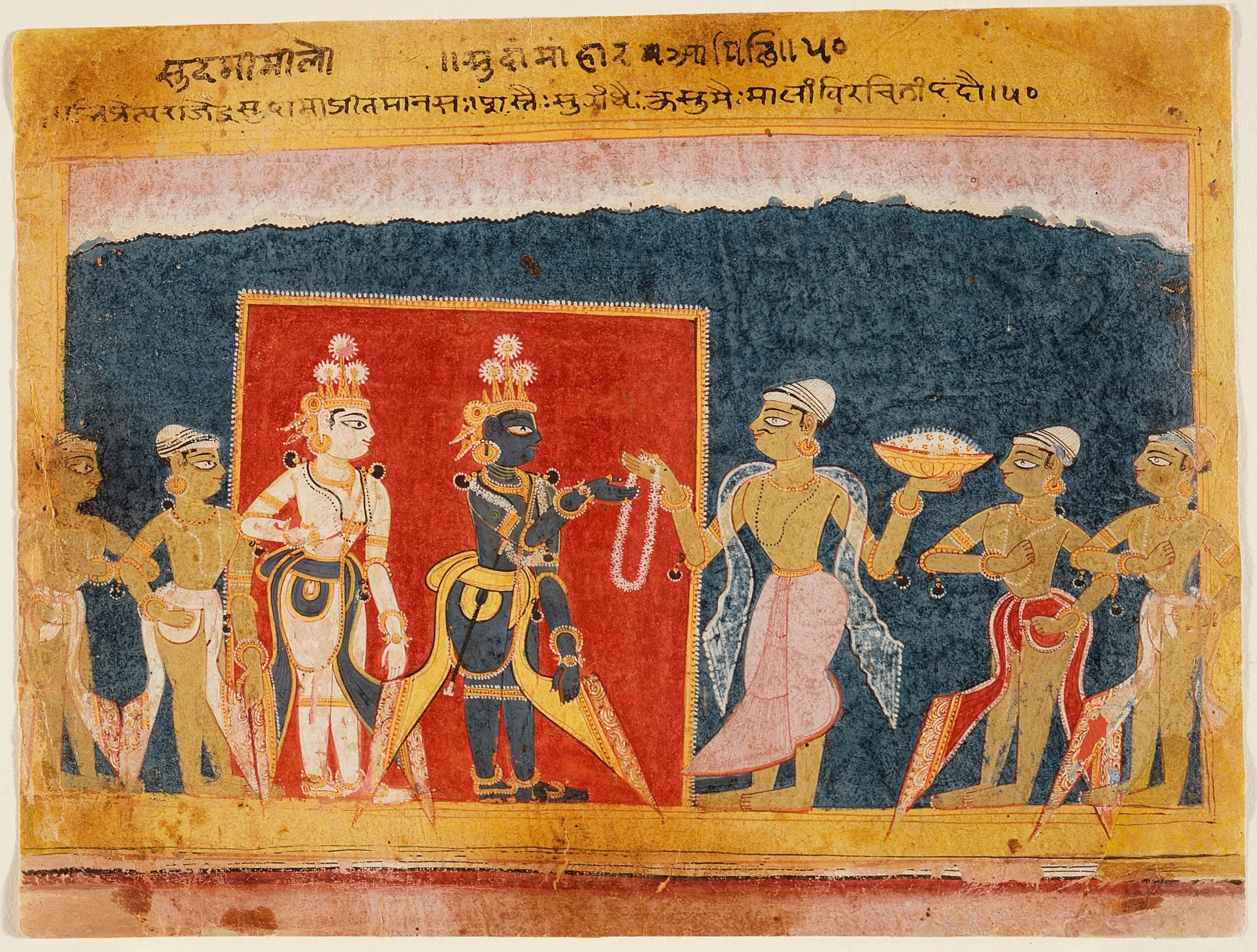
This folio is from the “Isarda” Bhagavata Purana, so named because the now dispersed album of paintings was discovered in the collection of the Isarda thikana, a feudatory subclan of the princely state of Jaipur, Rajasthan. The Sanskrit verse [#50] and identifying captions in the upper border all refer to the garland-maker Sudama. According to the story, when Krishna, Balarama, and their companion cowherders (gopas) entered Mathura they went to the house of Sudama, who honored them with water for ritual ablution, betel nut quids (pan), sandalwood paste, and garlands of fragrant flowers (Bhagavata Purana 10:41:43-52). Here, Krishna and Balarama are highlighted by their red backdrop. Sudama hands Krishna a floral garland from a bowl of fresh garlands.
Additional folios from this series are in the Cleveland Museum of Art (1971.234), Metropolitan Museum of Art, New York (1972.260), and San Diego Museum of Art (1990.585 and 1990.586).