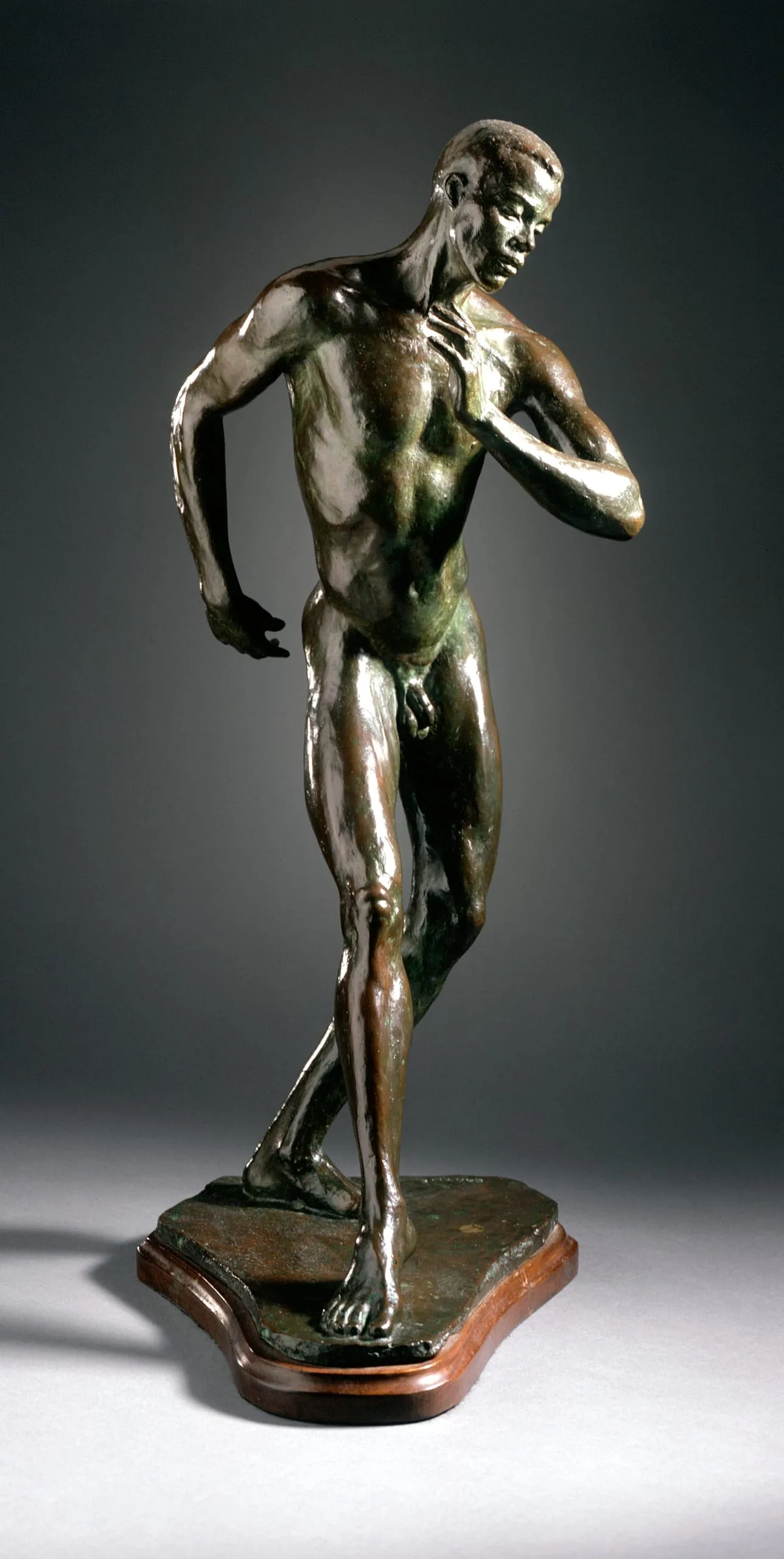
Richmond Barthé’s Inner Music bursts with movement and energy as the subject swings his arms in opposite directions while balancing just the toes of one foot on the ground in front of him. His hip juts out to the left while his head leans in the same direction. The full dynamism of the figure’s stance emerges only after viewing the work from several different angles. Barthé, who began modeling in clay while enrolled at the Art Institute of Chicago, later moved to New York City, where he became an active and important figure in the artistic circles of the Harlem Renaissance. Merging classical figuration with aspects of Black life and culture, he was celebrated for his dignified bronze statues of African American dancers, actors, workers, artists, and historical icons—from Josephine Baker and Paul Robeson to Henry Ossawa Tanner and Toussaint L’Ouverture.
The figure in Inner Music displays the lean and naturalistic physique that is characteristic of many of Barthé’s Black nude subjects. Barthé was academically trained and attuned to calls from Alain Locke to draw from African heritage in his art. Here, he incorporates typical Greek and Roman elements like the nude figure in a contrapposto position into the form of a recognizably Black man. An early-career trip to Paris had led him not only to classical sculptures in the Louvre but also to a cabaret where the dancer known as Féral Benga inspired one of the artist’s best-known sculptures with his saber dance. Inner Music, created decades after Féral Benga, similarly suggests sound and motion through the human form. Moreover, by sculpting a strong and beautiful Black male body, Barthé boldly challenged racial and gender conventions of the era.
Selected Bibliography
Fort, Ilene Susan. The Figure in American Sculpture: A Question of Modernity. Los Angeles County Museum of Art in association with University of Washington Press, 1995.
Lemmey, Karen, Tobias Wofford, and Grace Yasumura, et al. The Shape of Power: Stories of Race and American Sculpture. Smithsonian American Art Museum in association with Princeton University Press, 2024.
Lewis, Samella S. Barthé, His Life in Art. Unity Works, 2009. http://archive.org/details/barthehislifeina0000lewi.
Vendryes, Margaret Rose. Barthé: A Life in Sculpture. University Press of Mississippi, 2008.
Selected Exhibition History
NOT I: Throwing Voices (1500 BCE−2020 CE), LACMA, November 8, 2020–July 25, 2021.
Black American Portraits, LACMA, November 7, 2021−April 17, 2022.