LACMA

ShopMembershipMyLACMATickets
LACMA
Los Angeles County Museum of Art
5905 Wilshire Blvd.
Los Angeles, CA 90036
info@lacma.org
(323) 857-6000
Sign up to receive emails
Subscribe
© Museum Associates 2025
  • About LACMA
  • Jobs
  • Building LACMA
  • Host An Event
  • Unframed
  • Press
  • FAQs
  • Log in to MyLACMA
  • Privacy Policy
© Museum Associates 2025
Collections

Millard Sheets
Angel's Flight1931

On view:
Geffen Galleries, Labor and Leisure in the American Metropolis
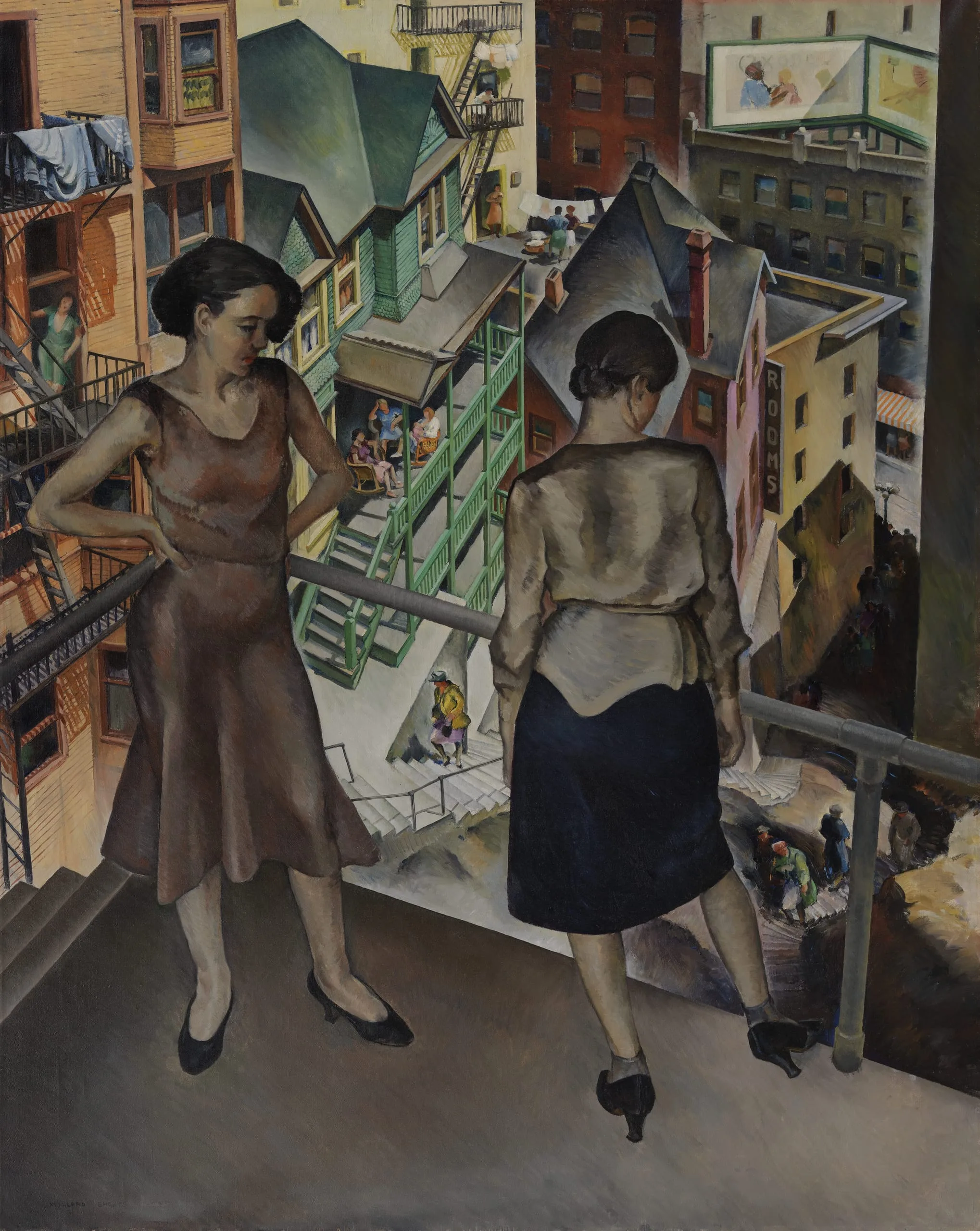
Oil painting of two women on an elevated urban balcony, seen from behind and in profile, overlooking a dense cityscape with fire escapes, rooftops, and small figures below
Artist or Maker
Millard Sheets
United States, California, Claremont, 1907-1989
Title
Angel's Flight
Place Made
United States
Date Made
1931
Medium
Oil on canvas
Dimensions
Canvas: 50 1/4 × 40 in. (127.64 × 101.6 cm) Framed: 56 3/4 × 46 3/4 × 3 in. (144.15 × 118.75 × 7.62 cm)
Credit Line
Gift of Mrs. L. M. Maitland
Accession Number
32.17
Classification
Paintings
Collecting Area
American Art
Curatorial Notes

At the beginning of his career, early in the 1930s, Millard Sheets created several urban views of Los Angeles like Angel’s Flight and Tenement Flats (1928, National Museum of American Art, Smithsonian Institution, Washington, D.C.). While Sheets may have been encouraged to create such cityscapes by his early teacher, Theodore Modra (1873-1930), a disciple of Robert Henri, he was probably inspired just as much by the American Scene painting popular during the Great Depression.

In Tenement Flats and Spring Street, Los Angeles, (1930, estate of the artist), Sheets presented the traditional view of city structures from ground level, possibly prompted by the example of the well-known Cliff Dwellers by George Bellows, (1913, LACMA; q.v.), which had been on view in the Los Angeles Museum since 1916. As noted by contemporary critics, however, Sheets proved more inventive with Angel’s Flight: he viewed the Los Angeles neighborhood from high on a hill. This unusual vantage point must have seemed logical though, given the unusually steep terrain of the area depicted, which is now known as Bunker Hill. A friend of Sheets’s who also painted the Los Angeles scene, Paul Sample (born 1896), was fascinated with unusual viewpoints.

The title of the painting, Angel’s Flight, refers to the now dismantled electric cable railway that was built in 1901 to carry pedestrians on Third Street up the steep hill from Hill Street to Olive, on the top of Bunker Hill. The funicular was built south of a road tunnel. At the same time a pedestrian stairway of 123 steps and ten ramps was constructed on the north side to give those who could not afford the railway free access to the top of Bunker Hill. On the crest of the hill a tall observation tower, known as Angel’s View, was constructed. The young women in the painting -- the model for both of whom was the artist’s wife, Mary -- may be standing on either the observation tower or a railway platform on the hilltop. Sheets omitted the famous cable railway and chose to view the scene looking north toward the stairway. He did not depict the stairs as straight, as they actually were, but showed them as meandering up the hill, thereby exaggerating the sense of height.

Each of the buildings has a slightly different perspective vanishing point. Furthermore, the two women placed in the foreground shadow serve as repoussoir elements, introducing the viewer to the scene below, and as a contrast to the brilliantly sunlit hill below, which further exaggerates the perspective. The prominence of the figures in the foreground and the effect of the unusual viewpoint are quite baroque, a quality seen in the paintings of Thomas Hart Benson and other regionalist artists.

Sheets’s palette is bright and varied, with the apartment buildings and boarding houses painted in vivid orange, red, yellow, and green. The color, combined with the perspective and contrasting light and dark areas, gives the painting a distinctively dynamic quality. Despite its Social Realist subject, Angel’s Flight was a precursor to Sheets’s brighter, more decorative postwar compositions. Sheets painted Angel’s Flight expressly for the 1931 Carnegie International Exhibition in Pittsburgh, the first major international show in which he was invited to participate. In 1932, the painting won a prize for the "most representative work" at the annual exhibition held at the Los Angeles Museum and was subsequently purchased for the museum.
Selected Bibliography
  • Millard Sheets in Retrospect, 1929 to 1950. Pasadena, Calif.: Pasadena Art Institute, 1950.
  • Millard Sheets: Tenth Anniversary Exhibition, 1929-1939, April 29-May 15. Los Angeles: Dalzell Hatfield Galleries, 1939.
  • Los Angeles County Museum of Art. New York: Thames and Hudson, 2003.
  • Fort, Ilene Susan and Michael Quick. American Art: a Catalogue of the Los Angeles County Museum of Art Collection. Los Angeles: Los Angeles County Museum of Art, 1991.
  • Barron, Stephanie, S. Bernstein and I. S. Fort, with essays by Stephanie Barron, Sherri Bernstein, M. Dear, Howard N. Fox and Richard Rodriguez. Made in California: Art, Image, and Identity, 1900-2000. Los Angeles: Los Angeles County Museum of Art and Berkeley: University of California Press, Berkeley, 2000.

  • Moure, Nancy Dustin Wall. Painting and Sculpture in Los Angeles, 1900-1945. Los Angeles: Los Angeles County Museum of Art, 1980.
  • LACMA: Obras Maestras 1750-1950: Pintura Estadounidense Del Museo De Arte Del Condado De Los Angeles. Mexico, D.F.: Museo Nacional de Arte, 2006.
  • McClelland, Gordon T. Millard Sheets: the early years (1926-1944). Newport Beach, Calif.: California Regionalist Art, Information Center, 2010.
  • Painting and Sculpture in California: the Modern Era. San Francisco: San Francisco Museum of Modern Art, 1977.
  • Arenson, Adam. Banking on Beauty: Millard Sheets and Midcentury Commercial Architecture in California. Austin: University of Texas Press, 2018.
  • Los Angeles County Museum of Art. Transformation: the LACMA Campaign. Los Angeles: Museum Associates, 2008.
Copyright
© Millard Sheets Estate

Related Unframed

Related Unframed

50 Works 50 Weeks: Millard Sheets’s “Angel’s Flight”
  • April 28, 2026
  • Alexander Schneider
Voices from the LACMA Archive
  • May 11, 2020
  • Julia Kim
From the Collection: Angel's Flight
  • June 29, 2015
  • Linda Theung
This Weekend at LACMA
  • November 28, 2014
  • Linda Theung
LACMA Everywhere | Art Everywhere US
  • August 5, 2014
  • Linda Theung
A Painting for My Los Angeles
  • January 31, 2013
Sheets and Siqueiros: Los Angeles, 1932
  • October 13, 2010
This Land is Your Land
  • July 1, 2010
Geocaching Angel's Flight
  • November 20, 2008