LACMA

ShopMembershipMyLACMATickets
LACMA
Los Angeles County Museum of Art
5905 Wilshire Blvd.
Los Angeles, CA 90036
info@lacma.org
(323) 857-6000
Sign up to receive emails
Subscribe
© Museum Associates 2026
  • About LACMA
  • Jobs
  • Building LACMA
  • Host An Event
  • Unframed
  • Press
  • FAQs
  • Log in to MyLACMA
  • Privacy Policy
© Museum Associates 2026
Collections

Bartolomé Estebán Murillo
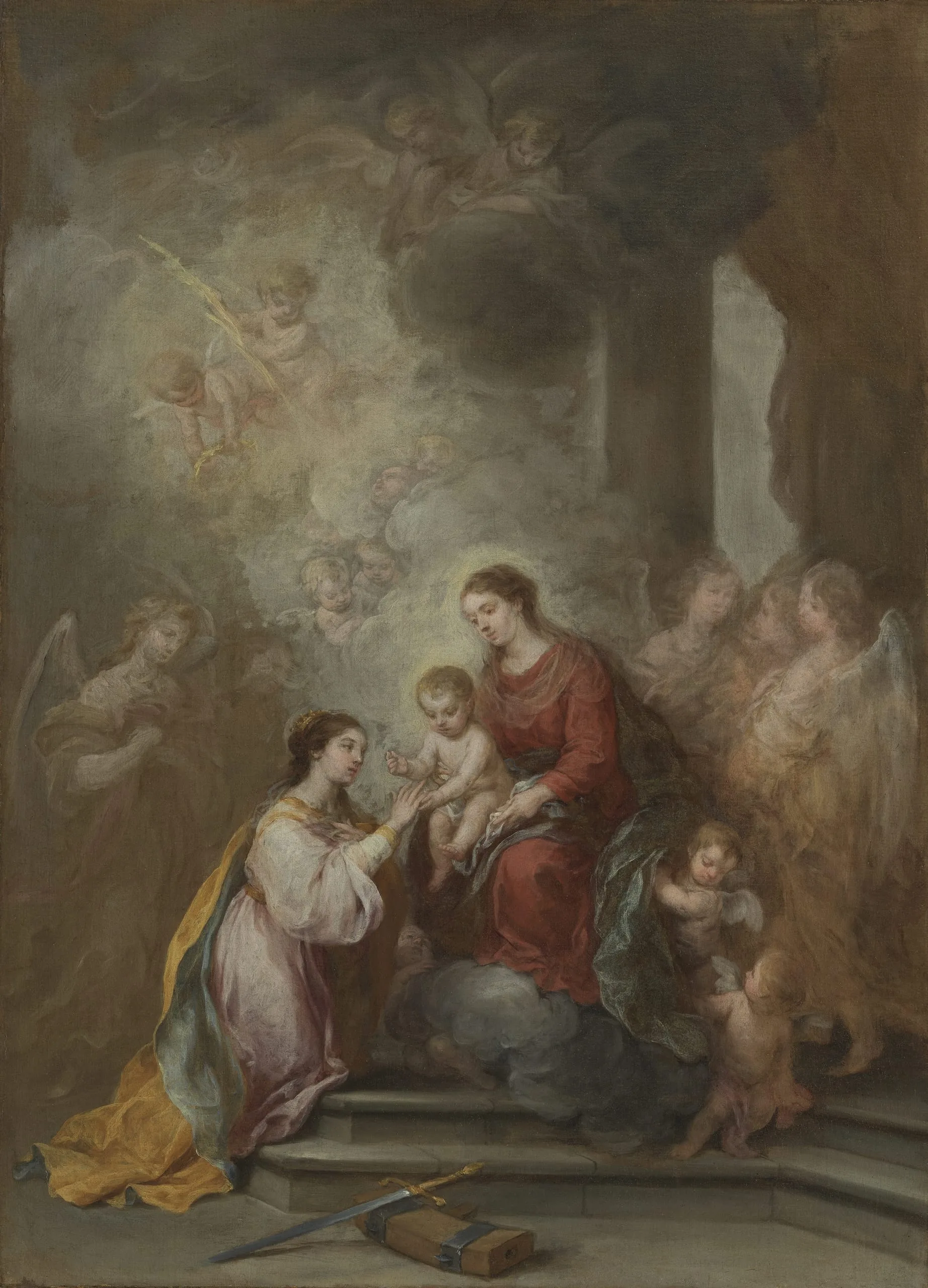
The Mystic Marriage of Saint Catherine1680-1682

On view:
Geffen Galleries, floor 2
Oil painting of a seated woman in red holding an infant toward a kneeling woman in pink and gold, surrounded by cherubs and angels in a hazy architectural setting

Bartolomé Estebán Murillo, The Mystic Marriage of Saint Catherine, 1680-1682, Los Angeles County Museum of Art, Gift of The Ahmanson Foundation, photo © Museum Associates/LACMA

Artist or Maker
Bartolomé Estebán Murillo
Spain, Seville, 1618-1682
Title
The Mystic Marriage of Saint Catherine
Date Made
1680-1682
Medium
Oil on canvas
Dimensions
Canvas: 28 × 20 1/2 in. (71.12 × 52.07 cm) Framed: 34 × 26 × 4 in. (86.36 × 66.04 × 10.16 cm)
Credit Line
Gift of The Ahmanson Foundation
Accession Number
M.83.168
Classification
Paintings
Collecting Area
European Painting and Sculpture
Curatorial Notes

This delicate oil sketch by Bartolomé Estebán Murillo served as the second preparatory stage for the central image of his grand altarpiece, The Mystic Marriage of Saint Catherine, in the Capuchin Abbey Church of Cádiz, Spain. Saint Catherine of Alexandria was a learned early Christian martyr who, according to legend, experienced a miraculous “mystical marriage” in which the Christ Child placed a ring on her finger as a sign of their spiritual union. Murillo depicts this intimate vision at the heart of the altarpiece: the Virgin Mary gently supports the Christ Child, who leans forward to offer the ring to the kneeling saint, while attendant angels and soft clouds underscore the heavenly character of the encounter. Symbols of Catherine’s later martyrdom—a sword and a fragment of the spiked wheel upon which she was tortured—anchor the ethereal scene. Typical of the relationship between sketch and finished altarpiece, the freely brushed composition conveys a spontaneity and intimacy absent from the more formal completed canvas.

The Capuchin high altarpiece, a lavish multipanel retable with richly carved and gilded frames, became Murillo’s final major undertaking. While working on another project in Cádiz in early 1682, Murillo suffered a fall from scaffolding that caused injuries leading to his death a few months later. Although he prepared the overall design and began the principal panel of The Mystic Marriage, its execution was completed by his pupil Francisco Meneses Osorio, who followed the master’s conception closely, altering only minor details such as the gestures of attendant angels and the articulation of the architectural setting. Murillo’s oil sketches occupy a special place within his oeuvre. They reveal the artist’s process of exploring iconography and composition while standing as independent works prized by later collectors.

Murillo spent nearly his entire career in Seville, a city that in the seventeenth century was still a major Spanish port and a lively artistic center. Unlike many of his Spanish contemporaries—Velázquez most famously—Murillo never undertook the formative trip to Italy that was a rite of passage for many European painters. Archival records place him briefly in Madrid in the mid-1640s, where he could have studied works by Titian, Rubens, and Van Dyck in the royal collection, but there is no evidence of extended travel beyond Spain. Because Murillo never forged personal ties in Italy, his relationship to the broader Baroque is best understood as one of dialogue at a distance, through the study of works in Madrid and prints that circulated widely. He filtered the period’s dominant trends—Caravaggesque chiaroscuro, Venetian colorism, and the graceful classicism of the Bolognese school—through the devotional and civic needs of Seville.

Provenance

Marqués de la Cañada,(1) El Puerto de Santa Maria (Cádiz). Sebastián Martinez (1747–1800), Cádiz, by 1785, sold to;(2) Manuel de Leyra, Cádiz, sold to;(3) Captain Edward Davies, London, by 1812(4) (sale, London, Christie’s, 25–26 Apr. 1817, lot 27, “Murillo, Marriage of St. Catherine, spirited and elegant sketch for a larger picture,” sold for £7 to); Major William de Blaquiere (b. 1778), London.(5) Otto Bernel, the Netherlands. W. Hekking, the Netherlands.(6) Irving M. Scott (1837–1903), San Francisco (sale, New York, American Art Galleries, 6 Feb. 1906, lot 31, bought in [by heirs]), by descent to; Scott heirs (sale, New York, Sotheby’s, 20 Jan. 1983, lot 86, sold to); [P. & D. Colnaghi & Co., Ltd., London, sold 1983 to]; LACMA.

Footnotes

(1) Glendinning and Macartney 2010, p. 46, identifies him as Guillermo Tirry (aka Terry; 1726–1763), 3rd marqués de la Cañada, noting that Richard Twiss had seen the painting with him during his travels in Portugal and Spain in 1772 and 1773. By that time, however, Guillermo Tirry was dead. The paint-ing was probably then the property of his son José Tirry, 4th marqués de la Cañada (d. 1824), who inherited the title in 1779.

(2) De la Cruz y Bahamonde 1813, vol. 13, p. 342 n. 1, states that following Martínez’s death, the collection was divided between Casado de Torres, and D. Francisco Viola, who sold it to the English.

(3) Davies 1819, p. 94: “I possessed the Barocillo of this picture. I had seen it in Spain, where, with three others, viz. the study of Santa Catalina, the small San Juan de Dios, and a small San Sebastian, were in the collection of Don Manuel de Leyra, at Cadiz, who had obtained them out of the collection of Don Sebastian Martinez.”

(4) According to Burton Fredericksen, former director, Getty Provenance Index (letter dated 27 January 1992 to Philip Conisbee, Murillo object file, Department of European Painting and Sculpture, LACMA), “Davies imported a number of Spanish paintings into England around 1812. This group, which included some works by Murillo, was put up for auction with Robins on 20 April 1812. (Davies’ name does not appear on the catalogue, but lots 12–47 at least are certainly his.) The results are not known, but evidently most were bought in since they reappeared at Christie’s on 26 April 1817. At the latter sale they were consigned by ‘Major Davis’ who is presumably the same person.” Major Davies was actually the son of Captain Davies.

(5) Probably William de Blaquiere (b. 1778), major general in army F.R. and S.A., second son of John Blaquiere (1732–1812), 1st Baron de Blaquiere, Ireland.

(6) Probably Willem Hekking II (1825–1904), who was a painter, draftsman, pen artist, watercolorist, and lithographer, active in Amsterdam.
Selected Bibliography
  • Stratton, Suzanne, et al. Bartolomé Esteban Murillo (1617-1682): Paintings From American Collections. Fort Worth, TX: Kimbell Art Museum, 2002.
  • Conisbee, Philip et al. The Ahmanson Gifts: European Masterpieces in the Collection of the Los Angeles County Museum of Art. Los Angeles: Los Angeles County Museum of Art, 1991.


  • Schaefer, Scott, and Peter Fusco. European Painting and Sculpture in the Los Angeles County Museum of Art: an Illustrated Summary Catalogue. Los Angeles: Los Angeles County Museum of Art, 1987.
  • Valdivieso, Enrique. Murillo: Catálogo Razonado de Pinturas. Madrid: Ediciones El Viso, 2010.
  • Navarrete Prieto, Benito. Murillo y las Metáforas de la Imagen. Madrid: Cátedra, 2018.
  • Lehmbeck, Leah, editor. Gifts of European Art from The Ahmanson Foundation. Vol. 3, Dutch Painting, Flemish Painting, Spanish Painting and Sculpture. Los Angeles: Los Angeles County Museum of Art, 2019.

Related Unframed

Related Unframed

50 Works 50 Weeks: Bartolomé Estebán Murillo’s “The Mystic Marriage of Saint Catherine”
  • September 3, 2025
  • Editors
Bartolomé Esteban Murillo’s Final Painting: The Mystic Marriage of Saint Catherine
  • April 3, 2017
  • Ellen Dooley