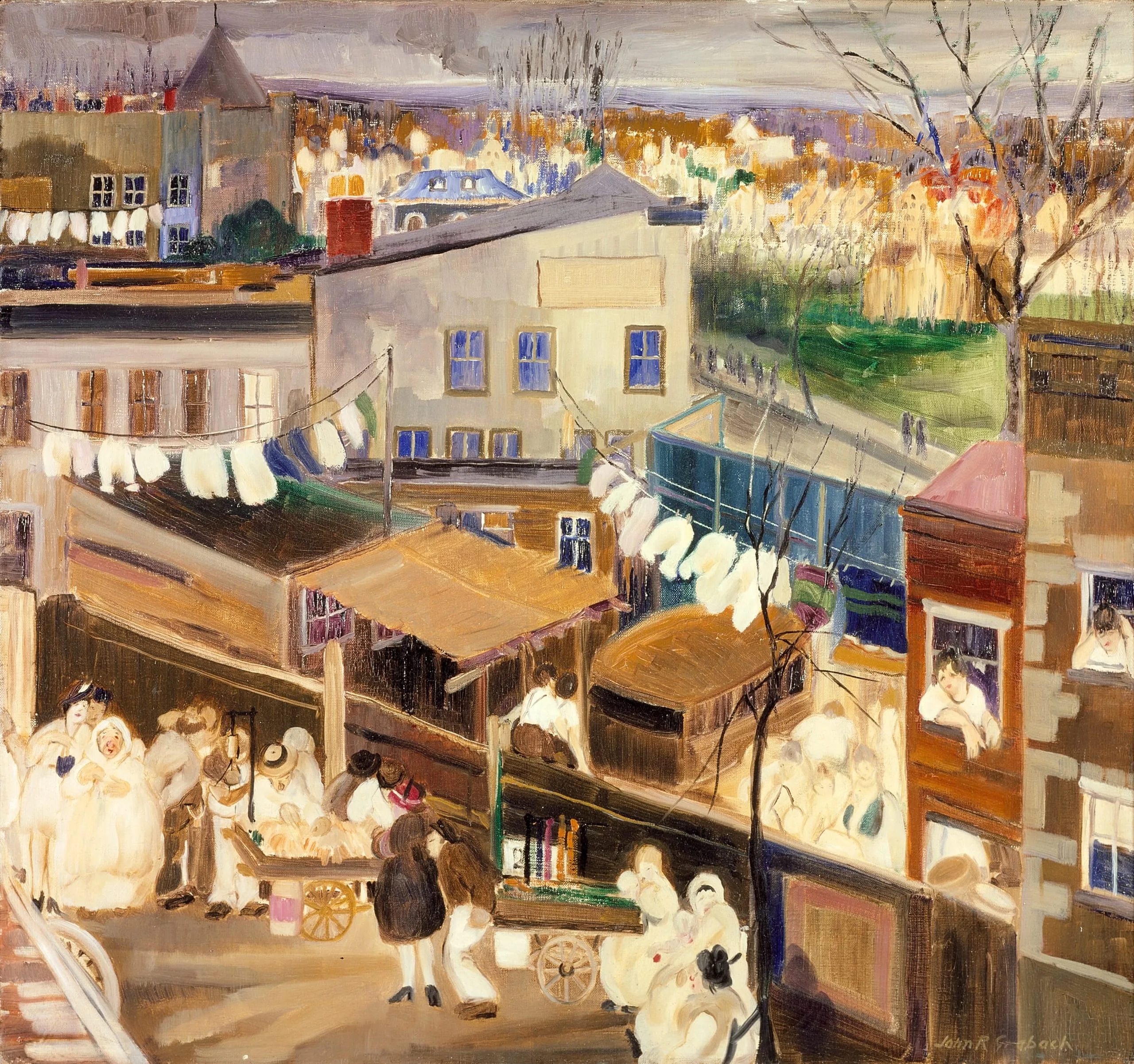
During World War I, when he worked as a mapmaker for the federal government, Grabach traveled to New York every day. He was so struck by the visual image of laundry dancing on clotheslines strung between the upper stories of tenement buildings and the activity of the inhabitants crowding the streets of the poor sections of the city that in the early 1920s he created a series devoted to the theme of wash day. Pushcart Vendors is one of the major paintings from the series. Grabach added to the view of clean white laundry fluttering in the wind an array of peddlers selling their wares from portable pushcarts. The locale was identified as New York when it was exhibited in 1924. Grabach was close friends with GEORGE LUKS and acquainted with the urban scenes of the Ash Can painters, and his paintings of lower-class New York neighborhoods were no doubt inspired by their example.
As did the Ash Can artists, Grabach created an image of lower-class city life without an element of dreariness, one characterized by constant activity and energy. A decade separates Grabach’s street scenes from those of the original Ash Can painters, however. Grabach, reflecting his earlier impressionist and postimpressionist concerns, showed a greater interest in the decorative quality of images. Unlike GEORGE BELLOWS in his Cliff Dwellers, 1913 (LACMA; q.v.), Grabach viewed the city from above, from a distance that prevented the artist and now the viewer from becoming immersed in the activity below. This high vantage point also led the artist to flatten the view, to literally pile the alleyways and buildings one on top of another rather than depicting the scene in depth. The two-dimensionality of the scene was further enhanced by the canvas’s high horizon line and almost square format. Grabach utilized formal devices that create the impression of liveliness, and he often incorporated diagonals into his compositions to intensify the sense of movement. In Pushcart Vendors the entire scene is set on an angle, with the wall that separates the buildings from the street functioning as the major diagonal. The wash on the clotheslines forms a counterpoint to the alley and buildings, thereby activating the densely packed scene. Grabach also used a greater variety of colors with less concern for pseudoscientific theory than did Bellows in Cliff Dwellers. Buildings are red, blue, white, and brown, the distant sky lavender, and a patch of grass sparkling green, and these colors flicker across the scene.