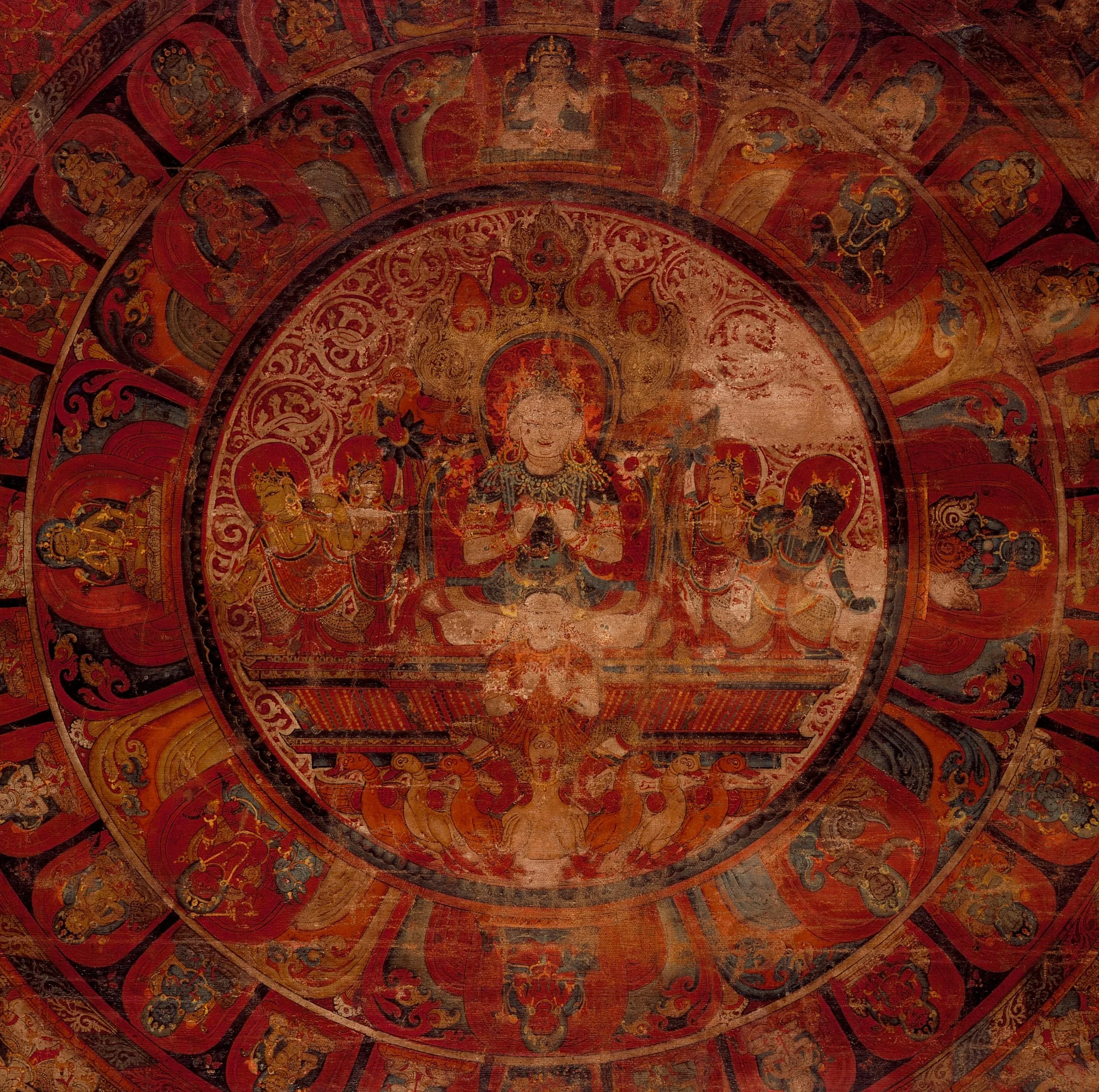
This Buddhist astrological mandala, a symbolic diagrammatic aid to meditation, was commissioned to commemorate a ceremony propitiating the moon god, Chandra, who is the white figure wearing a blue jacket in the center. Chandra rides in a chariot flanked by his two wives, Sobha and Kanti, and two archers, Sandhya and Godhuli, symbolizing dusk and twilight respectively, who are dispelling the demons of darkness. The god of the sky, Ambara, is the charioteer guiding the chariot’s flight through the night sky. Seven ganders pull the chariot, which is a Nepalese and eastern Indian convention, apparently derived from tantric Buddhist literature. The eight other planetary deities are arranged in the lotus petals surrounding Chandra, making this a representation of the nine planetary deities (navagraha) with Chandra as the presiding divinity. The outer circle of lotus petals contains the twenty-eight stars (nakshatras) personified as females. At the top of the painting are the faint remains of a Buddha. In each of the four corners sits a bodhisattva flanked by two of the eight Guardians of the Directions (ashtadikpala) and the Eight Auspicious Symbols of Buddhism (ashtamangala): a white parasol, pair of golden fish, conch, treasure vase, lotus, victory banner, wheel, and endless knot.
The bottom register is divided into three panels. On the left is a tantric Buddhist monk (Vajracharya) pours sacrificial oblations into a fire as an offering to Chandra. Behind him an attendant holds a manuscript, while members of the priest’s family respectfully observe. In the central panel is a dancing figure and two musicians. On the right is the donor who commissioned the ceremony and this painting and members of his family.