LACMA

ShopMembershipMyLACMATickets
LACMA
Los Angeles County Museum of Art
5905 Wilshire Blvd.
Los Angeles, CA 90036
info@lacma.org
(323) 857-6000
Sign up to receive emails
Subscribe
© Museum Associates 2025

Museum Hours

Monday

11 am–6 pm

Tuesday

11 am–6 pm

Wednesday

Closed

Thursday

11 am–6 pm

Friday

11 am–8 pm

Saturday

10 am–7 pm

Sunday

10 am–7 pm


  • About LACMA
  • Jobs
  • Building LACMA
  • Host An Event
  • Unframed
  • Press
  • FAQs
  • Log in to MyLACMA
  • Privacy Policy
© Museum Associates 2025
Collections

Unknown
Europeans Embracingcirca 1590

Not on view
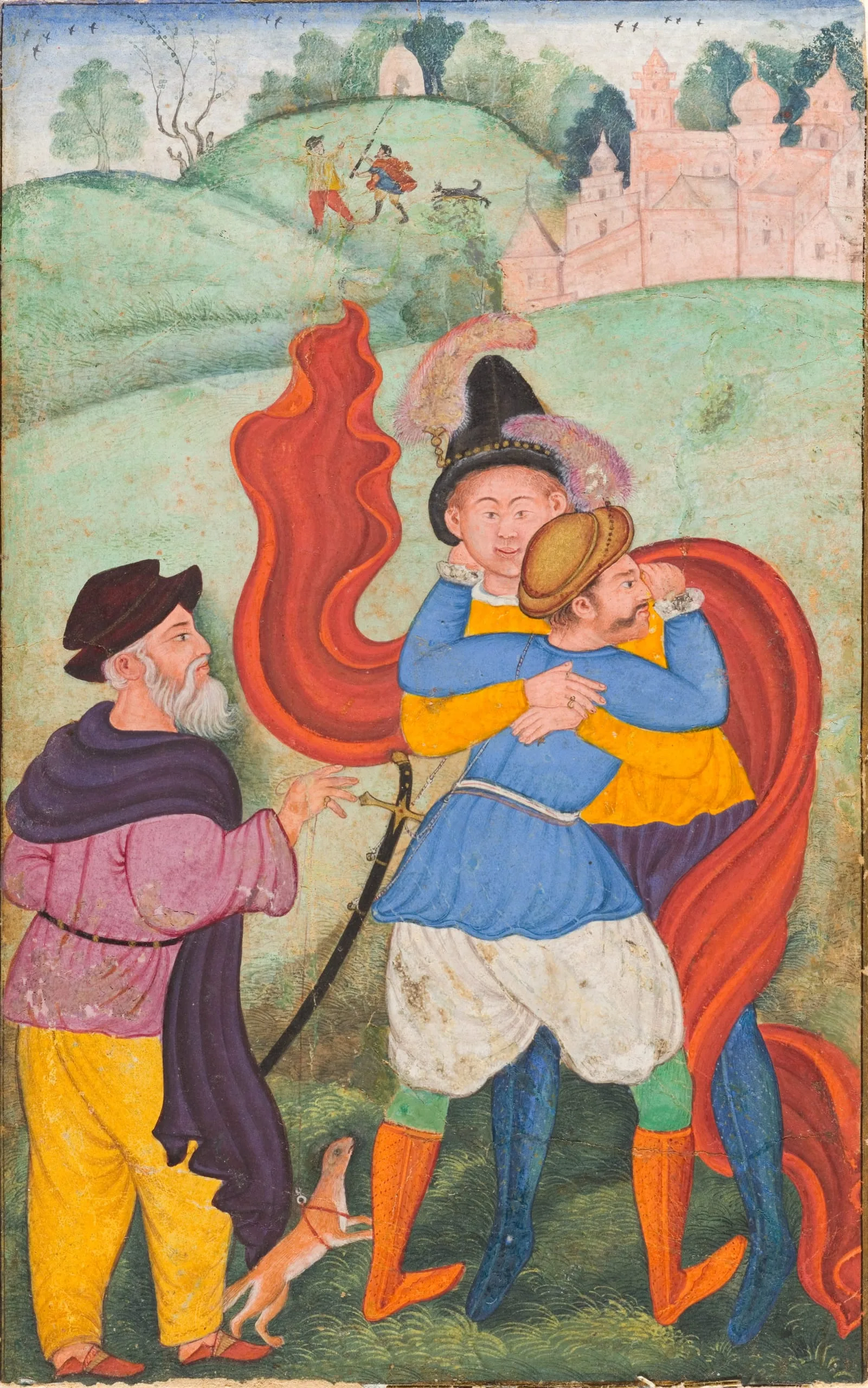
Indo-Persian or Mughal opaque watercolor painting showing three male figures in European-style dress in a green landscape, with two figures grappling at center and a billowing red banner behind them
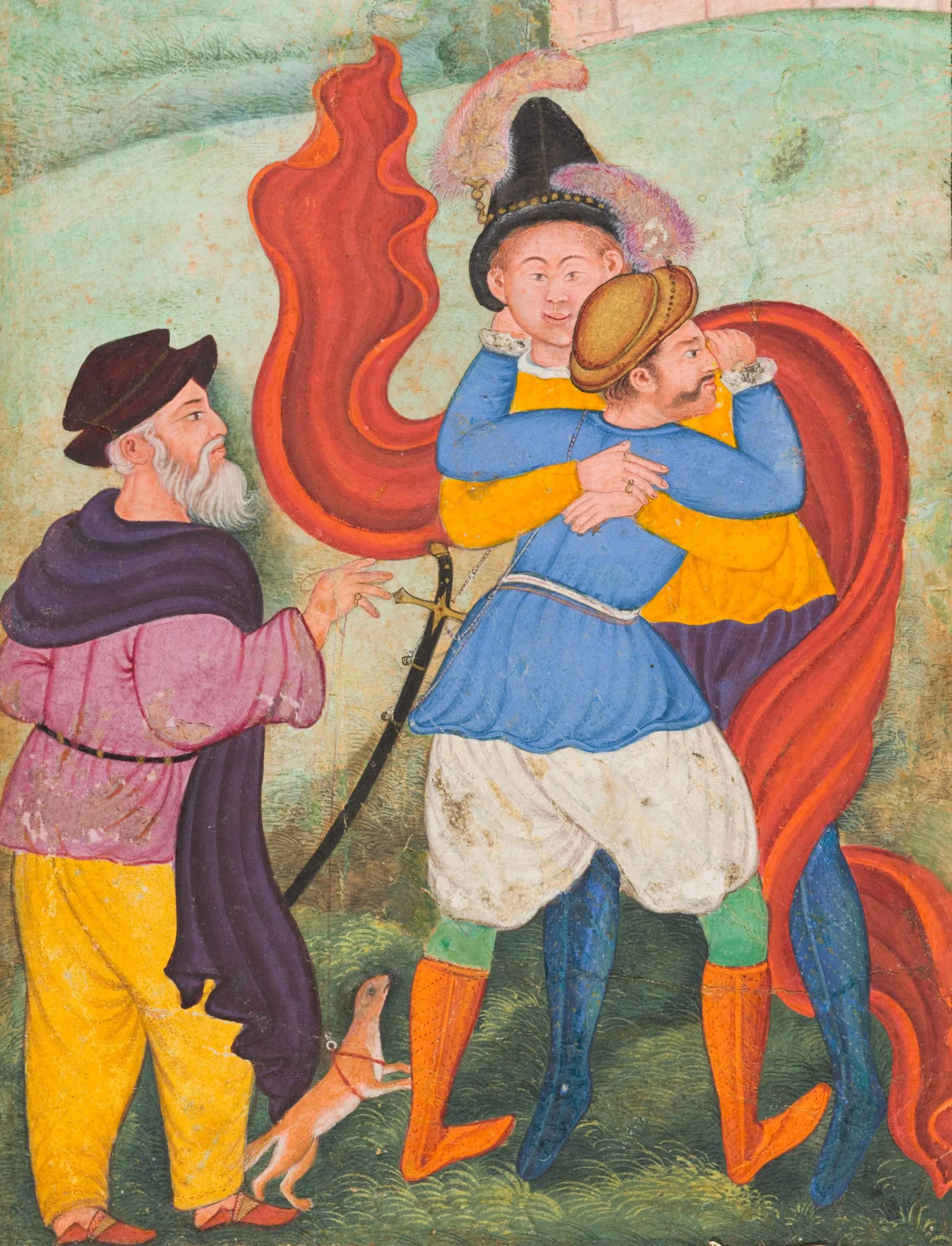
Opaque watercolor miniature painting depicting three male figures in a landscape. Two men in blue and yellow European-style dress embrace in the center, one wearing a tall black hat with feathers. An older bearded man in pink and yellow robes gestures toward them from the left. A small dog stands near their feet; a red swirling form and architectural structure appear in the background. Flat, vivid colors with fine brushwork characteristic of Mughal manuscript illustration.
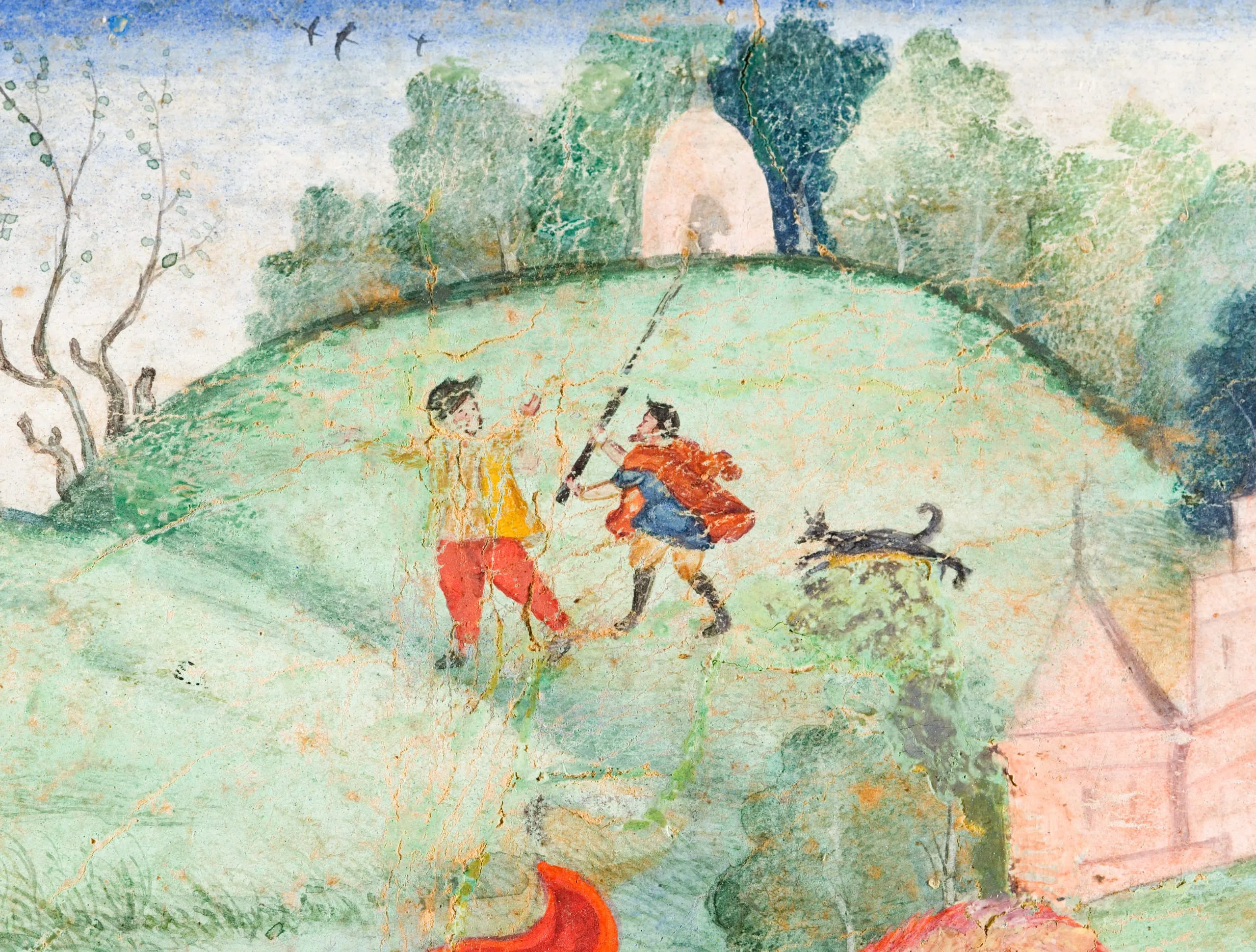
Tempera or gouache painting, detail showing two figures in colorful medieval dress on a green hillside, one holding a long pole or staff, with a black dog running nearby; a domed structure and trees in the background, surface shows cracking and paint loss
Artist or Maker
Unknown
Title
Europeans Embracing
Place Made
Pakistan, Lahore, Mughal Empire
Date Made
circa 1590
Medium
Opaque watercolor, gold, and ink on paper
Dimensions
Overall: 5 1/2 x 3 3/8 in. (13.97 x 8.57 cm)
Credit Line
From the Nasli and Alice Heeramaneck Collection, Museum Associates Purchase
Accession Number
M.83.105.20
Classification
Drawings
Collecting Area
South and Southeast Asian Art
Curatorial Notes

Despite the prevalence of portraits of Europeans in Mughal and Rajput painting, their representations are not as straightforward as one might first imagine. Presumably inspired by a European print or prints yet to be identified, this Mughal portrayal of Europeans Embracing from c. 1590 epitomizes the hybrid creative process underlying such images. Foreign figural types are characteristically depicted in dramatic postures and wear a mix-matched assortment of European Renaissance garb plucked from a variety of visual sources. These figures are often set in a Westernized landscape featuring diminishing perspective and European-style architecture.

Here, the bearded gentleman wears a 16th-century English “city flat cap” made of wool, the mustachioed man wears what is presumably a type of béret common to several northern European countries, and the man facing forward wears a feathered toque similar to that shown in M.80.6.7. The mustachioed man wears a shirt with lace cuffs fashionable in England and Wales during the Tudor period (1485–1603). Both embracing men wear leather leggings known as buskins. Rather than their customary capes, the Europeans have been given long flowing shawls.

The exotic appearance of the outlanders is further emphasized here by the unusual full-frontal visage of the central figure. Indian artists of this period were not experienced at representing the human face from this perspective and such portrayals often seem to border on caricature to modern viewers.
Selected Bibliography
  • Markel, Stephen. "The Enigmatic Image: Curious Subjects in Indian Art." Asianart.com, July 28, 2015. http://asianart.com/articles/enigmatic.