- Title
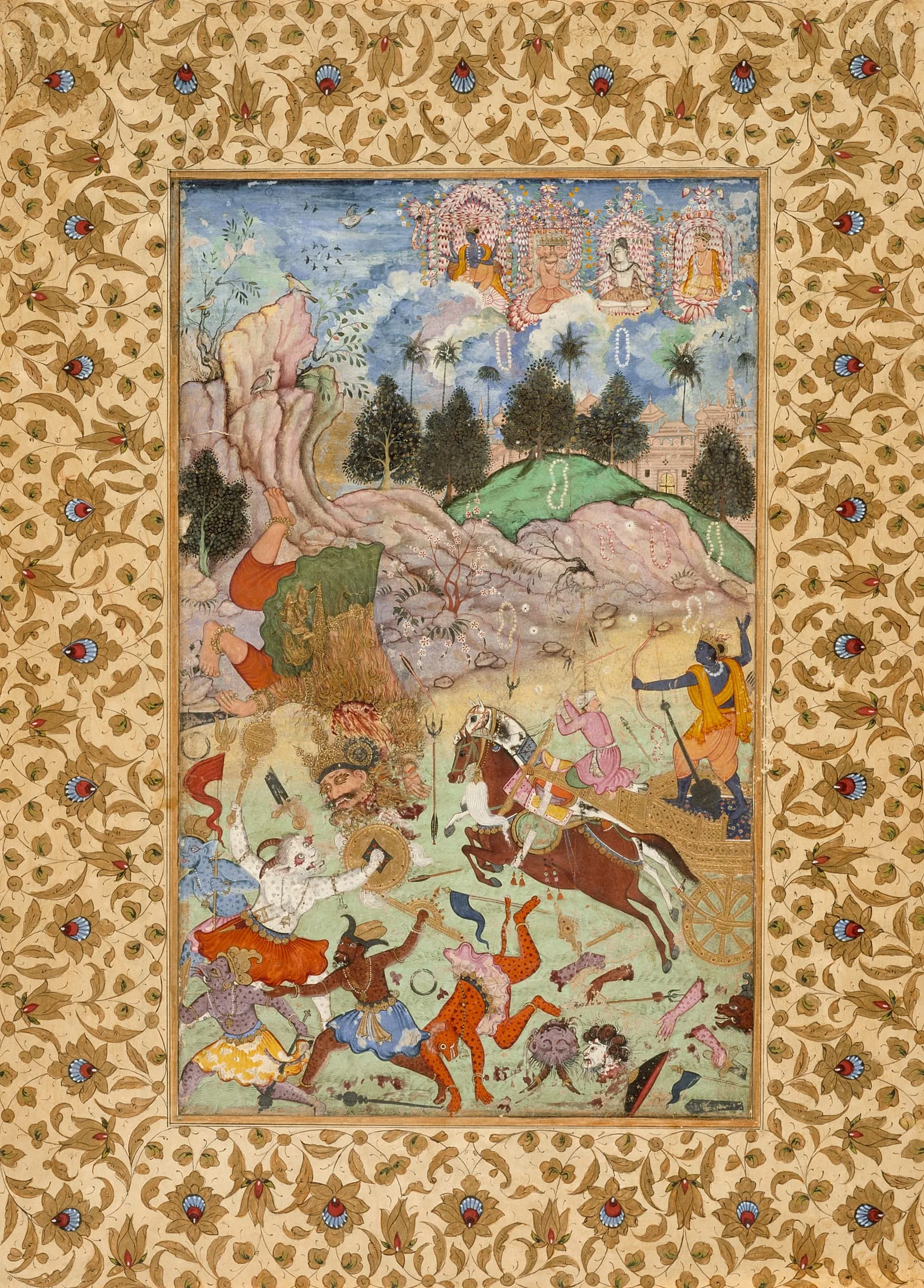
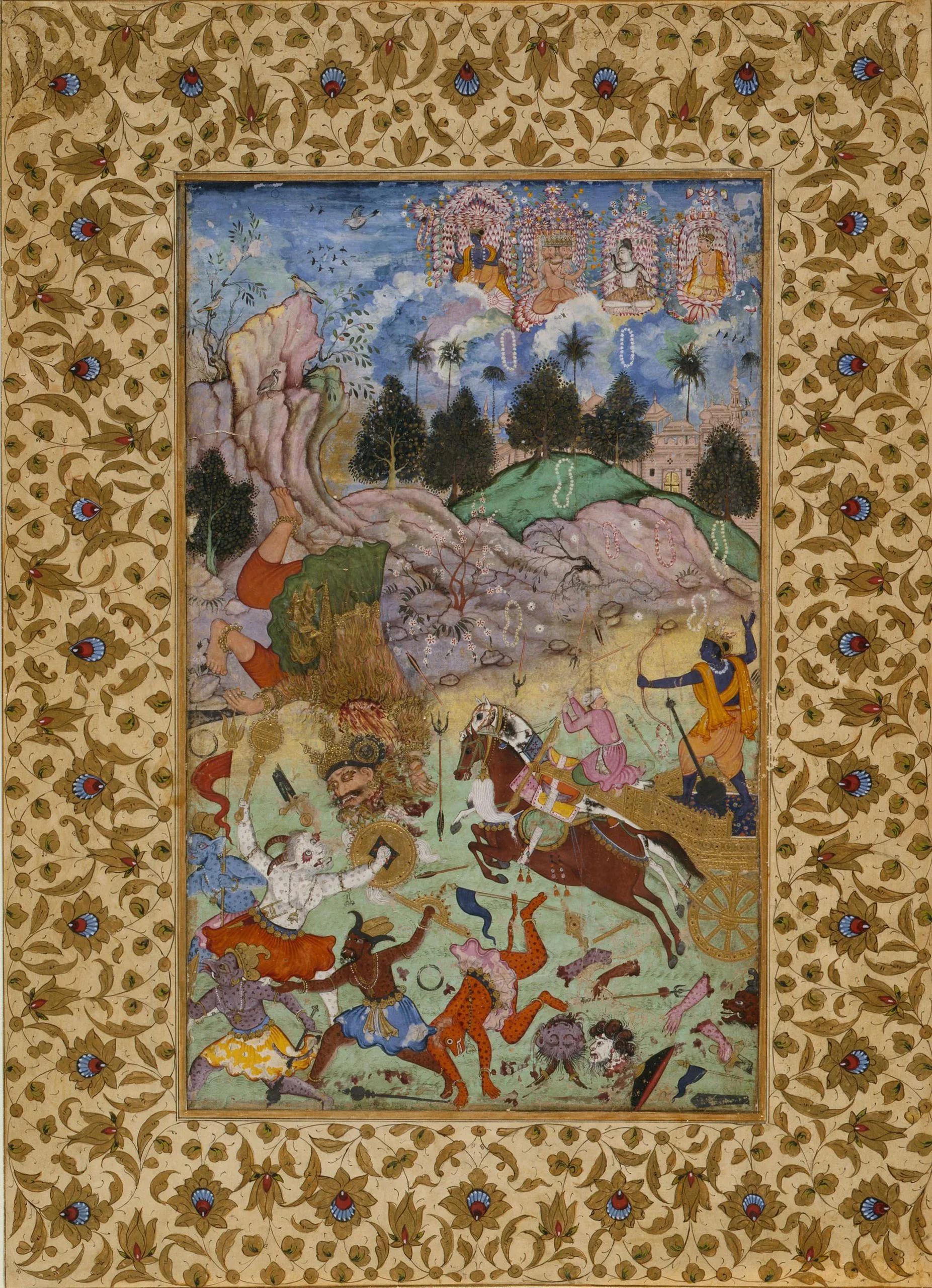
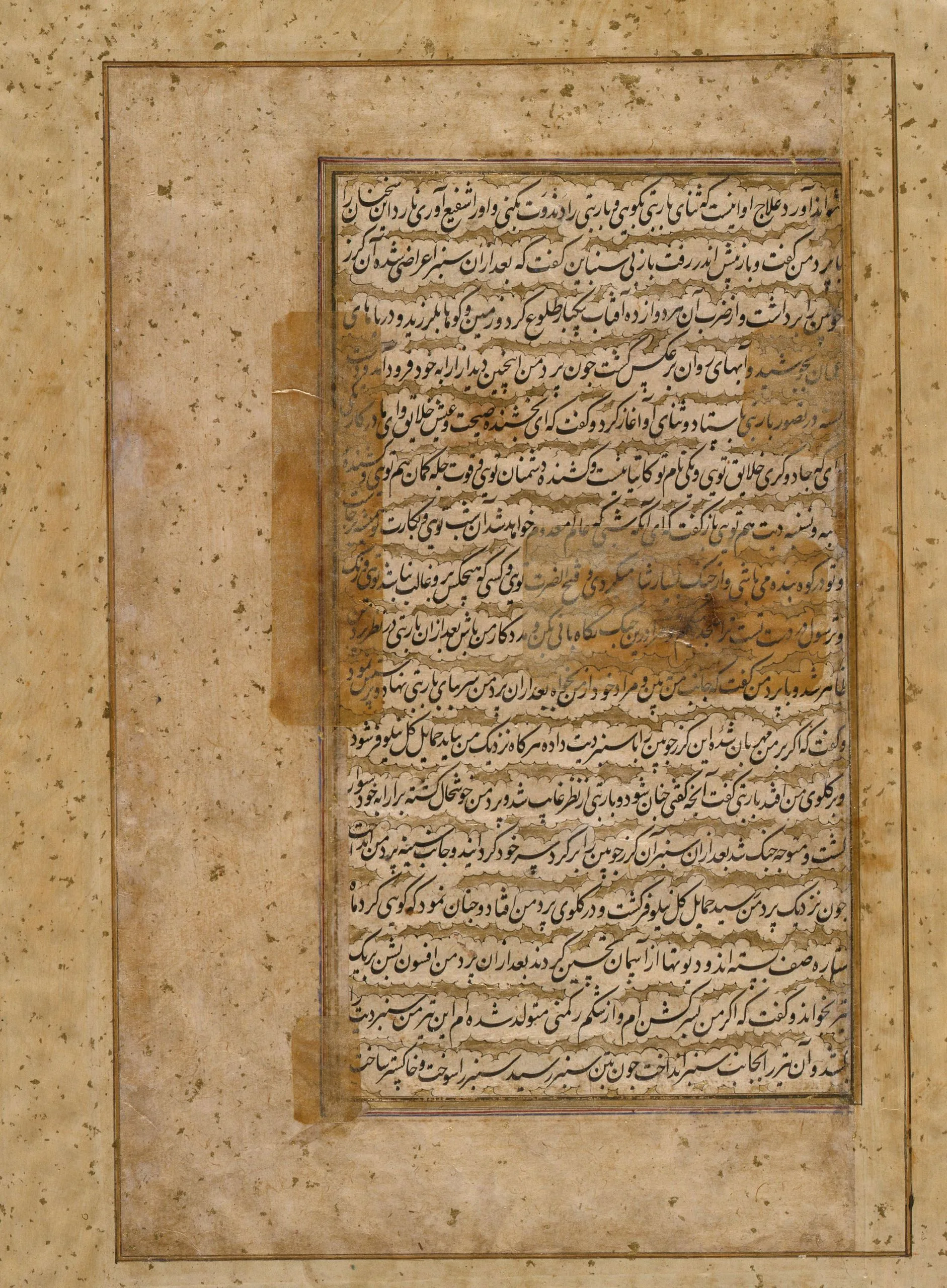
- Pradyumna Kills Shambara (recto), Calligraphy (verso), Folio from a Harivamsha (Lineage of Hari [Vishnu])
- Date Made
- circa 1585 (border: circa 1700)
- Medium
- Opaque watercolor, gold, and ink on paper
- Dimensions
- Sheet: 16 1/8 x 11 3/4 in. (41.96 x 29.85 cm); Image: 11 3/4 x 7 in. (29.85 x 17.78 cm)
- Accession Number
- M.83.105.4
- Curatorial Notes
The Harivamsha (Lineage of Hari [Vishnu]) is an appendix to the great Indian Sanskrit epic, the Mahabharata ([War of the] Great Bharatas), which is traditionally believed to have been composed by the revered sage Vyasa by the 1st century CE. It was translated into Persian for the Mughal Emperor Akbar (r. 1556-1605) by Mullah (or Mawlana) Sheri, who was killed in Kashmir in February 1586. This folio, M.78.9.10 and M.83.1.7 are from a widely dispersed Harivamsha manuscript that was a second copy of Akbar’s original volume. The folios were remounted into later borders in circa 1700. Verses from the text are on the obverse.
This folio illustrates the death of the demon king Shambara (or Samvara) by the son of Krishna and Rukmini, Pradyumna, who was an avatar of Kamadeva, the Hindu god of desire. The tale is narrated in Chapters 162-165 of the text. Shambara had abducted the infant Pradyumna soon after his birth in Dwarka and thrown him in the ocean where he was swallowed by an enormous fish, which was later caught by a fisherman and sold to Shambara’s kitchen. When the fish was cut open, one of Shambara’s wives Mayavati (or Mayadevi), who was an incarnation of Rati, the wife of Kamadeva, recognized the beautiful child as her divine spouse and raised him without Shambara’s knowledge. Later, after the boy was grown, Mayavati revealed his true identity and told him how he been abducted by Shambara. Pradyumna then killed Shambara and his acolytes with Mayavati’s magical help.
- Selected Bibliography
- Pal, Pratapaditya. Indian Paintings in the Los Angeles County Museum of Art. New Delhi: Lalit Kala Akademi, 1982.
- Pal, Pratapaditya. Indian Painting, vol.1. Los Angeles: Los Angeles County Museum of Art, 1993.
- Heeramaneck, Alice N. Masterpieces of Indian Painting : From the Former Collections of Nasli M. Heeramaneck. New York: A.N. Heeramaneck, 1984.