- Title
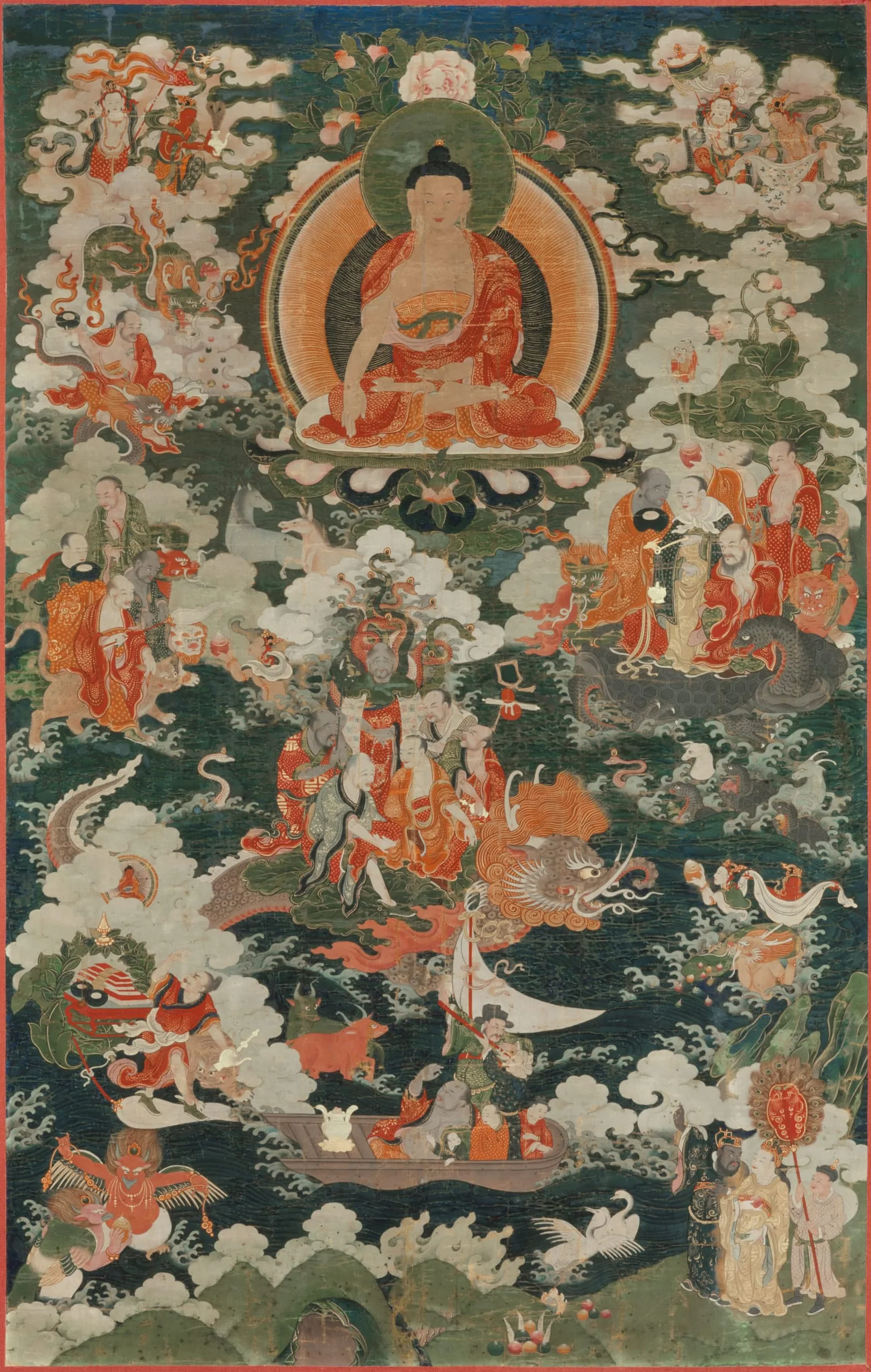
- Buddha Shakyamuni and the Sixteen Great Arhats
- Date Made
- 18th century
- Medium
- Mineral pigments and gold on cotton cloth
- Dimensions
- 28 3/4 x 18 1/2 in. (73 x 47 cm)
- Accession Number
- M.83.105.18
- Curatorial Notes
This richly detailed painting from Kham in Eastern Tibetan depicts the historical Buddha Shakyamuni in the upper center seated in the meditation posture (padma asana) on a lotus base with his hand extended in the gesture of Turning the Wheel of the Law (dharmachakra mudra or dharmachakra-pravartana mudra). He is floating in the heavens above an ocean filled with auspicious figures and personages, principally the Sixteen Great Arhats (Buddhist saints) or Elders (sthaviras). There are three columns of figural groups. On the left from top to bottom are a white-skinned god holding a standard with a mythical aquatic creature banner (makara dhvaja) and a red-skinned goddess holding a Vase of Immortality (tshe-bum) with peacock feathers (see M.83.2.1); one arhat with a makara and dragon; four arhats with a dragon, snow lion and snow leopard; the lay attendant Dharmatala or Dharmata with a tiger and an ewer (see M.84.227.2), and beside a shrine and image in the clouds of the red-skinned Jina Buddha Amitabha with his hands held in the meditation gesture (dhyana mudra). Beneath him are two half-avian, half-human Garudas holding a jewel or chain of jewels. In the center column below the Buddha are six arhats riding a makara; sea cows; and the Chinese patron Hva Shang riding in a boat with the children he protects. Hva Shang had been a monk who fled China after offending the Ming Dynasty Emperor. In the right-hand column are a white-skinned god holding an honorific parasol and a peach-skinned goddess emptying a white silk cloth of flowers symbolizing the auspicious of the event. Beneath them are five arhats standing on a reptilian tortoise and with a snow lion. Underneath them are a half-human serpent (naga) bearing jewels and two celestials holding a jewel and a white silk cloth symbolic of pacification. In the lower right corner standing on the shore is the Chinese Ming Emperor attired in an elegant robe. Beside him a dark-skinned courtier points to the miraculous appearance of the Great Arhats emerging from the sea. An attendant behind the emperor holds an honorific peacock fan over his head. In the middle of the shoreline are heaps of flaming jewels and white unicorn or rhinoceros horns. In the bottom center is an empty cave. Missing from standard representations of Shakyamuni and Sixteen Great Arhats are the Buddha’s two foremost disciples, Shariputra and Maudgalyayana, and the Four Guardians of the Directions (dikpalas), Vaishravana, Virupaksha, Dritarashtra and Virudhaka. See also M.77.155.1, M.77.155.3, and M.83.2.1a-b.;
See Himalayan Art Resources (no. 85736), https://www.himalayanart.org/items/85736. See also Stephen Little, "The Arhats in China and Tibet," Artibus Asiae 52:3/4 (1992): 255-281.
- Selected Bibliography
- Chakraverty, Anjan. Sacred Buddhist Painting. New Delhi: Lustre Press Pvt. Ltd., 1998.
- Pal, Pratapaditya. Art of Tibet. Los Angeles; Berkeley, CA: Los Angeles County Museum of Art; University of California Press, 1983.
- Pal, Pratapaditya. Art of Tibet. Expanded edition. Los Angeles: Los Angeles County Museum of Art, 1990.