- Title
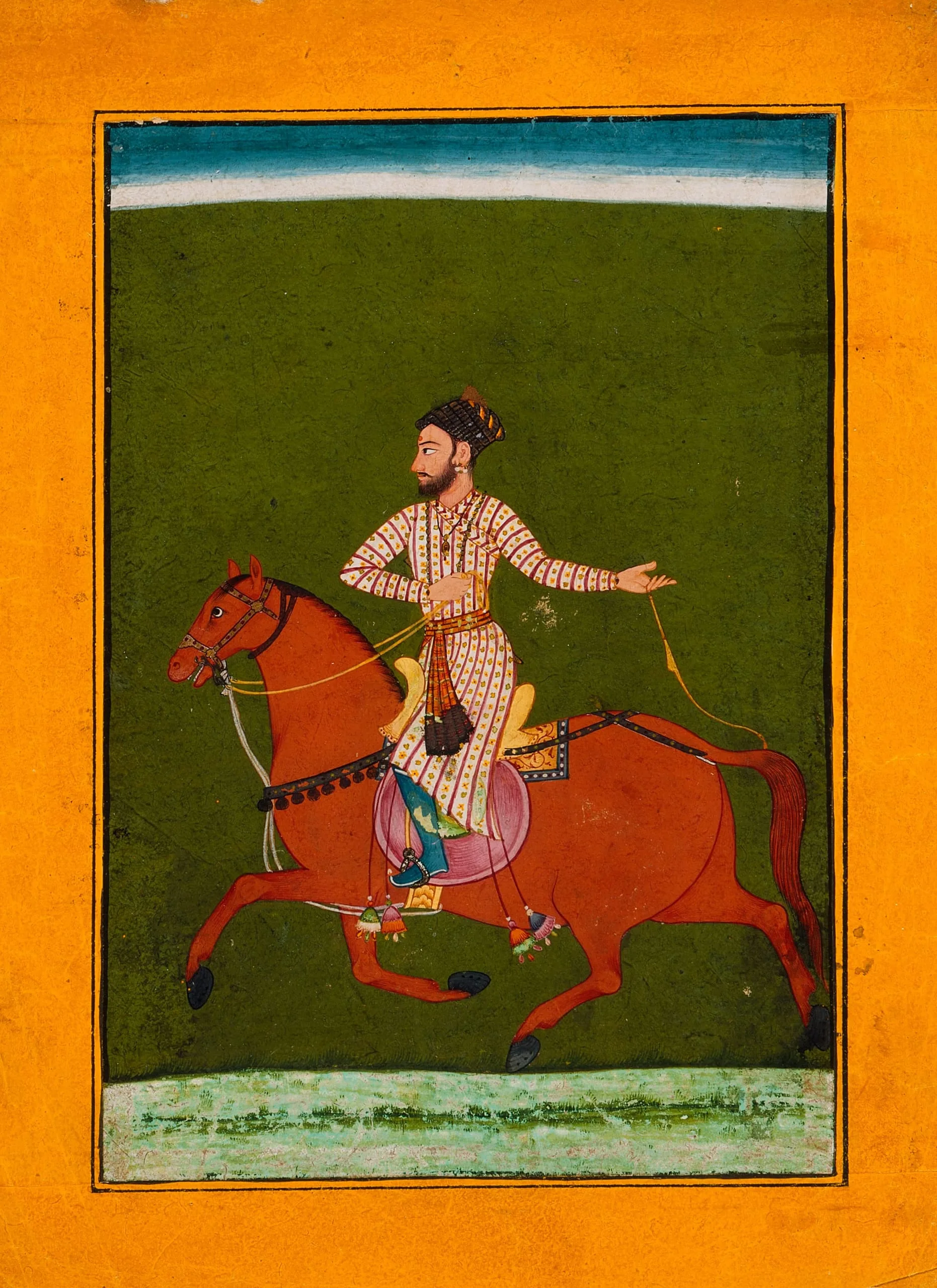
- Desakh Ragaputra, Fifth Son of Bhairava Raga, Folio from a Ragamala (Garland of Melodies)
- Date Made
- circa 1685
- Medium
- Opaque watercolor, gold, and silver on paper
- Dimensions
- Image: 8 1/8 x 5 1/2 in. (20.63 x 13.97 cm); Sheet: 10 1/4 x 7 3/4 in. (26.03 x 19.68 cm)
- Accession Number
- M.83.105.10
- Curatorial Notes
Desakh Ragaputra is the fifth son of Bhairava Raga in the variant ragamala (garland of melodies) classification system known as Meshakarna’s system (developed by Meshakarna, a court priest from Rewa, Madhya Pradesh, in his Ragamala of 1570), which was followed in Pahari ragamalas. Meshakarna’s system has six males (ragas), each of whom who has five or six wives (raginis) and eight or nine sons (ragaputras). In the more widespread Rajasthani classification system, Desakh (or Desakhya) is a ragini and the third wife of Hindola Raga. Meshakarna compares the melodies to a sound in nature or a human activity. Desakh Ragaputra is likened to “sakkuli” or clarified butter (ghee). It is envisioned as a wrestler or acrobat, which is analogous to the imagery of Desakhya Ragini in the Rajasthani system (see AC1999.127.43). Here, however, the melody is personified as a princely man riding a cantering chestnut mare in an open field.
This painting is from the earliest known Bilaspur ragamala. Additional folios from this dispersed series are in the San Diego Museum of Art (1990.1150–.1152). This folio and its series mate M.82.42.7 have a yellow border and are from a slightly earlier Bilaspur ragamala than M.71.1.29, M.71.1.49 and M.77.19.31, which have a red border.
- Selected Bibliography
- Rosenfield, John. The Arts of India and Nepal: The Nasli and Alice Heeramaneck Collection. Boston: Museum of Fine Arts, Boston, 1966.