LACMA

ShopMembershipMyLACMATickets
LACMA
Los Angeles County Museum of Art
5905 Wilshire Blvd.
Los Angeles, CA 90036
info@lacma.org
(323) 857-6000
Sign up to receive emails
Subscribe
© Museum Associates 2025
  • About LACMA
  • Jobs
  • Building LACMA
  • Host An Event
  • Unframed
  • Press
  • FAQs
  • Log in to MyLACMA
  • Privacy Policy
© Museum Associates 2025
Collections

Unknown
Palden Lhamo (Shri Devi)circa 1750-1850

Not on view
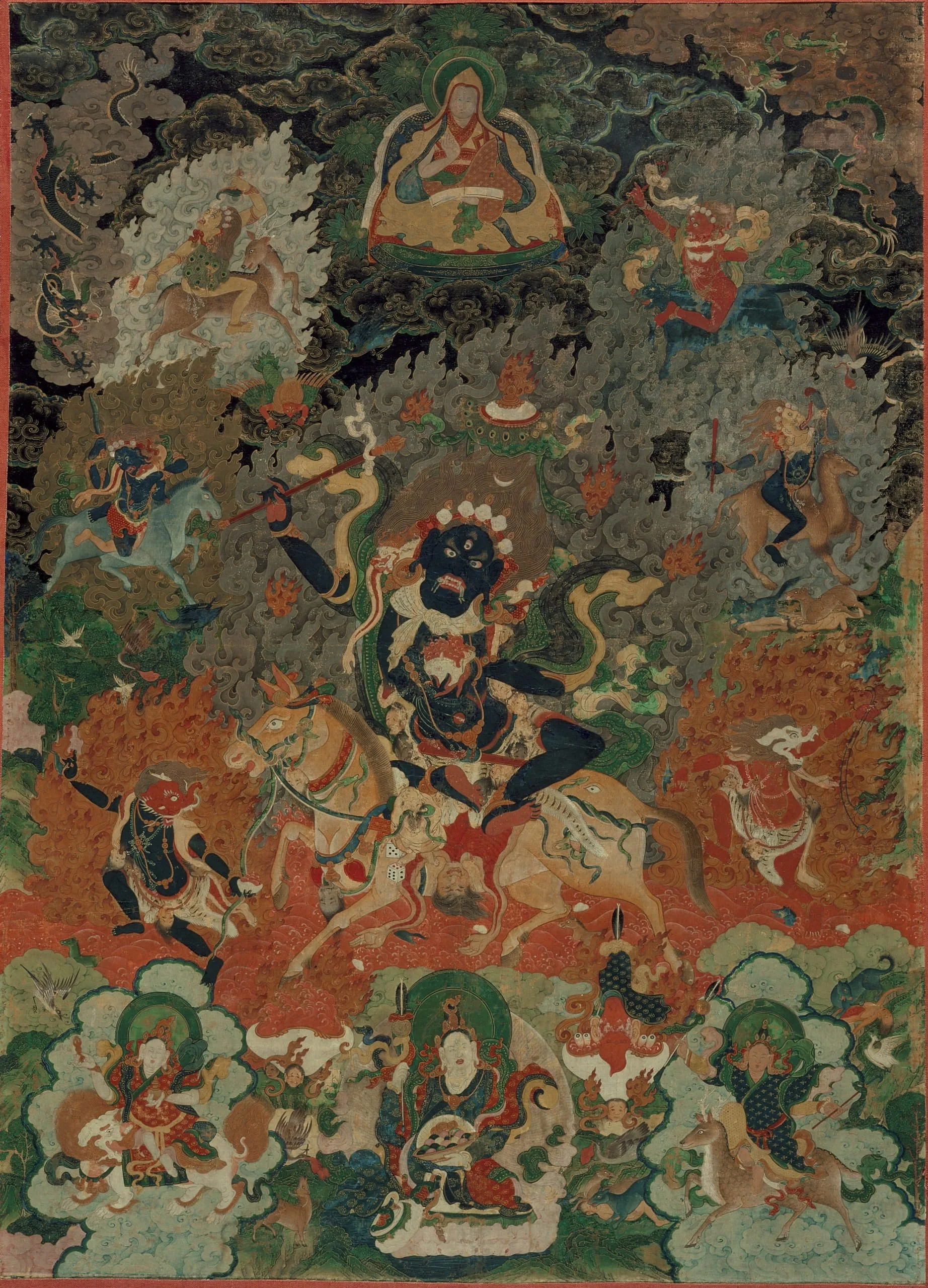
Tibetan thangka painting with a dark blue multi-armed deity riding a gold horse at center, surrounded by mounted attendants, swirling flames and smoke, a meditating figure above, and cloud-borne figures at the lower register

Unknown, Shri (Palden Lhamo), circa 1750-1850, Los Angeles County Museum of Art, From the Nasli and Alice Heeramaneck Collection, Museum Associates Purchase, photo © Museum Associates/LACMA

Artist or Maker
Unknown
Title
Palden Lhamo (Shri Devi)
Place Made
Central Tibet, a Gelug Monastery
Date Made
circa 1750-1850
Medium
Mineral pigments and gold on cotton cloth
Dimensions
28 1/2 x 21 1/4 in. (72.39 x 53.98 cm)
Credit Line
From the Nasli and Alice Heeramaneck Collection, Museum Associates Purchase
Accession Number
M.83.105.17
Classification
Paintings
Collecting Area
South and Southeast Asian Art
Curatorial Notes

Palden Lhamo (Glorious Goddess), known in Sanskrit as Shri Devi, is a fierce Dharmapala (protector deities) in Vajrayana Buddhism and the supreme guardian of the Tibetan nation, the Dalai Lamas, and the Buddhist faith. She is committed to the defense of spiritual seekers from dangerous entities and negative forces threatening to obstruct their process on the path to enlightenment.

In this painting, the goddess is represented in her iconographic form as Magzor Gyalmo (Warrior Queen). She is depicted with an angry, glaring face, bulging eyes, bared teeth, and flaming hair. She wears a crown of skulls, and a long garland of severed skulls (mundamala) as well as the sun in her navel and the moon in her hair. In a sea of blood riding her donkey mount (khyang), she sits on a saddle blanket made from the flayed skin of her own child. Hanging from the front of her saddle is a pestilential sack of diseases tied with a snake, alluding to her ability to cure diseases inflicted by harmful spirits. In her upraised right hand, she holds a club with a thunderbolt (vajra) terminal. In her left hand, she carries a skullcup (kapala) filled with magical potions and the blood of evildoers. Magzor Gyalmo is flanked by her main attendants, reptile-headed Makaravaktra and lion-headed Simhavaktra. Above her are the four ferocious Queens of the Seasons (Dukyi Gyalmo). She is accompanied along the bottom of the painting by three female protective spirits. In the top center of the painting, a "Yellow Hat" Gelug lama identifies its sectarian affiliation.
Selected Bibliography
  • Huntington, John C. and Dina Bangdel. The Circle of Bliss: Buddhist Meditational Art. Columbus: The Columbus Museum of Art; Chicago: Serindia Publications, 2003.
  • Pal, Pratapaditya. Art of Tibet. Expanded edition. Los Angeles: Los Angeles County Museum of Art, 1990.
  • Fisher, Robert E. Art of Tibet. London: Thames and Hudson, 1997.
  • Larson, Gerald et al. In Her Image: The Great Goddess in Indian Asia and the Madonna in Christian Culture. Santa Barbara: UCSB Art Museum, University of California, 1980.
  • Pal, Pratapaditya. Art of Tibet. Los Angeles; Berkeley, CA: Los Angeles County Museum of Art; University of California Press, 1983.
  • Pryke, Louise M. Scorpion. London: Reaktion Books, 2016.