The Ramayana narrates the epic saga of the valiant Prince Rama and his dutiful wife, Princess Sita, who was abducted by Ravana, the arrogant ten-headed King of Lanka (probably modern Sri Lanka), during Rama's unjust fourteen-year forest exile from his capital of Ayodhya, Uttar Pradesh. To rescue Sita, Rama and his faithful brother Lakshmana assembled a great army of monkeys and bears led by the Monkey-King Sugriva and his Monkey-General Hanuman. After several magical battles, the princess was freed, and the happy couple triumphantly returned home to rule their kingdom. Rama and Sita epitomize the ideal ruler and the paragon of fidelity in Hindu culture.
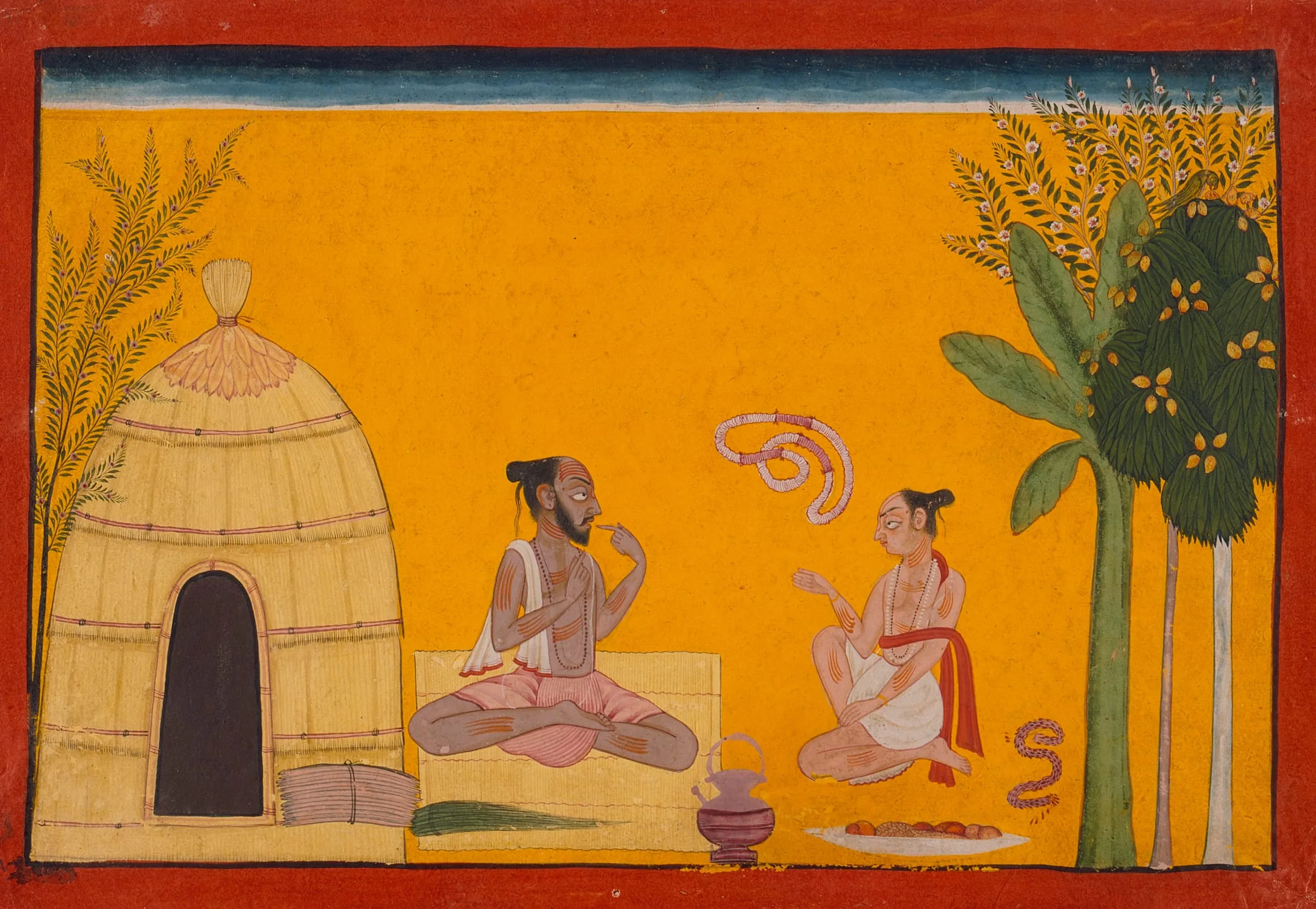
This scene is from Book 1 (Bala kanda) when the sage Valmiki, traditionally regarded as the epic’s author, describes the origin of the verse form he later used to compose the Ramayana to his pupil, the sage Bharadvaja (Ramayana 1:2:16-41).
Valmiki sits by his thatch hut near the Tamasa River. He points to his mouth, stressing his discourse to the kneeling Bharadvaja. The floral garland between them may symbolize his new verse meter with an equal number of syllables. The broken garland to the right may represent discarded verse meters.
This painting, and its series mates M.74.5.11, M.77.19.22, M.87.278.2, and M.91.348.2, are from a widely dispersed large series known as the “Shangri” Ramayana, so called because it was formerly in the ancestral collection of the Shangri branch of the royal family of Kulu, Himachal Pradesh.