LACMA

ShopMembershipMyLACMATickets
LACMA
Los Angeles County Museum of Art
5905 Wilshire Blvd.
Los Angeles, CA 90036
info@lacma.org
(323) 857-6000
Sign up to receive emails
Subscribe
© Museum Associates 2025

Museum Hours

Monday

11 am–6 pm

Tuesday

11 am–6 pm

Wednesday

Closed

Thursday

11 am–6 pm

Friday

11 am–8 pm

Saturday

10 am–7 pm

Sunday

10 am–7 pm


  • About LACMA
  • Jobs
  • Building LACMA
  • Host An Event
  • Unframed
  • Press
  • FAQs
  • Log in to MyLACMA
  • Privacy Policy
© Museum Associates 2025
Collections

Unknown
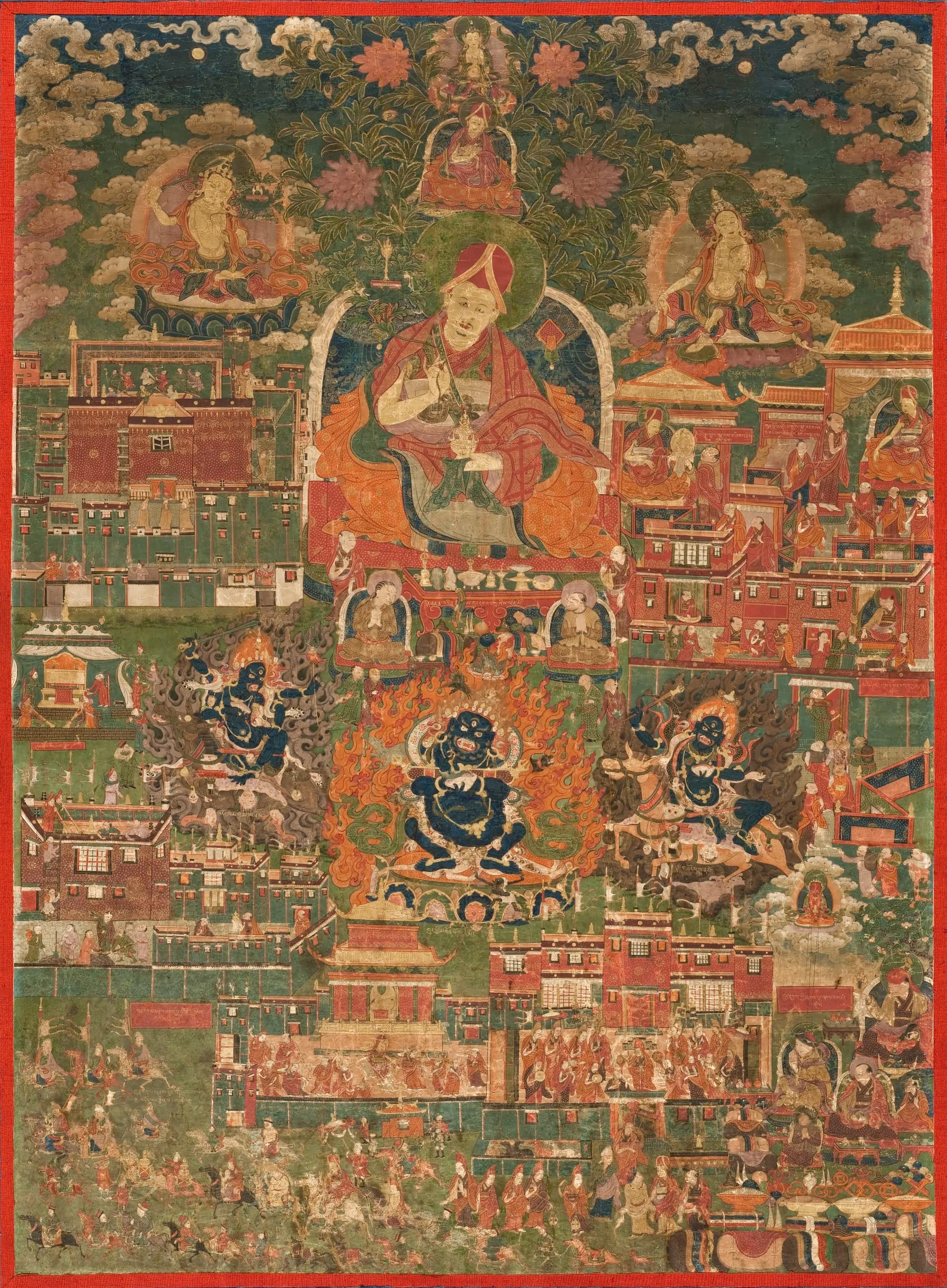
Kunga Tashi and Incidents from His Life (Abbot of Sakya Monastery, 1688-1711)circa 1675-1700

Not on view
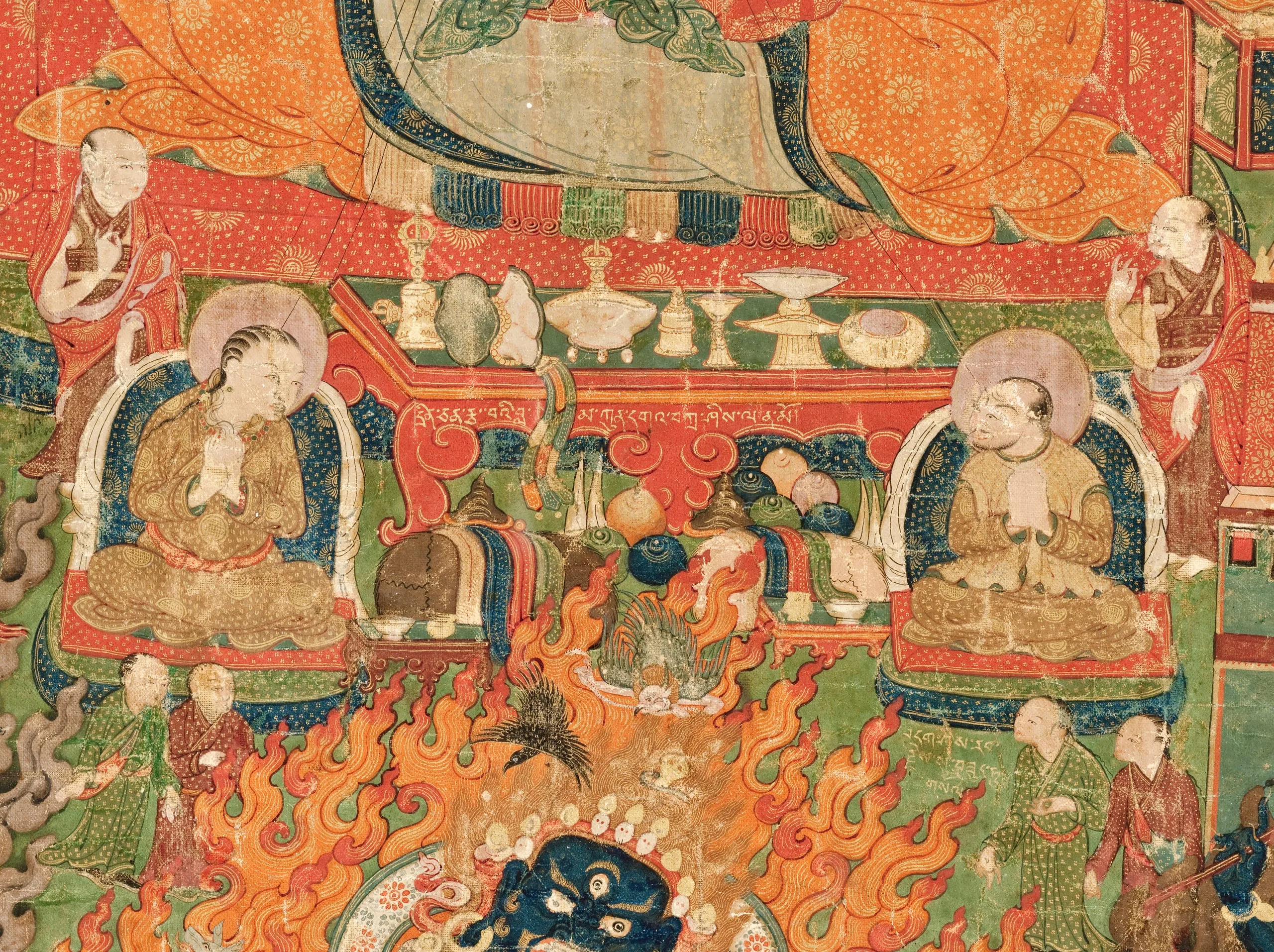
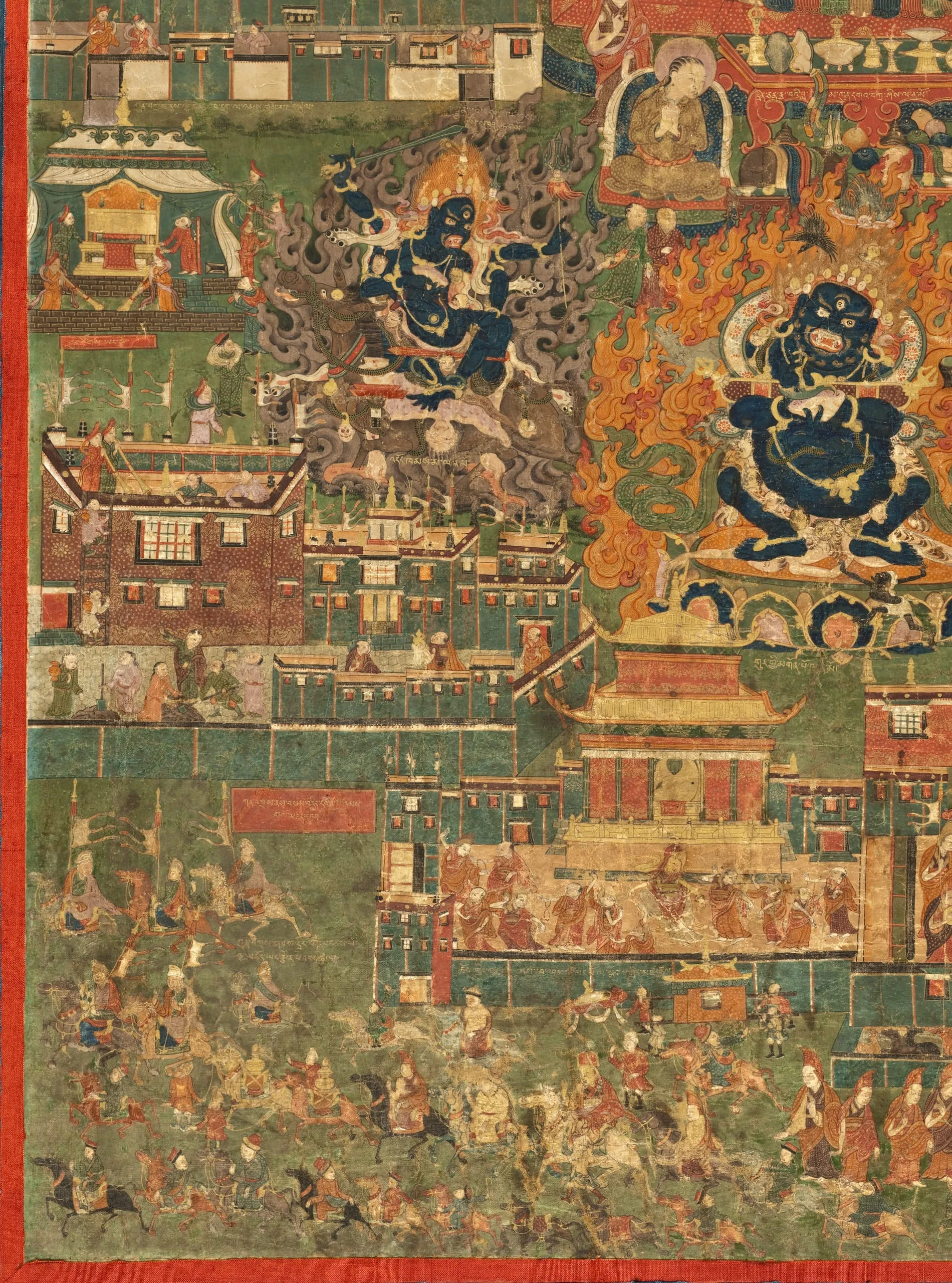
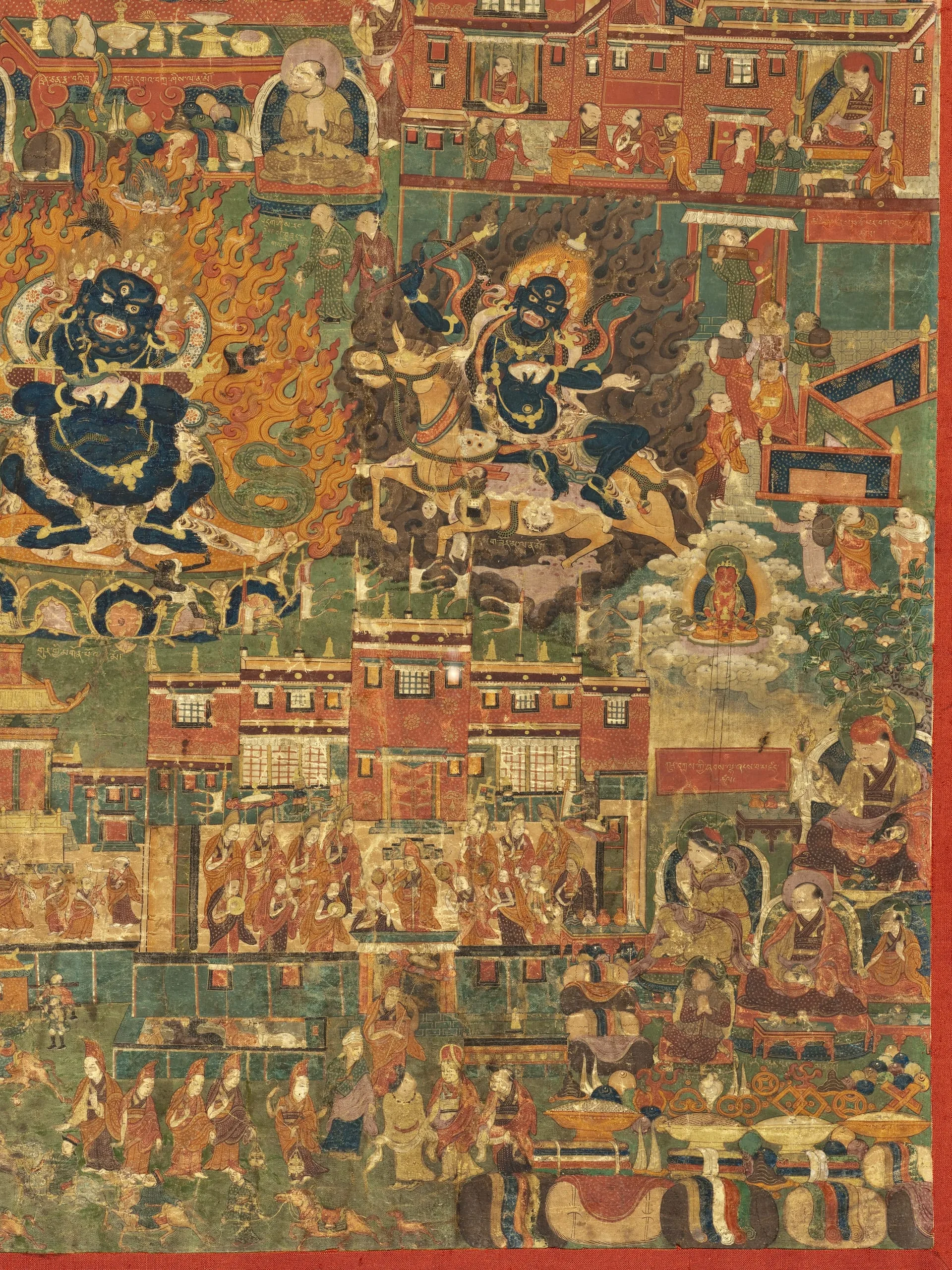
Tibetan thangka painting with a central enthroned lama in red robes surrounded by deities, monastery complexes, wrathful guardian figures, and processions of smaller figures across multiple registers
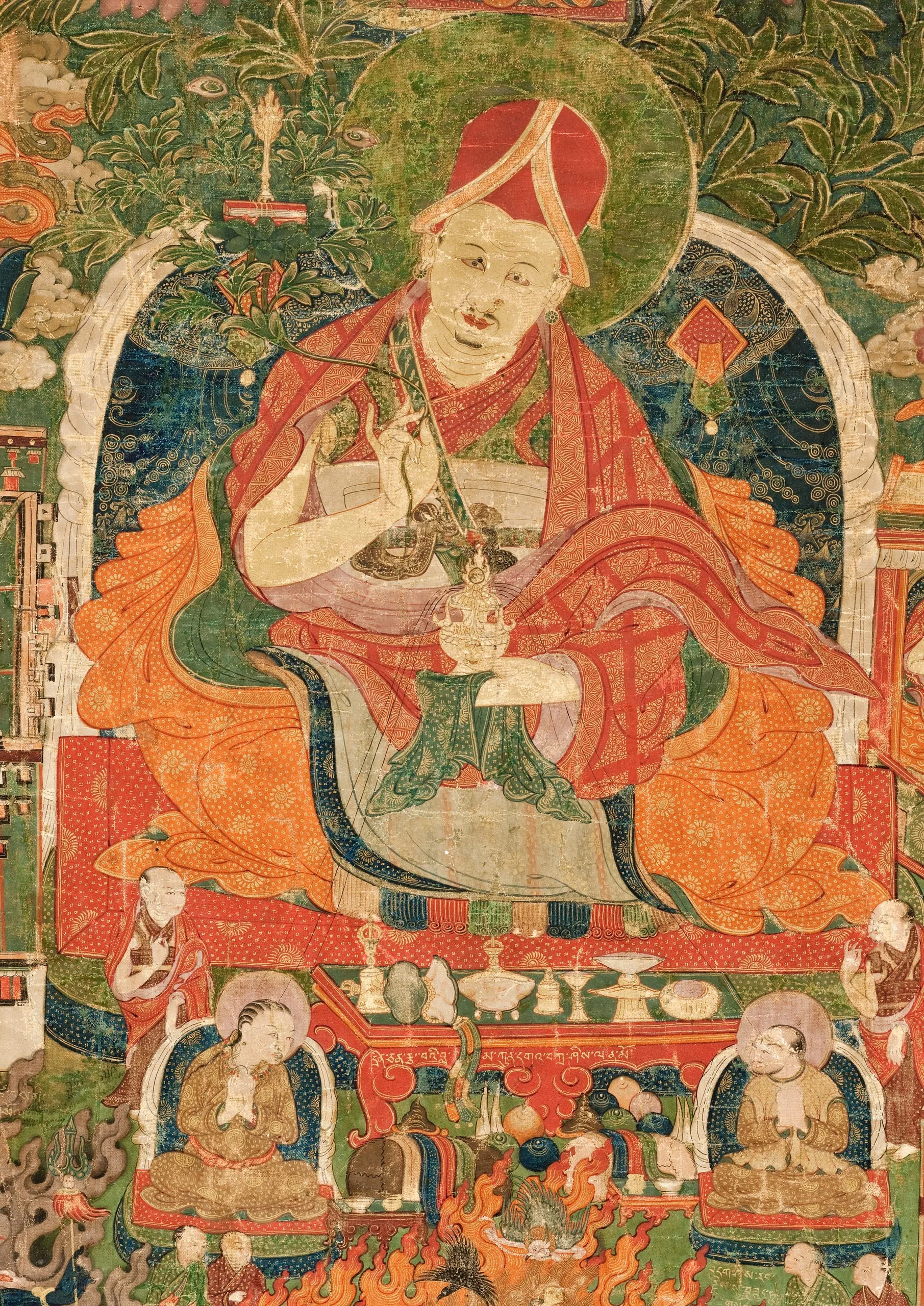
Tibetan thangka depicting a seated lama in red robes and a red ceremonial hat, holding ritual objects, set against a green halo and leafy background. Three smaller seated figures appear below with offering vessels and a line of Tibetan script. Rich colors of orange, red, and gold throughout.
Tibetan thangka painting detail, two seated monks with gray halos flanking a red altar table bearing ritual offerings; flames and a dark wrathful figure below; red and green ground with Tibetan script inscription at center; additional robed figures at margins.
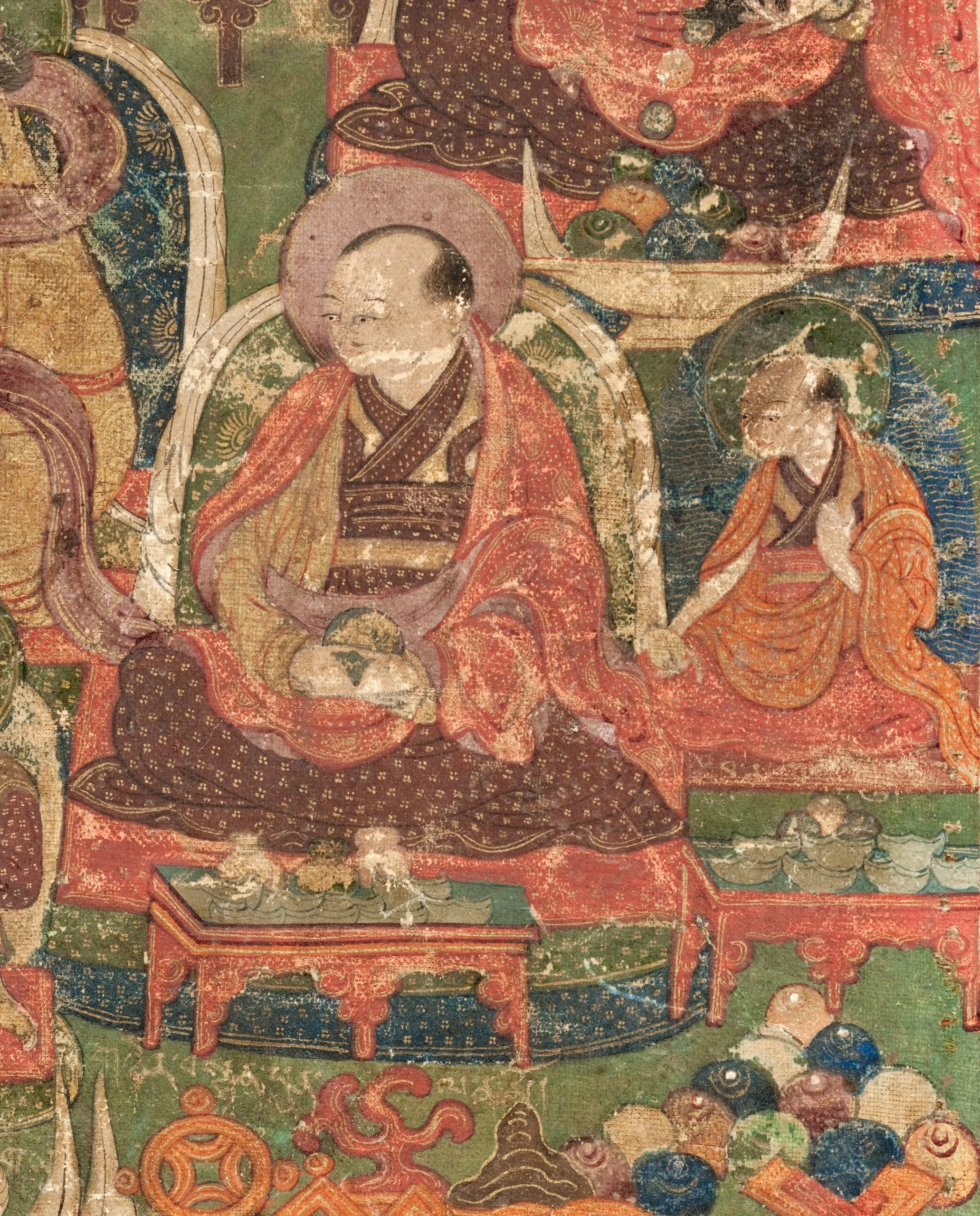
Tibetan thangka detail, pigment on cloth with visible aging and paint loss. Central seated figure with circular halo in dark red and maroon robes holds a bowl in a meditative pose atop a red platform. A smaller robed figure sits to the right near stylized water and rock formations. Rich patterned textiles, cloud forms, and decorative elements in red, green, blue, and gold fill the composition.
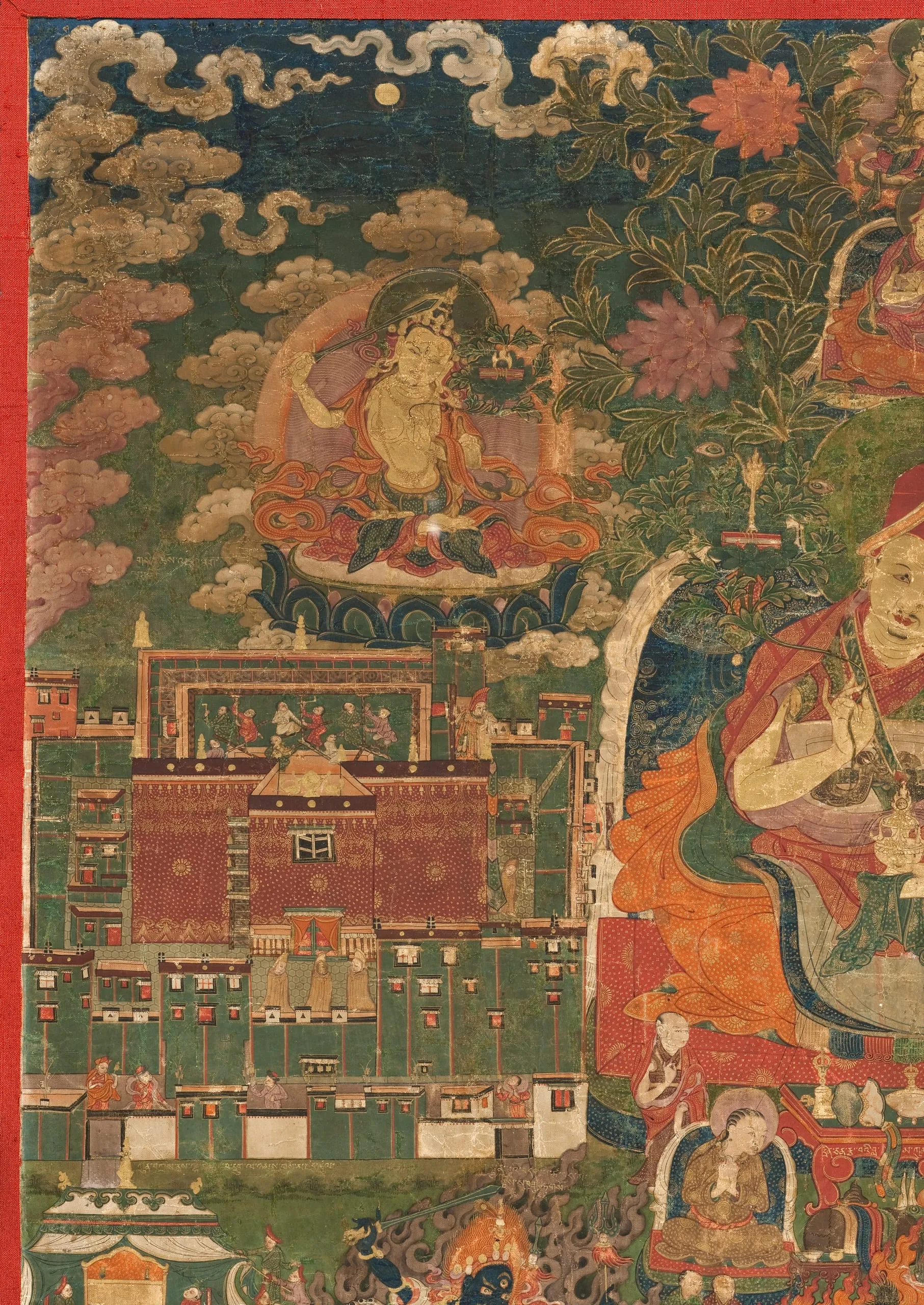
Tibetan thangka painting with fine brushwork; a golden deity seated on a lotus throne amid swirling clouds occupies the upper center, above a detailed architectural complex with multi-story red and green monastery buildings; partial figure in red robes at right edge; deep green sky with gold cloud formations.
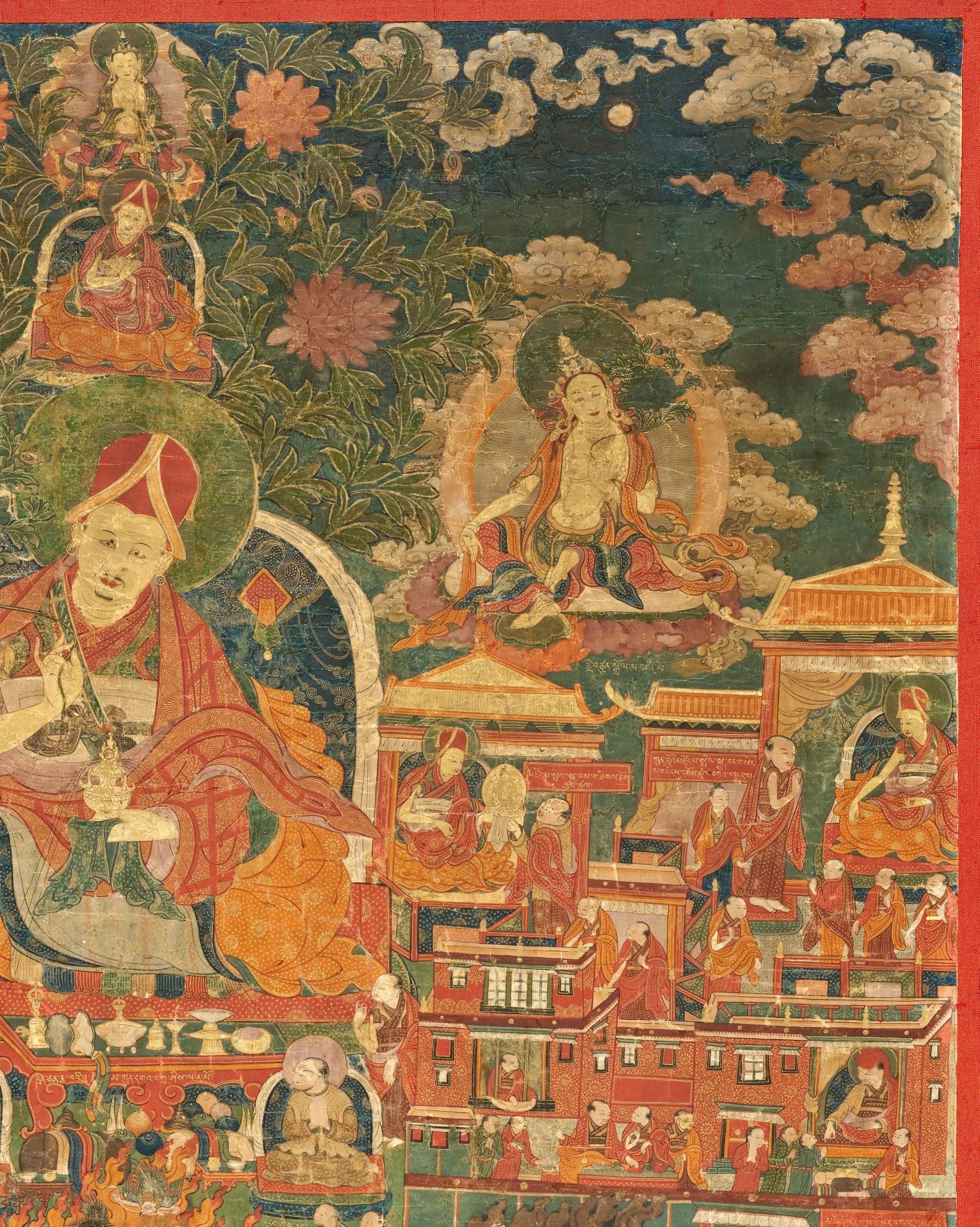
Tibetan thangka painting with mineral pigments and gold detail. A large seated lama in red hat and robes dominates the lower left, holding ritual objects. Above, a pale deity figure with golden halo sits amid clouds and flowering trees. The right side depicts a multi-storied monastery complex with numerous robed figures in red and orange. Additional seated figures and divine beings appear in the upper register against a deep blue sky.
Tibetan thangka painting on cloth depicting a densely detailed narrative scene: dark blue wrathful deities surrounded by flames occupy the upper center and right, above multi-storied monastery buildings rendered in teal and red. Lower registers show processions of numerous small figures on horseback and foot across a green landscape, with a seated Buddha figure at upper right amid orange and gold clouds. Fine mineral pigments with intricate brushwork throughout.
Tibetan thangka painting with dense narrative composition in mineral pigments on cloth. Upper register features dark blue wrathful deities surrounded by orange flames; center shows a mounted figure above a red multi-storied monastery complex; lower registers depict rows of robed figures in procession and assembly. Red border frames the composition.
Artist or Maker
Unknown
Title
Kunga Tashi and Incidents from His Life (Abbot of Sakya Monastery, 1688-1711)
Place Made
Central Tibet, Tsang Valley, a Sakyapa Monastery
Date Made
circa 1675-1700
Medium
Mineral pigments and gold on cotton cloth
Dimensions
37 x 27 1/4 in. (93.98 x 69.22 cm)
Credit Line
From the Nasli and Alice Heeramaneck Collection, Museum Associates Purchase
Accession Number
M.83.105.16
Classification
Paintings
Collecting Area
South and Southeast Asian Art
Curatorial Notes

Kunga Tashi reigned as abbot of the Sakya monastery from 1688 until his death in 1711. As no biography has been found, little is known about his life. Hence, this painting with its identifying inscriptions is the most complete record of his activities.

Kunga Tashi, the central figure in the painting, is depicted wearing the distinctive red hat of a Sakyapa hierarch. In his left hand, he holds the flowering Vase of Immortality, associated with the Dhyanibuddha of Unmeasured Life, Amitayus. In his right hand, he holds a lotus stalk surmounted by the manuscript and flaming sword of Manjushri, the Bodhisattva of Wisdom. Kunga Tashi orders his treasurer, to his left, to have a golden statue made and a temple built.

Directly below these scenes, Kunga Tashi offers gems to the god of wealth Kubera while accompanied by the lay donor who funded his religious undertakings. Immediately to the left Kunga Tashi lectures in the temple where monks were tested in theology and logic. In the cavalcade in the bottom left Kunga Tashi is depicted traveling [?] to perform a religious ceremony near the source of the Yangtze River in eastern Tibet. Above the procession he orders the repair of the Samtin monastery and the great temple, Lhakhang Chenmo, one of the important monasteries at Sakya.

The Sakyapa hierarch depicted directly above Kunga Tashi represents either his father, Sonam Wangchök (1638–85), or another great Sakyapa teacher. The two monks who commissioned this painting are seated below Kunga Tashi and, according to the inscription, are "praying to obtain his favor." The presence of Manjushri above Kunga Tashi’s right shoulder and Tara, the female Bodhisattva of Compassion, above his left symbolize his Enlightenment. The Buddha Vajradhara, who is considered to be the source of Sakyapa teachings, is depicted at the top center. Below the throne, Mahakala as the Lord of the Pavilion, the tutelary (protective) deity of the Sakyapa, is flanked by two forms of the fierce female deity, Palden Lhamo.

This painting exemplifies the stylistic changes that spread throughout central Tibet during the late 17th century. Traditionally Sakyapa paintings were strictly symmetrical. Influenced by Chinese art, Tibetan artists began to incorporate landscape elements into their paintings and to create more active compositions. Kunga Tashi is asymmetrically posed, and the events of his life are identified by inscriptions and divided by thin areas of landscape. Each portion of the story is descriptively portrayed within an architectural setting, rather than being subsumed by just the principal figures.
Selected Bibliography
  • Xingyun, editor. Encyclopedia of Buddhist Arts. Los Angeles: Buddha's Light Publications USA, 2018.