- Title
- The Bodhisattva Avalokiteshvara
- Date Made
- circa 200
- Medium
- Gray schist
- Dimensions
- 68 x 23 1/4 x 8 in. (172.72 x 59.06 x 20.32 cm)
- Accession Number
- M.83.105.1
- Curatorial Notes
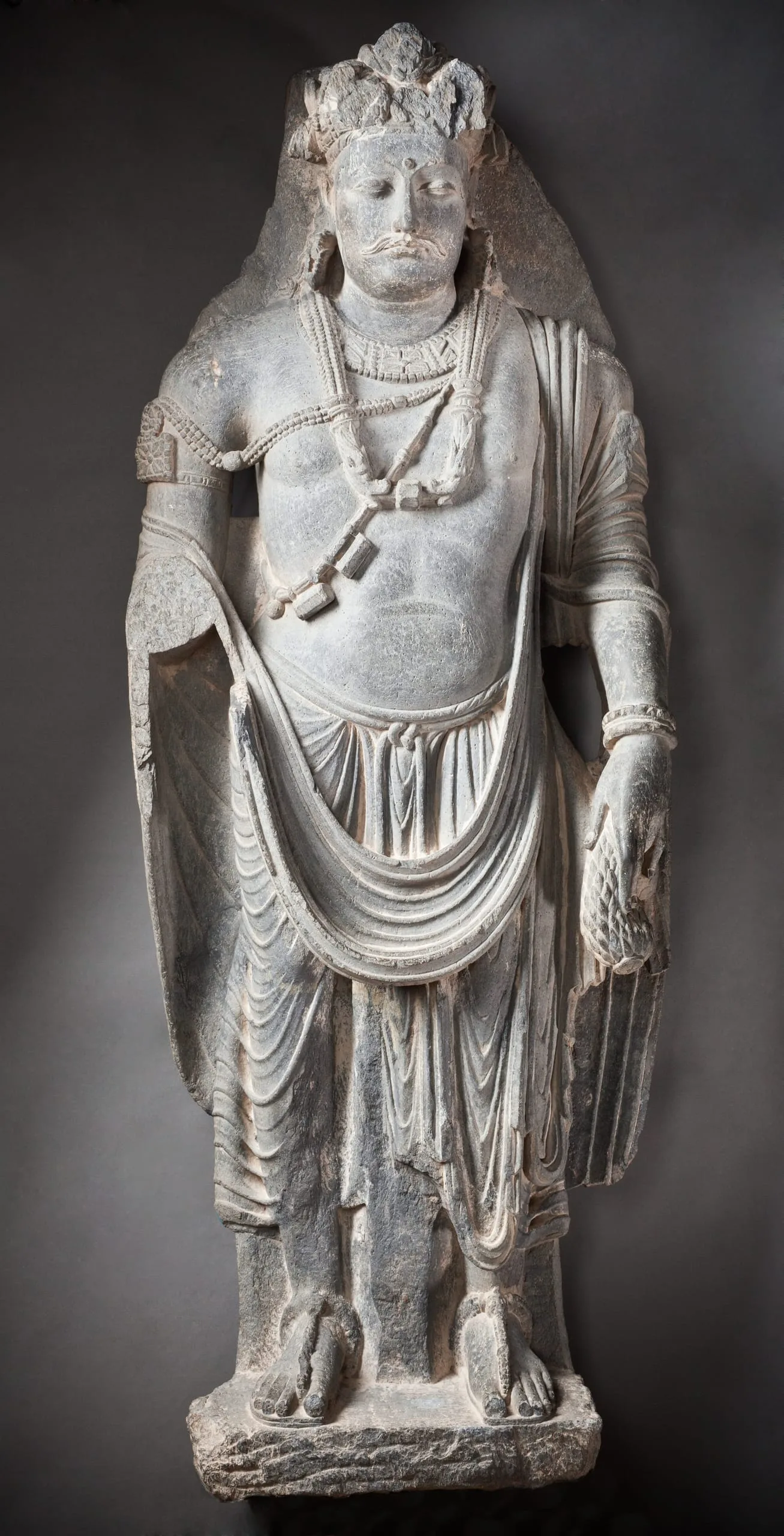
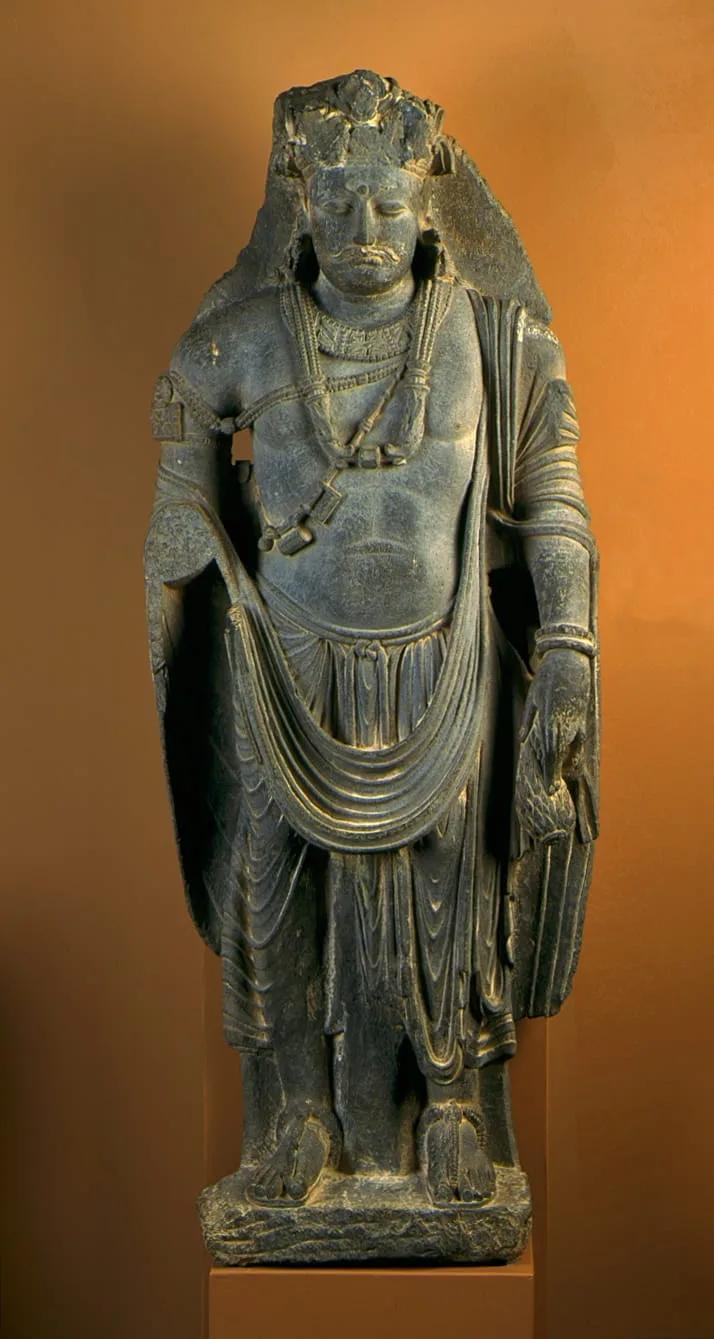
Avalokiteshvara, the Bodhisattva of Compassion, is represented in this crisply carved schist image that would have originally been over six feet in height when its nimbus was intact. A Bodhisattva is a being who has the capacity to become a Buddha but has chosen to remain on earth until all sentient beings have attained enlightenment. Accordingly, bodhisattvas are depicted with the ornate jewelry used to distinguish earthly kings. He wears heavy earrings, a rigid neckband with floral patterns, a pearl necklace with tête-à-tête terminals in the form of a mythical aquatic animals (makara), a cord with three prayer amulets that hangs diagonally across his chest, a triple strand of pearls over his upper right arm, armlets, and bracelets. He is mustachioed and has a sacred forehead marking (urna). His turban is now damaged but was originally similar to that of M.71.1.45. He carries a head garland in his left hand. Similar to the crown given to ancient Olympic athletes, it marks the bodhisattva’s spiritual victory – his future attainment of nirvana. His now-missing right hand may have originally been held in the gesture of reassurance (abhaya mudra). He wears sandals rather than being barefoot as would be a Buddha. The treatment of the drapery folds of his dhoti and shawl and his naturalistic musculature indicate Roman stylistic influence that reached the ancient Gandharan region of Afghanistan and Pakistan via the Eurasian trade network known as the Silk Routes.