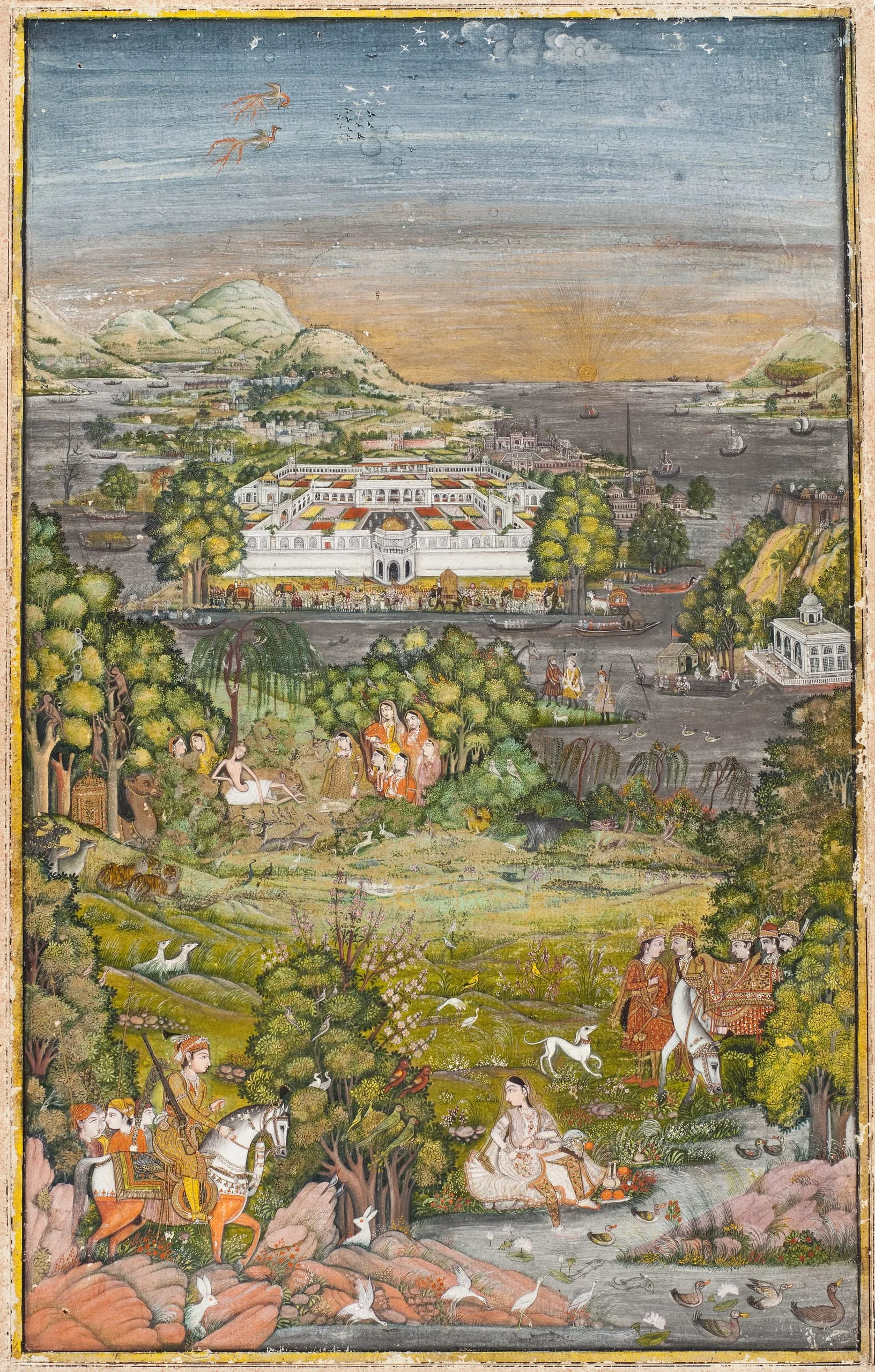
This composite illustration portrays two sets of famous literary lovers beneath a receding landscape with architectural complexes and a river with sailing ships and pleasure boats.
In the foreground, the Persian lovers Khusraw and Shirin are represented. Khusraw (or Khosrow II, r. 590-628) was one of the last Sasanian kings of Iran. The story of his tragic romance for the Armenian princess Shirin was long told in Persian literature, such as in the Shahnama (Book of Kings) by Firdausi (circa 934-1020) written in circa 977-1010, but it was best immortalized in the Khamsa (Quintet) of Nizami Ganjavi of Iran (c. 1141–1209). Their tale is also called the story of Shirin and Farhad, with the latter being Shirin’s rival suitor. Here, Khusraw on horseback sees Shirin seated on a riverbank about to bathe.
In the middle ground, the 7th-century Arab lovers Layla and the emaciated Majnun are depicted. They were childhood sweethearts whose father forbade them to be together and arranged for Layla to marry a rich merchant from Ta’if in Saudia Arabia. Obsessed with Layla, Majnun left home to wander in the desert for the remainder of his life. Layla dies of heartbreak. This representation follows the pictorial tradition of the Khamsa of Amir Khusraw of Delhi (1253–1325) in that it includes Layla’s camel, which is not found in the story recounted in Nizami’s Khamsa.
On the reverse is a seal stamp indicating that the painting was once in the collection of the Miraj court near Bijapur, Karnataka.