LACMA

ShopMembershipMyLACMATickets
LACMA
Los Angeles County Museum of Art
5905 Wilshire Blvd.
Los Angeles, CA 90036
info@lacma.org
(323) 857-6000
Sign up to receive emails
Subscribe
© Museum Associates 2025

Museum Hours

Monday

11 am–6 pm

Tuesday

11 am–6 pm

Wednesday

Closed

Thursday

11 am–6 pm

Friday

11 am–8 pm

Saturday

10 am–7 pm

Sunday

10 am–7 pm


  • About LACMA
  • Jobs
  • Building LACMA
  • Host An Event
  • Unframed
  • Press
  • FAQs
  • Log in to MyLACMA
  • Privacy Policy
© Museum Associates 2025
Collections

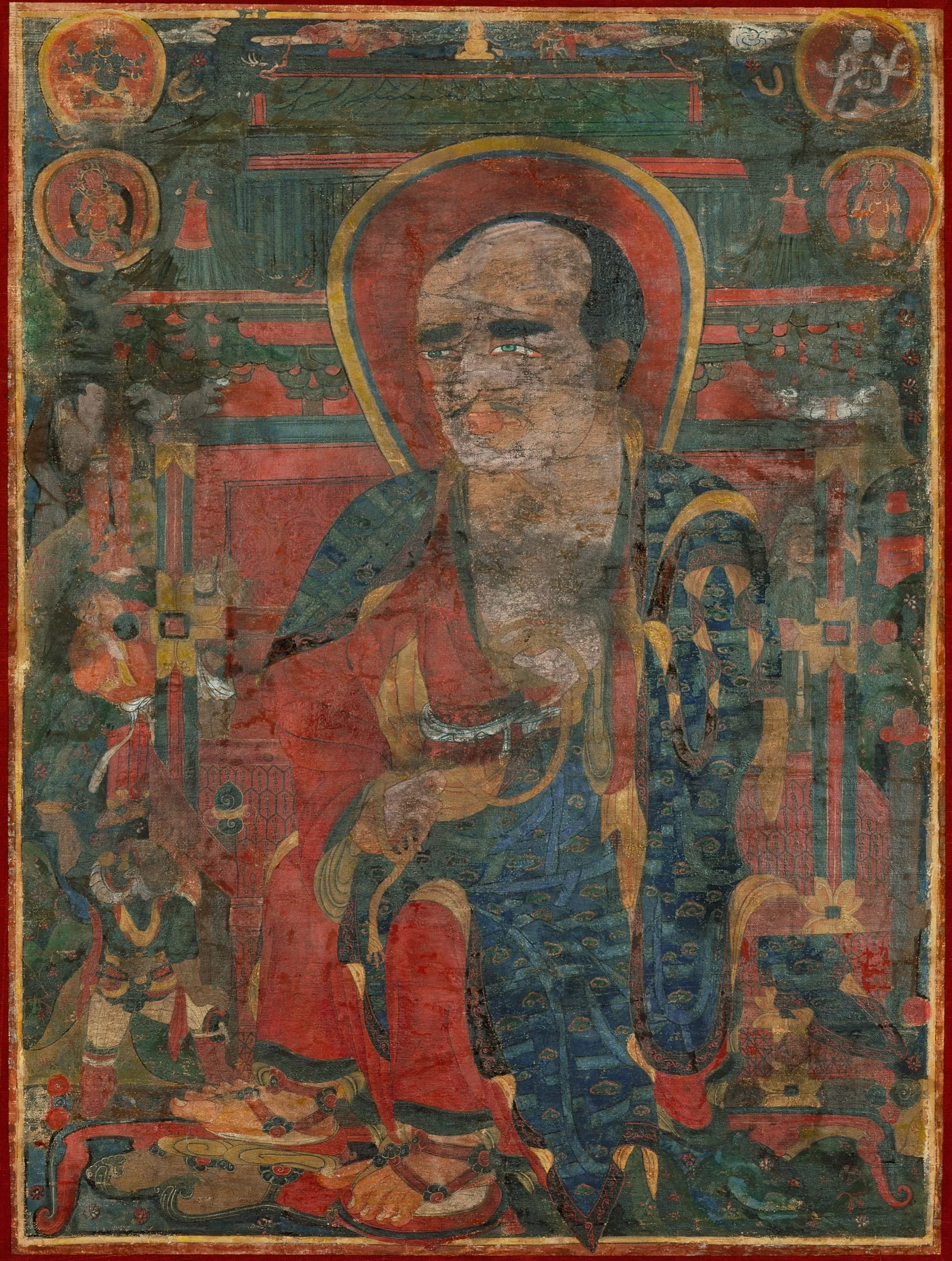
Unknown
The Arhat Kanakavatsalate 15th century

Not on view
Vertical Tibetan-style painting of a large, seated, bald figure with a red halo, teal robe, and significant paint loss, set against a crimson architectural backdrop with flanking smaller figures and corner roundels
Artist or Maker
Unknown
Title
The Arhat Kanakavatsa
Place Made
Central or Eastern Tibet
Date Made
late 15th century
Medium
Mineral pigments and gold on cotton cloth
Dimensions
29 x 21 1/2 in. (73.7 x 54.6 cm)
Credit Line
From the Nasli and Alice Heeramaneck Collection, Museum Associates Purchase
Accession Number
M.83.105.19
Classification
Paintings
Collecting Area
South and Southeast Asian Art
Curatorial Notes

In both Theravada and Mahayana Buddhism, the arhats are believed to have been the Buddha Shakyamuni’s original disciples, and to attained enlightenment through their own efforts. They were endowed with transcendent wisdom (prajna). Functioning much like saints, their role was to protect the Dharma, or Buddhist teaching, until the coming of Maitreya, the Buddha of the Future.

Arhat Kanakavatsa (Golden Calf) is thought to have born in ancient Magadha in present-day Bihar. At the same time of his birth, an elephant auspiciously gave birth to a golden calf, a miraculous event that gave Kanakavatsa his name. He is said to reside on Saffron Hill in Kashmir with 500 other Arhats. His primary attribute is a long jeweled noose (pasha) given to him by the serpent demigods (nagas) that is symbolic of great memory and self-mastery.

Kanakavatsa is nimbate, enthroned in front of an elaborate shrine, and wearing voluminous robes. He has blue eyes, regarded as in Chinese painting as characteristic of Kashmiri residents. He holds his jeweled noose in front of his chest with both hands. Beside his right foot is a figure in Mongolian garb who is likely the "barbarian" King of Kashmir who visited Kanakavatsa. Three goddesses and a black fierce god appear in aureoles (prabhavali) in the upper corners.

Comparable Tibetan individual portraits of Kanakavatsa are in the Brooklyn Museum (1993.192.10) and Rubin Museum of Himalayan Art, New York (P1990.1.1 and F1996.33.3).
Selected Bibliography
  • Pal, Pratapaditya. The Art of Tibet. New York: The Asia Society, Inc., 1969.
  • Pal, Pratapaditya. Art of Tibet. Los Angeles; Berkeley, CA: Los Angeles County Museum of Art; University of California Press, 1983.
  • Pal, Pratapaditya. Art of Tibet. Expanded edition. Los Angeles: Los Angeles County Museum of Art, 1990.
  • Beguin, Gilles. Dieux et Demons de l'Himalaya: Art du Bouddhisme Lamaique. Paris: Grand Palais, 1977.