- Title
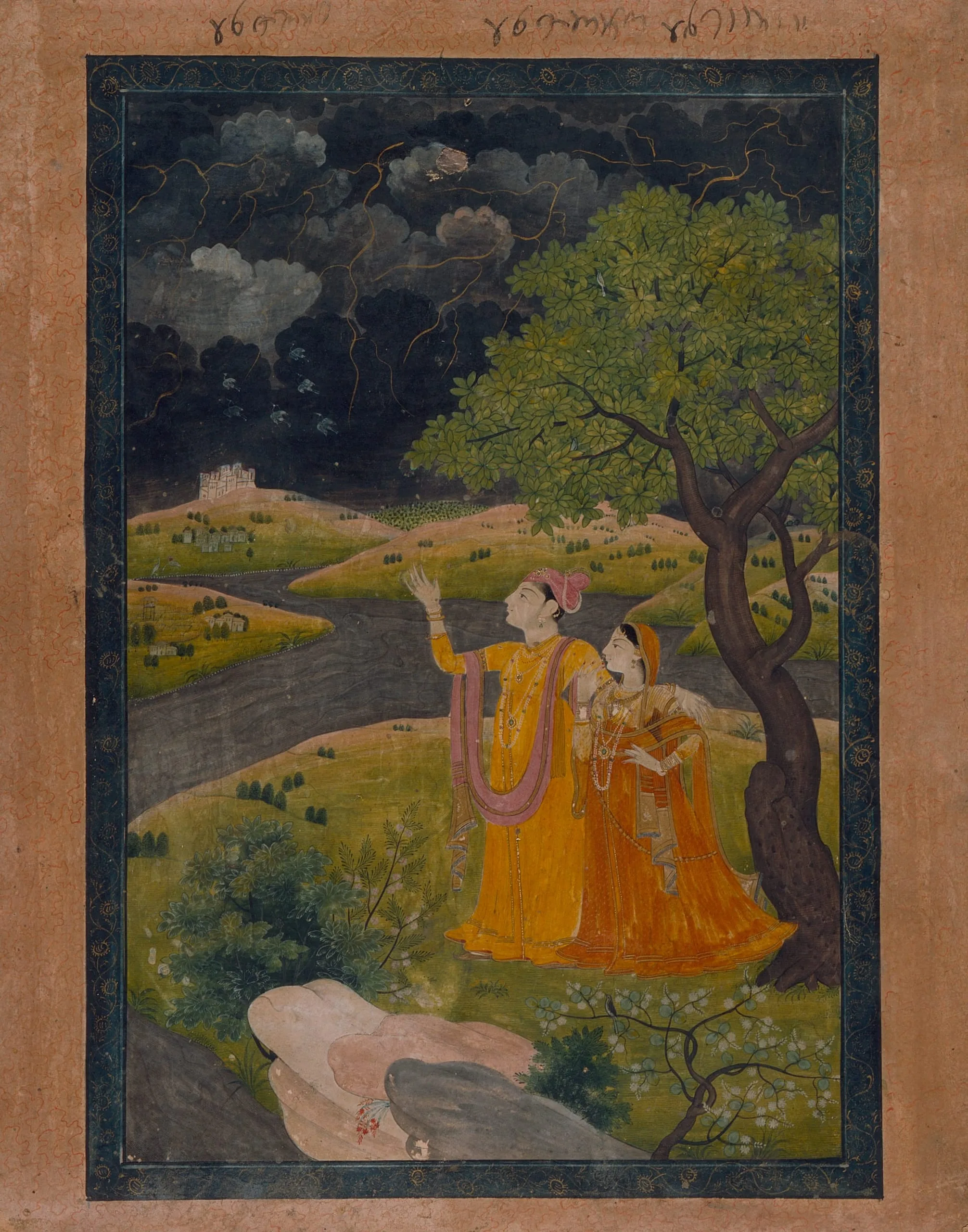
- A Prince and a Noblewoman Watching the Monsoons
- Date Made
- circa 1810-1820
- Medium
- Opaque watercolor, gold, silver, and ink on paper
- Dimensions
- Image: 8 1/2 x 5 5/8 in. (21.59 x 14.28 cm); Sheet: 10 x 8 in. (25.4 x 20.32 cm)
- Accession Number
- M.83.105.7
- Curatorial Notes
This emotionally charged yet stylistically subdued painting is an illustration of a romantic monsoon scene (Varsha Vihara) celebrating affectionate union, sensory delight, and princely leisure during the arrival of the rainy season. The popular theme is akin to the amorous imagery used for the month of Shravana (July–August) in the Barahmasa (The Twelve Months) that portrays the lunar months of the year and their correlating emotional states and social activities. See M.70.19.
Identified as royalty by their copious jewelry and luxurious garments, a noble couple stands beneath a tree on a hillside watching the gathering storm clouds and a flock of white cranes (bagula) flying across the darkened sky. The cranes are a traditional Indian poetic symbol of romantic awakening and the arrival of the monsoon rains.
Inscribed in the upper margin is a thrice repeated archivist or scribal notation in Takri script that reads, 46, followed by what may be a subject category or register heading.
- Selected Bibliography
- Rosenfield, John. The Arts of India and Nepal: The Nasli and Alice Heeramaneck Collection. Boston: Museum of Fine Arts, Boston, 1966.