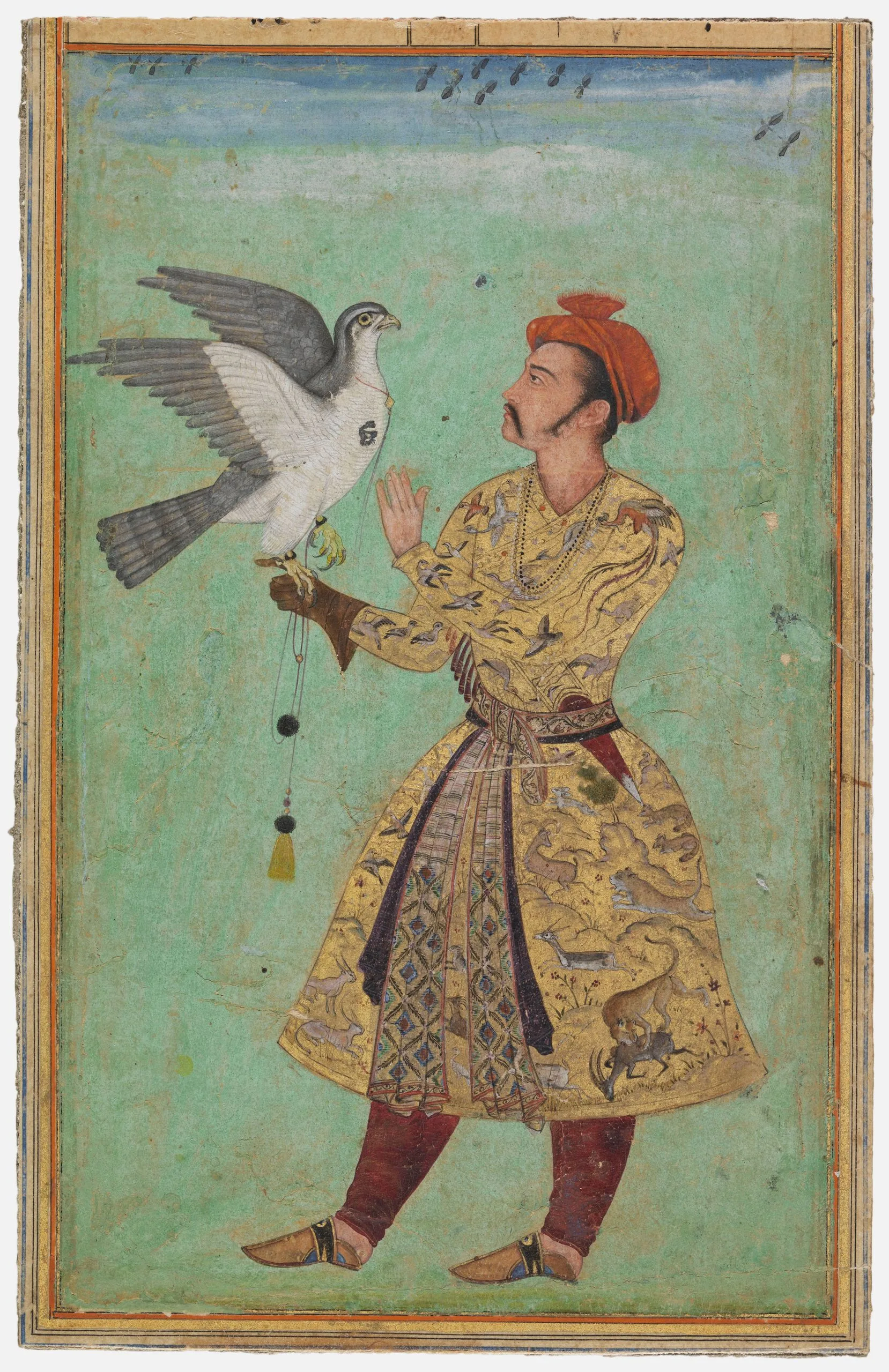
Hunting with sporting birds was a favorite activity at most Islamic courts and has been documented since the Umayyad period (661–750). The practice of hawking or falconry was probably introduced through contact with Iran following the Islamic conquests. The domesticated and specially trained birds of prey were highly prized at courts throughout Islamic lands, and frequently depicted in a variety of mediums, often with their royal owners—as in this painting of a Mughal prince with a falcon, perched on the royal falconer’s protective gauntlet.
The prince, perhaps Salim (the future Emperor Jahangir, r. 1605−27) or his half-brother Daniyal (1572−1605), is sumptuously attired in a Persian-style coat of the type worn for hunting and riding. Known from extant examples, such robes, as here, are elaborately and appropriately decorated with animals of prey and their predators. Such precision in detail, along with the naturalism of the bird, the individualized countenance of the prince, and the three-dimensionality of the figures despite the flat background, typify Mughal painting, distinguishing it from contemporaneous Iranian painting, with which it shares a common lineage.