- Title
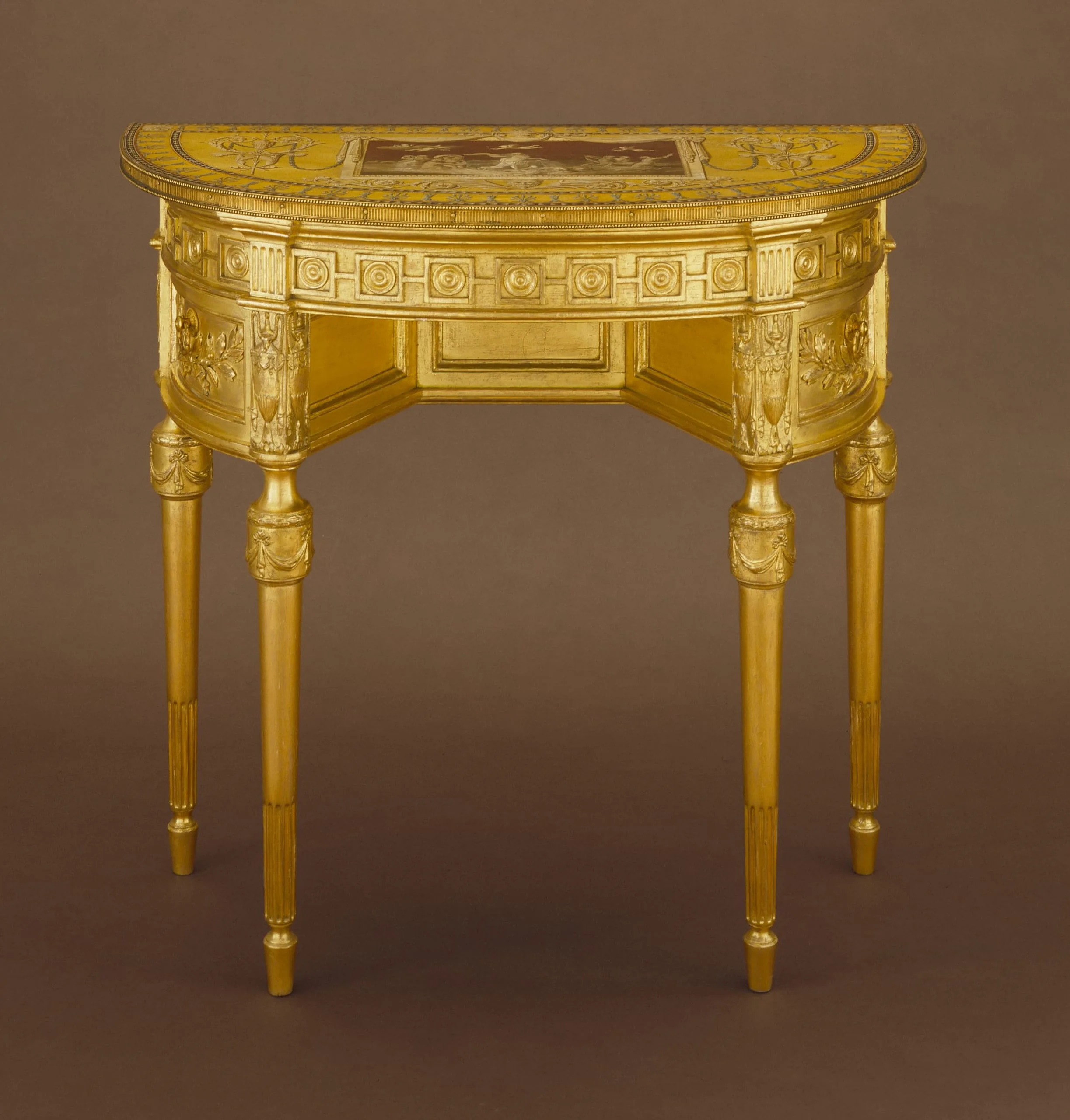
- Buckingham House Side Table
- Date Made
- circa 1780
- Medium
- Wood, gilt, paint, ormolu, brass, bronze mounts with gilding
- Dimensions
- 33 × 35 × 17 1/2 in. (83.82 × 88.9 × 44.45 cm)
- Accession Number
- M.83.38
- Curatorial Notes
This gilded side table is part of a suite of three tables (the other two are now held at the Metropolitan Museum of Art and the Victoria and Albert Museum) designed for a royal residence of King George III and Queen Charlotte. It may have been intended for the Second Drawing Room of Buckingham House (now Palace) which was remodeled between 1762 and 1773, or Windsor Castle. All three tables bear the stamp “G IV R” for their subsequent owner King George IV (r. 1820–30), indicating royal provenance.
Characteristic of the English Neoclassical movement popularized by architect Robert Adam (1728–1792), the tables were modeled after designs of William Chambers (1723–1796) by John Yenn, a student of Chambers. Reflecting the growing influence of Greek and Roman antiquity in English art and architecture, the center of the table depicts Amphitrite from Raphael’s fresco The Triumph of Galatea in the Villa Farnesina, Rome. The scene is attributed to Italian artist Giovanni Battista Cipriani, who also painted the ceiling of the Second Drawing Room. Cipriani renders the mythological figures in grisaille, enclosed in a trompe l’oeil frame with a central urn, surmounted by drapery with ram’s heads to either side, and flanked by stylized urns embellished with scrolling leaves. Along the edge of the tabletop is a double border of white painted husks on a black ground with a band of alternating green-painted anthemions and bellflowers. The slightly inset giltwood frame is decorated with a narrow frieze with a Greek key-and-coin motif. Above each of the four legs are elongated urns with ram’s-head covers; the turned legs with swags at the top taper to fluting near the bottom and terminate in peg feet. Designed to be placed against a wall, side tables were often semi-elliptical and allowed for a mirror to be hung above to reflect any light placed on the table surface.
Cynthia Kok
2025
- Selected Bibliography
- Phil Freshman. Los Angeles County Museum of Art Report, July 1, 1981-June 30, 1983. Los Angeles: Los Angeles County Museum of Art, 1984.