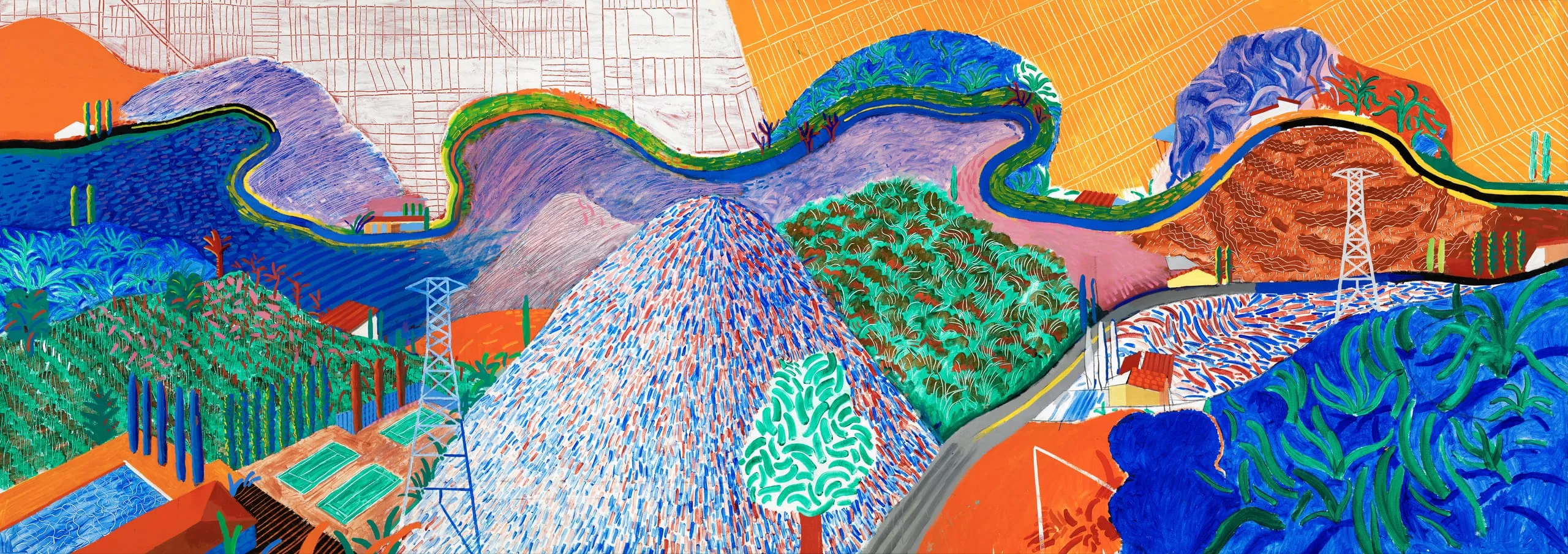
British-born artist David Hockney's great affection for the city of Los Angeles, his home since the 1960s, is evident in the many works that draw upon its cultural iconography: luxurious swimming pools, sun-drenched landscapes, and handsome young men at play. Painted from memory in just a few weeks, Mulholland Drive: The Road to the Studio (1980), the largest of Hockney's canvases, vividly captures the quintessential Los Angeles activity: driving. It is a personalized panoramic map of Los Angeles based on the artist's daily trip from his home in the Hollywood Hills to his studio on Santa Monica Boulevard. Hockney (born 1937) establishes a sense of distance by alternating between detailed renderings of objects (trees, houses, tennis courts, and power lines) that represent sections of the landscape and more abstract planes of color or simple grids that define the outlying Studio City and Burbank. Mulholland Drive swirls across the top of the work, moving the viewer's eye from left to right and conveying the sense of motion and altitude that the artist experienced on the ridge road.
Overview excerpted from J. Patrice Marandel, Claudia Einecke, eds., Los Angeles County Museum of Art: European Art (Paris: Fondation Paribas, 2006).