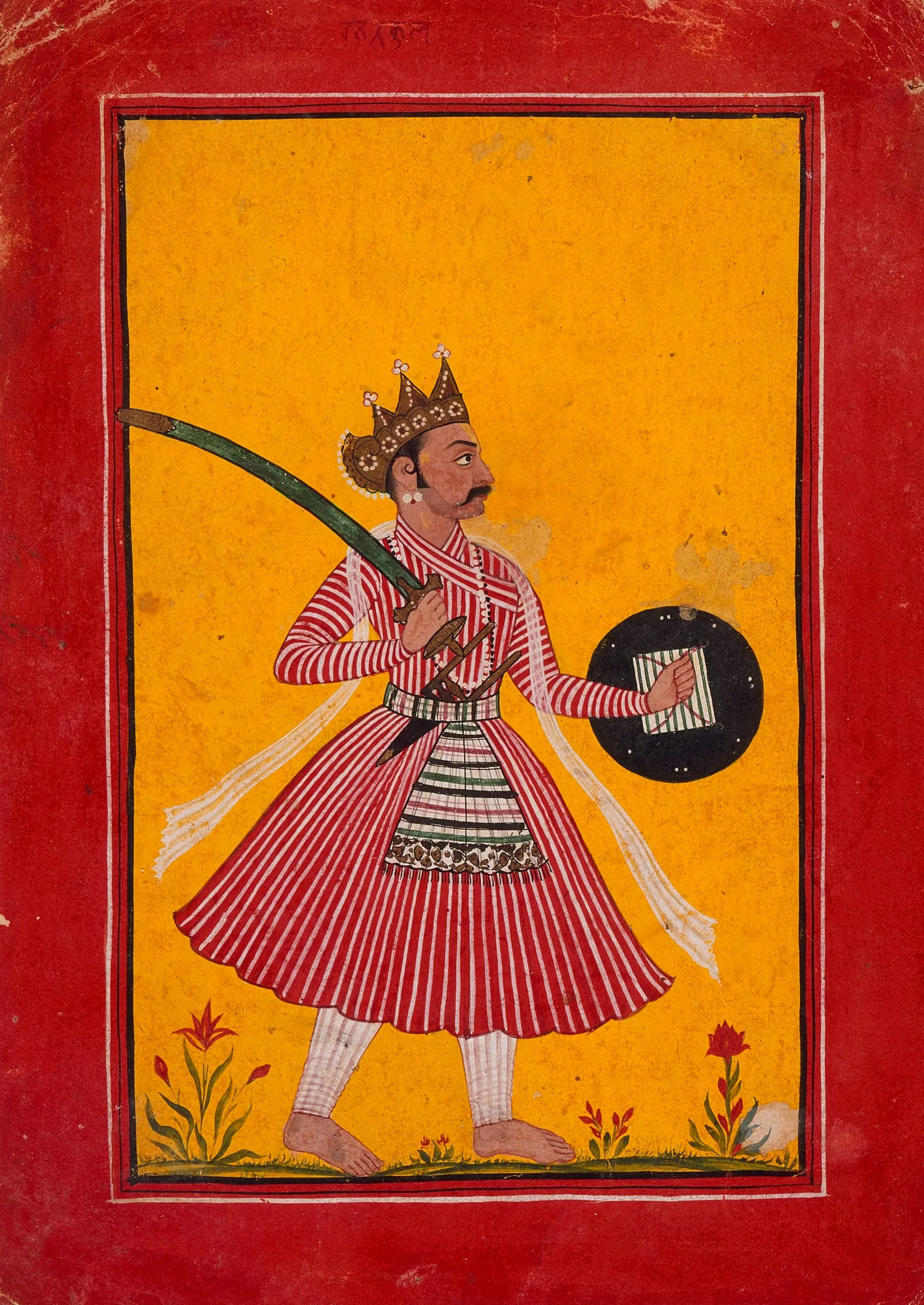
As identified by the faint devanagari inscription in the upper red border, the subject of this portrait is Raja Nakula. Since no king by that name is known from historical records, and because the figure is wearing a five-pointed crown (shown here in profile) that is associated with Krishna and other Vaishnava deities rather than a turban normally worn by Pahari monarchs, it has been suggested that this is a dream portrait of Nakula, the fourth of the five heroic Pandava brothers of the epic Mahabharata ([War of the] Great Bharatas). Nakula, the twin of Sahadeva, was skilled at swordsmanship and, accordingly, is shown here brandishing a sword. Nakula's older brother, the legendarily powerful Bhima, is also sometimes represented in series of dream portraits, which were used by astrologers for divination purposes. For example, see a Bhima portrait in a closely related dream series attributed to Nurpur, Himachal Pradesh (?), circa 1700, in the Museum of Fine Arts, Boston (17.2770). For a Mankot dream portrait of Nakula’s father Raja Pandu and his stepmother Kunti, see M.69.13.6.
This painting may belong to a group of early Mankot portraits dating from the reigns of Raja Mahipat Dev (r. circa 1660-1690) and Raja Dhota Dev (r. circa 1690-1710). Mankot was exceptional in producing portraits of diverse subjects, ranging from rajas to palace servants to astrological deities. For the latter, see a Mankot personification of Mangala (Mars) in the British Library, London (Add.Or.4318).